


The wolf pup was sitting in the middle of the logging road as if it had been waiting for the right car. Deputy Jack Mercer saw the black shape only after Ranger began whining in the back of the cruiser. Ranger did not whine. In nine years with the Sawtooth County Sheriff’s Office, the German Shepherd had barked at armed men, tracked missing kids through rain, and once stood perfectly still while a drunk ranch hand swung a shovel at Jack’s head.
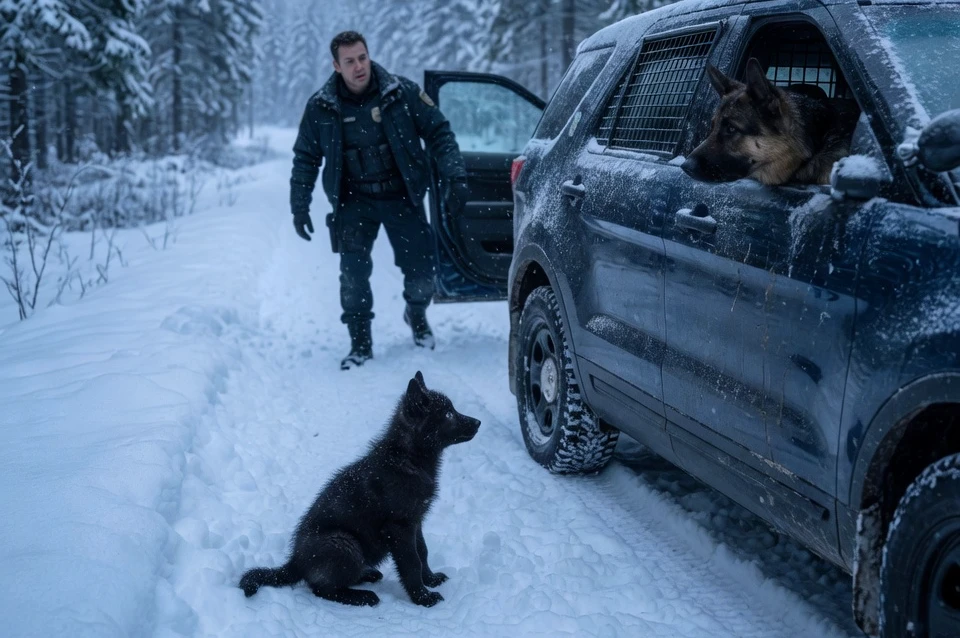
But he had never made that sound.
Jack eased off the gas. The road was narrow there, two frozen tire ruts winding through tall pines north of Pinehaven, Idaho, with snow piled hard along both sides. He knew every turn of it. He knew where the creek iced over first, where elk crossed at dusk, where the radio signal vanished for six miles and came back near the old fire tower.
The little black shape lifted its head.
Jack hit the brake.
Ranger pressed his nose against the grate behind the front seat, his breath fogging the metal. A low sound kept working out of his throat, not warning, not excitement, but something close to pleading. Jack looked from his dog to the animal ahead and felt the old patrol instincts sharpen inside him.
It was a wolf pup. Maybe three months old. Too young to be alone, too small to be sitting in the open, too calm for anything wild that had not already run out of options.
Jack killed the engine. The silence that followed felt too large for the narrow road. Wind moved softly through the lodgepole pines, shaking powder from the branches. Somewhere deeper in the timber, a raven gave a flat, impatient call.
“Stay,” Jack told Ranger.
Ranger’s ears flicked, but his eyes never left the pup.
Jack opened the door and stepped out. The cold came at him fast, sliding under his collar and into the places his uniform never quite covered. He kept his hands visible and moved slowly, because he had worked long enough around both dogs and people to know that fear could turn anything dangerous.
The pup did not retreat.
That was the first thing that unsettled him. A healthy wolf pup should have vanished the second the cruiser stopped. It should have slipped between the trees and left only paw marks behind. Instead, it watched Jack approach with amber eyes that looked almost too bright against its midnight coat.
At twenty feet, Jack stopped. “Hey there,” he said, though he knew his voice meant nothing to it. “What are you doing out here?”
The pup stood.
It did not run toward him. It did not bare its teeth. It took two careful steps to the right side of the road, toward the forest, then turned back and looked at him again.
Ranger barked once inside the cruiser, sharp and desperate.
Jack glanced back. “I said stay.”
Ranger ignored him. The dog’s front paws were already braced against the door, his whole body trembling with the strain of not being where he thought he needed to be.
Jack had seen Ranger alert to narcotics, weapons, blood, human scent, fear. He had seen him work through chaos with the steadiness of a seasoned deputy. This was different. This was not training. This was recognition.
The wolf pup took another few steps toward the trees, then stopped again.
Jack stared at the small dark animal and felt, against every rule he had ever followed, that he understood.
“You want me to come with you,” he said quietly.
The pup waited.
Jack stood on that frozen road with twenty-eight years of law enforcement behind him and a dozen regulations moving through his mind. Wild animal. Possible rabies risk. Notify Idaho Fish and Game. Do not approach. Do not interfere. Secure the area if needed. Wait for the right people with the right truck and the right paperwork.
He had lived by rules for most of his adult life. Rules made sense. Rules kept young deputies from doing brave, stupid things. Rules had kept him alive in places where emotion would have gotten him hurt.
But rules had never sat in the road with a baby animal’s eyes.
Jack went back to the cruiser and opened the rear door. Ranger launched out, but he did not charge the pup. He landed in the snow, lowered his head, and moved to Jack’s left side, shoulder pressed against his thigh as if reminding him they were a team.
“Easy,” Jack murmured.
The wolf pup watched the dog for one suspended moment. Ranger held still. Then the pup turned and slipped into the trees.
Jack followed.
The first hundred yards were hard going. Snow reached his knees in places, crusted on top but soft underneath, breaking with each step. The pup moved ahead with delicate urgency, never getting too far, never letting them lose sight of it. Every so often it glanced over its shoulder, eyes flashing between branches.
Ranger stayed close. He did not chase. He did not lunge. He moved with a kind of grave restraint Jack had never seen in him, as if he understood that this was not a pursuit.
After ten minutes, Jack’s lungs began to burn. At fifty-four, he could still pass every department fitness test, but there was a difference between running on a track and fighting your way through winter timber in a bulletproof vest. He stopped once, hand on a pine trunk, breath smoking in the cold.
The pup stopped too.
It did not sit. It simply waited until Jack straightened, then moved on.
“You picked the wrong deputy for a morning hike,” Jack muttered.
Ranger glanced up at him.
“Don’t look at me like that.”
They walked another five minutes before the trees opened into a shallow hollow tucked behind a stand of cedar. Large granite rocks leaned together at the far side, making a low shelter half-hidden by snow and old needles. The pup went straight to it and paused at the dark opening.
Then it looked at Jack.
He had found bodies in drainage ditches, children lost in culverts, old men collapsed behind woodpiles. He had learned that the body often understood bad news before the mind did. His chest tightened before he took the first step toward the rocks.
The air near the shelter smelled wrong. Not strong, not yet, because the cold had locked everything down, but old enough to tell him death had been nearby.
Jack crouched and shone his flashlight into the opening.
A second pup lay curled in the back.
For a moment, Jack did not move. The smaller pup was black like the first, but its fur had lost its shine. Its sides moved in quick, shallow jerks. Its ribs showed beneath the coat, and one front paw twitched as if it were chasing something in a dream it did not have the strength to wake from.
The first pup slipped past Jack and curled around the smaller one. It began licking its brother’s face in small, frantic strokes.
Ranger lowered himself to the snow at the mouth of the shelter. His ears went back. He made a soft sound Jack had heard only twice before, both times near a grieving child.
“Oh, buddy,” Jack whispered.
He reached in slowly. The healthy pup stiffened but did not snap. The smaller one did not react at all when Jack touched its side. It was cold. Too cold. The heartbeat under his fingers was there, but faint and fast, like a moth trapped behind glass.
Jack swallowed.
He knew then that the pup on the road had not been wandering. It had not been curious. It had not been lost.
It had gone for help.
The thought landed hard because it did not stay in the forest. It went somewhere inside Jack he had sealed off three years earlier.
Eli had called at 9:17 on a Thursday night.
Jack remembered the time because he had looked at the phone and thought, I’ll call him back when the search teams check in. A twelve-year-old boy had gone missing near the river that evening, and Jack had been coordinating deputies, volunteers, drones, dogs, the whole frantic machine of a county trying to save one child before the temperature dropped.
Eli’s name had lit the screen. His younger brother. His softer brother. His brother who asked too many questions and worried too much and noticed when Jack was tired even through the phone.
Jack had sent the call to voicemail.
The boy by the river survived. Eli did not.
Two weeks later, Jack found out that his brother had died alone in his apartment after a heart attack. The doctor said fast help might have changed the outcome. Might have. That word had lived in Jack’s body ever since, small and sharp, moving when he moved, sleeping when he slept.
He had not listened to Eli’s last voicemail all the way through.
Now a wolf pup was licking its brother’s face in a frozen hollow, and Jack could not look away.
Ranger crawled forward, slow and careful, then lay against the two pups. The healthy pup froze. Its amber eyes fixed on the German Shepherd’s face, measuring danger, measuring warmth. Then, with a tiny exhausted shift, it pressed closer to Ranger’s chest.
The smaller pup gave a weak sigh.
Jack blinked hard. “Okay,” he said, mostly to himself. “Okay. We’re not doing this by the book.”
He shrugged out of his winter patrol jacket and spread it on the snow. The cold bit immediately through his uniform shirt, but he barely felt it. He reached in again and wrapped the smaller pup in the jacket, lifting it with the care he would have used for a newborn.
It weighed almost nothing.
The healthy pup rose at once, panic flashing across its small body.
“I’m taking him for help,” Jack said softly. “You can come, or you can hate me forever, but I’m taking him.”
The pup stared at him, then moved to the entrance and stood beside Ranger.
Jack was about to turn back toward the road when Ranger suddenly lifted his head and looked past the shelter. His nostrils worked. Jack followed the dog’s gaze and noticed, for the first time, the trail pressed into the snow beyond the rocks.
Bigger tracks. Not the pups’.
He settled the bundled pup against his chest and walked another fifty yards through the cedar, Ranger at his side and the healthy pup close behind. In a shallow dip between two fallen trees, he found the mother.
She lay on her side, black fur salted with gray around the muzzle, her body already frozen into the shape of her last rest. There were no trap marks Jack could see, no blood in the snow, no obvious sign of a bullet or snare. Just an old wound on one hind leg, infected enough to explain a slow decline, and a body that had finally stopped fighting.
The healthy pup moved past Jack and stood near her head. It did not whine. It did not touch her. It simply looked at her for one long moment, then turned back toward the shelter where its brother had been dying.
Jack understood that too.
The pup already knew what could not be saved.
In the snow between the hollow and the road, Jack saw the proof: tiny tracks layered over tiny tracks, a narrow path made by repeated trips through the trees. The pup had walked out day after day, maybe morning and evening, to the road where vehicles sometimes passed. It had sat there in the cold with no language except its own body.
Waiting.
Jack looked down at the bundle in his arms. The smaller pup’s mouth had fallen open slightly. Its breathing hitched, then came again.
“Hold on,” Jack said.
He did not know whether he meant the pup, himself, or the part of him that had been trying for three years not to feel anything at all.
The trip back to the cruiser was slower. Jack carried the smaller pup tucked inside the jacket against his chest while Ranger broke trail through the snow. The healthy pup stayed so close that twice Jack nearly stepped on it. Every few yards, it glanced up at the bundle as if counting breaths.
At the road, the cruiser looked ordinary and impossible at the same time. A county vehicle. A computer mount. A radio. A thermos of coffee gone lukewarm in the cup holder. All the plain, controlled objects of Jack’s life waiting for him after the wild had asked something of him no policy manual could answer.
He opened the rear door. Ranger jumped in first and turned, making room. Jack placed the smaller pup on the blanket he kept for wet search days. Ranger lowered himself beside it, his body curved around the bundle.
The healthy pup stood outside the open door.
Jack crouched. “Your call.”
For several seconds, the pup looked back toward the trees. Toward the mother. Toward the shelter. Toward the only world it had known.
Then it stepped forward, sniffed Jack’s bare hand, and pressed its cold nose into his palm.
A small act. A terrible trust.
The pup jumped into the cruiser.
Jack shut the door and got behind the wheel. His fingers were stiff on the ignition. He should have radioed dispatch. He should have called Fish and Game. He should have done ten things in the right order, with the right words, in the right tone.
Instead, he drove.
The closest person he trusted with an animal in that condition was Dr. Leah Moreno, forty miles away in Pinehaven. Leah treated ranch dogs, barn cats, horses, goats, and the occasional owl somebody found stunned on a highway shoulder. She was not a wildlife rehabber. She would remind him of that before she let him through the door.
He pressed the accelerator anyway.
In the rearview mirror, Ranger’s brown eyes met his. The healthy pup lay pressed against the dog’s front legs, alert even in exhaustion. Between them, the bundle did not move.
Jack drove harder.
By the time he pulled into Pinehaven Animal Clinic, the sun had climbed over the ridge and turned the icy parking lot white with glare. Leah’s old green pickup sat near the side entrance. Jack left the cruiser running for the heat and carried the jacket bundle toward the door with Ranger and the healthy pup at his heels.
Leah opened before he knocked.
She was wearing blue scrubs under a fleece jacket, her dark hair twisted up with a pen stuck through it. Her expression shifted from annoyance to concern to disbelief as her eyes dropped to the animal in Jack’s arms.
“Jack,” she said carefully, “please tell me that isn’t what I think it is.” – The smaller pup gave one thin, broken breath against his chest. Then it went still…
To read the rest of the story – CLICK the NEXT button 👇👇👇