


The first time Banyan caught Tom Whitaker’s sleeve and refused to let go, I wrote sustained contact in the behavior log. I did not write embrace. At Cascadia Rainforest Center, we were trained to be careful with words. A full-grown Bornean orangutan could wrap two fingers around a man’s wrist with what looked like tenderness and still leave bruises without meaning to. Banyan was thirty-two years old, broad through the shoulders, deep red in the hair, with cheek pads that made his face look ancient when he turned toward the glass. He had been born in captivity, but his bloodline came from Kalimantan, and everything about him carried the slow, watchful intelligence of an animal built for a forest none of us could give back to him.
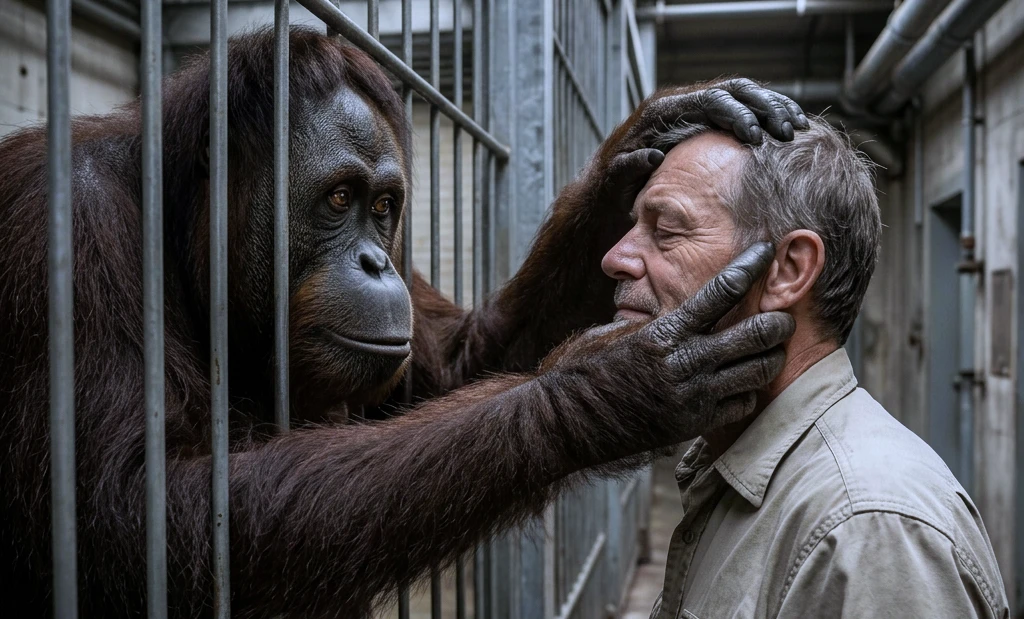
That morning, he was not threatening anyone.
He was not begging.
He had threaded one long arm through the protected-contact training window, hooked two fingers in the faded cuff of Tom Whitaker’s work shirt, and pressed his forehead against the steel mesh as if the old keeper were something that might drift away.
Tom laughed the first time. So did Caleb Ruiz, the younger keeper assigned to the rainforest wing that summer. Even I smiled from the observation corridor, mostly because Tom did. He had a laugh that made people in the building relax. It was low, dry, and familiar, the kind of laugh that had been floating through that wing since before half the staff had badges.
“Come on, Banyan,” Tom said, glancing at the wall clock. “You already had breakfast. Don’t start bargaining like a lawyer.”
Banyan did not release him.
Tom was fifty-eight, though most of us still thought of him as younger because he moved through the building with such muscle memory. He knew which gate squeaked before rain. He knew which hose kinked near the back drain. He could tell by the sound of Banyan’s knuckles on a platform whether the orangutan was bored, irritated, or simply reminding the room that he was still awake.
I had watched Tom train new keepers for years. He never showed off. He did not tell heroic stories about dangerous animals or pretend great apes loved people the way dogs did. He told every intern the same thing on their first week: “Don’t make him perform your feelings. Respect is quieter than that.”
That was why the sleeve bothered me.
Banyan had never been a clingy animal. He tolerated certain staff, ignored others, and granted Tom a kind of careful preference that had taken decades to earn. If Tom stood at the contact wall, Banyan might come over. If Tom offered a hand target, Banyan might present one long finger. If Tom whistled the two-note cue they had used since the old wing, Banyan sometimes answered with a soft mouth sound that made visitors press their palms against the glass.
But this was different.
“Has he been doing this all week?” I asked.
Caleb shifted beside me with a tablet tucked under one arm. He was twenty-nine, bright, careful, and still new enough to look pained every time an animal changed in a way he could not explain. He tapped the screen and brought up the behavior log without taking his eyes off Banyan.
“All month,” he said.
“How often?”
He hesitated, and that hesitation told me the number would not be small.
“Yesterday we logged eleven sleeve holds,” he said. “Three wrist contacts. Two times he blocked the shift door and wouldn’t move until Tom came back to the wall. This morning makes four contacts before nine.”
I looked through the glass again. Tom had stopped joking. He was standing very still on the staff side of the training window, letting Banyan keep the cuff. Their bodies were separated by steel and protocol, but the emotional shape of the moment was unmistakable. The orangutan had fixed his gaze on Tom’s face with an intensity that made the rest of the habitat seem to fall away.
“Any changes in diet?” I asked. “Medication? Construction noise? New cleaners?”
“We checked all of that.”
“Visitors?”
“Normal numbers. School groups last week, but Banyan’s seen worse.”
“Pain?”
“Vet exam was clean. Dental, joints, labs, all normal for him.”
“What about Tom’s schedule?”
Caleb lowered the tablet. “Same shift. Same days. Same route. Same everything.”
Inside the service corridor, Tom gently tugged his sleeve, not enough to resist, only enough to ask. Banyan tightened his fingers. His enormous arm did not jerk or pull. He simply held, making refusal look almost delicate.
“Banyan,” Tom said, quieter now. “Buddy. I’ve got work.”
The orangutan’s eyes stayed on him.
Tom glanced toward us through the glass. He looked embarrassed, which was the first thing that unsettled me. Tom was not a man easily embarrassed by animals. He had been spat on by gibbons, shoved by a tapir, and once spent half an hour explaining to a group of donors why a lemur had stolen his radio. He wore animal chaos like weather.
But this was not chaos.
This was attention.
I stepped closer to the glass. “Tom, can you ask him for release?”
Tom gave me a thumbs-up with his free hand. “Sure.”
He clicked his tongue twice, then used the cue that meant all done. Banyan knew it. He had known it for twenty-two years. Usually, he would release, wait, and accept a small piece of pear or fig through the feeder as reinforcement. That morning, he looked at Tom’s hand, looked back at Tom’s face, and held the sleeve for another nine seconds.
Then he let go.
The moment Banyan released him, Tom stepped back, smoothed his cuff, and smiled too broadly. “See? Gentleman.”
Caleb did not smile. Neither did I.
Tom moved to the supply cart, checked the feed buckets, then paused with one hand resting on the handle. It was a tiny pause, barely longer than a breath. His eyes moved across the cart as if he had forgotten what he had come there to get. He touched the pocket of his khaki shirt, looked toward the fruit bin, then back at the bucket already in his hand.
Banyan saw it before I fully understood what I was seeing.
The orangutan crossed the habitat floor with that slow, rolling confidence adult males have, using his knuckles lightly and pausing only once to look toward the service door. He returned to the contact wall and placed his fingers through the mesh again.
Tom blinked down at the bucket. Then he laughed, but this time the sound did not land right.
“What, you keeping inventory now?”
Banyan made a low breathy sound through his throat sac. Not a full long call. Not yet. Just the beginning of one, soft and contained, as if something inside him had started to rise and stopped.
I had heard Banyan long call twice in my life. Once after a new male arrived temporarily in quarantine on the far end of the building. Once during a winter storm when a tree came down across the visitor path and the crash made every radio in the wing light up at once. His long call was not a scream. It rolled through walls and bone, a sound older than the building, older than language, a sound that made people lower their voices without knowing why.
This was smaller, but it carried the same warning shape.
Tom reached for the mesh. Banyan’s fingers found his sleeve again.
I checked the time on my phone and began logging.
For the next six minutes, the entire morning routine bent around that contact. Caleb stood beside the feed cart with a banana crate against his hip. A vet tech stopped in the corridor and did not ask why nobody was moving. Visitors had not yet been allowed into the building, so only staff witnessed the strange stillness of a red-haired great ape holding a man by the cuff as if the day itself had become uncertain.
When Banyan finally let go, Tom turned away too quickly.
“I’ll get the produce sheets,” he said.
The produce sheets were clipped to the cart in front of him.
Caleb opened his mouth, then shut it. Tom saw the clipboard before either of us said anything. He picked it up with a quickness that felt like apology.
“Right,” he said. “There they are.”
He did not look at us.
That was the moment I stopped thinking about Banyan first.
I watched Tom finish the feeding routine. His hands remembered more than his face did. He sliced fruit with the same efficient rhythm, checked water, read Banyan’s posture, corrected Caleb gently when a bowl was set too close to the lower platform. He still knew the animal. He still knew the room. But there were brief gaps between the motions, small blank spaces where his certainty thinned.
Banyan reacted to every one.
He touched Tom’s sleeve when Tom repeated a question.
He moved closer when Tom stared too long at a lock panel.
He sat near the contact wall and would not go to the upper ropes when Tom rubbed his forehead with the heel of his hand.
By late morning, I had stopped asking whether the orangutan was distressed. He was. The harder question was what had distressed him.
Near noon, Tom stepped into the staff break alcove and took his cap off. From the corridor, I saw him press both hands against the metal counter and lower his head. He looked tired in a way I had not seen before, smaller somehow, as if the building had taken a little of his height.
I waited until he went to wash up before turning to Caleb.
“How long have you been noticing things?”
He did not pretend not to understand. His jaw tightened, and he looked toward the employee restroom door.
“A while.”
“That isn’t an answer.”
“I know.”
“Caleb.”
He rubbed the back of his neck. “Three or four months. Maybe six if I’m honest. Small stuff at first. He’d ask if Banyan had gotten his meds when he’d just signed the sheet. He’d put the enrichment keys in the freezer. One morning he came in on his day off and got mad because he thought we’d changed his schedule.”
“Did you report it?”
“Dana knows some of it.”
Dana Keene was the director of animal care, and she was not a woman who missed things. If she knew “some of it,” then either the rest had been hidden or everyone had agreed to call it stress until the word stopped working.
“His wife called last week,” Caleb said. “Not officially. Just… she called me.”
I waited.
“She asked if Tom had seemed confused here. She said he got lost driving home from the grocery store. Same store they’ve used for twenty years.”
A door closed behind us. Tom came out drying his hands on a blue shop towel, the one he always kept looped through his belt when he worked the orangutan wing. He saw our faces and stopped.
“What?”
“Nothing,” Caleb said too fast.
Tom looked at me instead. There was a warning in his expression, but also a plea. Do not make me say it where everyone can hear.
I did not.
“We’re going to keep watching Banyan this week,” I said. “I want clean notes, video pulls, the works. Whatever this is, we document it properly.”
Tom nodded. “Fair.”
His voice was steady. His hand was not. He folded the blue towel twice, then unfolded it, then seemed to realize he was doing it and hooked it back through his belt.
In the habitat, Banyan had climbed to the lower platform and was watching the corridor through a gap in the artificial fig leaves. He was not eating. A mango slice rested untouched between his feet.
Tom saw him and softened. He always softened when he looked at Banyan, even on difficult days. “He’s going to sulk because I’m late with the browse.”
“Tom,” I said, “let Caleb handle the browse today.”
The sentence landed harder than I meant it to.
Tom turned slowly. “Why?”
“Because I want to see how Banyan responds if you step back for one routine.”
“That’s not necessary.”
“It’s one routine.”
“I said it’s not necessary.”
Caleb looked down. The hallway seemed to narrow around us. Tom was not angry in the usual sense. He was afraid, and the fear had come wearing anger because that was the only coat it could find.
After a moment, Tom exhaled. “Sorry.”
“It’s okay.”
“No,” he said. “It isn’t.”
He took one step toward the habitat, then stopped near the staff gate. His hand hovered over the keypad. The code had not changed in eight years. Every keeper in the wing could enter it half-asleep, and Tom had probably entered it more than ten thousand times.
His fingers did not move.
Banyan rose from the lower platform.
Tom stared at the keypad as if the numbers had rearranged themselves. His thumb touched the edge of the blue towel at his belt. Caleb took a half step forward, ready to help, but Banyan reached the contact wall first. He set both hands against the mesh, drew a breath so deep it lifted the loose skin beneath his throat, and let out a low, rolling call that filled the empty visitor hall.
Tom closed his eyes.
Caleb turned to me, and whatever he had been trying to protect came apart in his face.
“There’s a report,” he said quietly. “From the staff parking lot. Dana asked me not to leave it in the shared system.”
“What report?”
He glanced once at Tom, then pulled a folded sheet from the back of his tablet case. The paper had been opened and closed so many times the creases had gone soft. Caleb held it out to me with two fingers, as if it were heavier than paper had any right to be. – “Read the last line,” he said…
To read the rest of the story – CLICK the NEXT button 👇👇👇