


Ranger heard them before Caleb Ward did. The old German shepherd had been lying under the kitchen table with his chin on his paws, half asleep while rain hammered the roof of the Wyoming ranch house. Then his ears rose. His body went still. A second later, he stood and walked to the front door without making a sound.
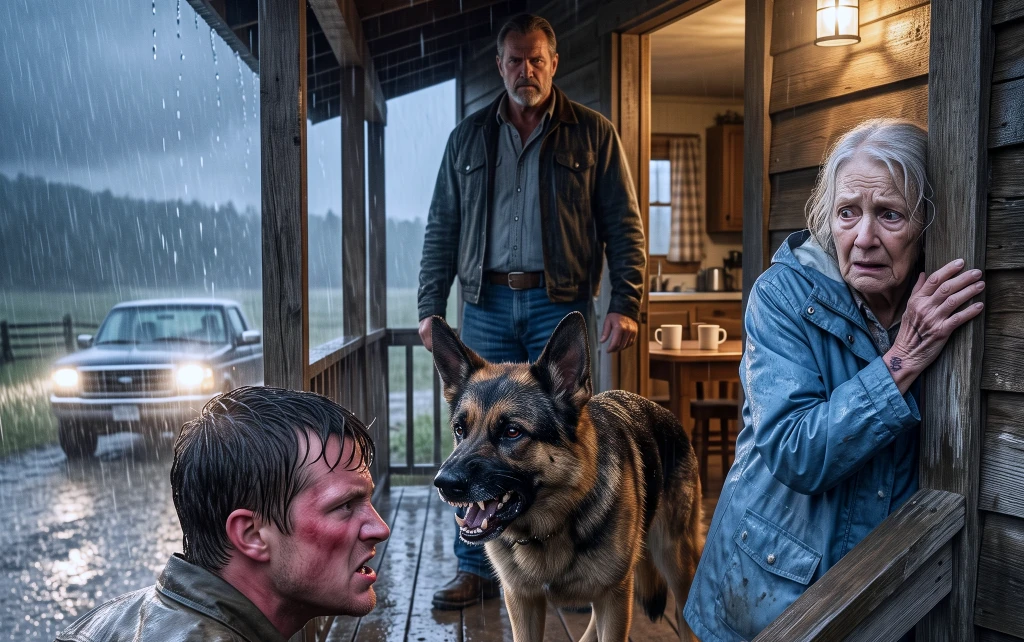
Caleb looked up from the sink, one hand still wrapped around a dish towel. Ranger did not waste energy on coyotes, thunder, or the loose porch shutter that banged whenever the wind came hard from the north. The dog had spent too many years beside Caleb in places where the wrong sound could matter, and when Ranger listened like that, Caleb listened too.
“What is it?” Caleb asked.
Ranger stared through the narrow glass beside the door. His tail stayed low. His breathing changed.
Caleb dried his hands, crossed the kitchen, and looked out into the rain. At first, all he saw was the long dirt lane, black with mud, and the weak yellow glow of the porch light trembling across the yard. Then lightning opened the sky for half a second, and two figures appeared at the gate.
They were old. That was the first thing Caleb understood.
The man leaned on a cane, his shoulders bent under a dark coat that hung heavy with rain. The woman beside him was smaller, nearly swallowed by a faded blue rain jacket buttoned crookedly at the throat. She had one hand locked around the man’s sleeve and the other pressed against her chest as though she was holding herself together from the inside.
Caleb opened the door.
Cold rain blew into the house. Ranger moved to Caleb’s left side, close enough that his shoulder brushed Caleb’s leg. The dog did not bark. He only watched.
“Evening,” Caleb called.
The old man lifted his head. Water ran off the brim of his cap and down the deep lines in his face. He had a narrow, weathered look, the kind old ranchers got after a lifetime of wind, work, and keeping their troubles to themselves.
“We saw your light,” he said. His voice was hoarse, but he kept it polite. “We don’t mean to bother you.”
The woman tried to smile. It came and went quickly, as if she did not trust her face with anything larger. “We only need somewhere dry for a little while.”
Caleb stepped onto the porch. “You’re a long way from town.”
“Yes, sir,” the man said.
“You lost?”
The man hesitated. The woman looked toward the barn, not the house, and Caleb noticed the way her eyes stopped there with relief and shame tangled together.
“No,” the man said. “Not lost.”
The rain fell harder, bouncing off the porch steps and turning the yard into a silver haze. Caleb looked from the old man’s soaked shoes to the woman’s trembling hands. They had not come in a car. They had not brought luggage. The woman carried a plastic grocery bag twisted tight around something soft, maybe clothes, maybe medicine, maybe nothing she could afford to leave behind.
The old man cleared his throat. Pride made the words come out stiff. “Would it be all right if we sat in your barn until the storm lets up? We won’t touch anything. We’ll be gone before morning.”
Ranger moved first.
He stepped down from the porch and crossed the mud slowly, head low, ears forward. The woman froze when the shepherd approached her, but Ranger did not crowd her. He stopped at her boots, sniffed the wet edge of her coat, then sat beside her as if he had known her for years.
The woman’s mouth trembled. “Oh,” she whispered. “Aren’t you something?”
Caleb watched Ranger lean lightly against her leg. The dog did not give trust cheaply, especially not to strangers who appeared out of a storm. He had once stood between Caleb and a man with a knife in a crowded street overseas. He had once refused to enter a room where a tripwire waited under a rug. He knew fear, and he knew when someone carried too much of it.
“You’re not sleeping in the barn,” Caleb said.
The old man’s face tightened. “I understand. We’ll move on.”
“I mean you’re coming inside.”
Neither of them moved at first. Kindness, Caleb had learned, could frighten people who had lived too long without it. The old woman looked up at him, searching his face for the trap. The old man shifted his cane in the mud and seemed to measure Caleb the way tired men measure bridges before trusting them with their weight.
Then Ranger stood and turned toward the porch.
That decided it.
Inside, the ranch house smelled of wood smoke, coffee, and cedar dust from the split logs Caleb kept stacked near the stove. He gave them towels, found dry socks in a laundry basket, and turned the heat up until the old pipes knocked softly in the walls. The woman thanked him three times before she sat down. The old man tried to stand near the door until Caleb pulled a chair out from the kitchen table and nodded toward it.
“Sit before you fall,” Caleb said. “No charge for chairs.”
The old man gave a weak breath that might have been a laugh if he had more strength. “Everett Whitcomb,” he said. “This is my wife, Marian.”
“Caleb Ward.”
Everett looked at Ranger, who had settled beside Marian’s chair. “And him?”
“Ranger.”
Marian lowered one hand toward the dog. Ranger lifted his head and touched his nose to her fingers. Her eyes filled so quickly she turned her face away, pretending to look at the stove.
Caleb set mugs of tea in front of them. He had lived alone on the Double W for almost four years, long enough to forget how fragile other people could look under his kitchen light. His father had bought the place when Caleb was a kid, back when the barns were straight and the fences did not need patching every other week. After the Navy, after the funerals, after the doctors told him he was fine in ways that did not matter, Caleb came home and stayed because the land did not ask questions.
It needed work. That he understood.
Marian wrapped both hands around the mug. Her gloves lay on the table, dark and dripping. When she pushed one sleeve back, Caleb saw the bruise.
It circled her wrist in four uneven shadows, too dark and too deliberate to be from bumping into a cabinet. He had seen that shape before on people who claimed they had fallen. He had heard the same quiet hurry in their voices.
Marian noticed his eyes and tugged the sleeve down. “Thin skin,” she said. “Happens when you get old.”
Everett looked at the table.
Caleb did not push. The fastest way to lose frightened people was to force truth before they had a safe place to put it.
“Do you need a doctor?” he asked.
“No,” Marian said at once.
Everett’s hand tightened around his mug. “Not tonight.”
That answer told Caleb more than either of them meant it to.
The storm crowded the windows. Rain slid down the glass in crooked lines, and somewhere outside a loose hinge tapped against the side of the barn. Ranger’s ears flicked at each sound, but he stayed close to Marian’s chair, his body angled between her and the front door.
Caleb leaned against the counter. “Anyone know you’re here?”
Everett opened his mouth, then closed it.
Marian stared into the tea. “We didn’t tell anyone.”
“That’s not what I asked.”
The old woman flinched at the gentleness more than she would have at a shout. Everett looked up, and Caleb saw the fight inside him: the old habit of protecting family from outsiders, even when family had become the danger.
“Our grandson worries,” Everett said finally. “Too much sometimes.”
Marian’s fingers tightened around the mug until her knuckles went pale.
Caleb waited.
“He’s been helping with things,” Everett continued. “Bills. Appointments. The house.”
“Helping,” Caleb said.
Everett’s face changed a little at the word. He did not contradict it, but he did not defend it either.
Marian whispered, “We just needed air.”
The sentence landed in the kitchen with more weight than she could have known. Caleb had once heard a man say that exact thing after being pulled from a collapsed building. Not rescue. Not justice. Air.
“How far did you walk?” Caleb asked.
Everett looked embarrassed. “Maybe two miles. Maybe a little more.”
“In this weather?”
“We waited until he left,” Marian said, then bit her lip as if she had betrayed herself.
Caleb’s eyes moved to Everett. The old man had gone very still.
“Who left?” Caleb asked.
Before either of them could answer, Ranger lifted his head.
The change was small but immediate. His shoulders tightened. His ears came forward. The low sound that moved through him was not quite a growl, not yet, but it pulled Caleb’s attention to the window.
Headlights swung across the far end of the lane.
Everett set his mug down too quickly. Tea sloshed over the rim and onto the table. Marian’s hand flew to her throat, and all the little color the stove had brought back to her face disappeared.
The truck came fast for a road that bad. Its beams bounced over ruts and cut through the rain, hard and white, until the whole kitchen seemed to flash with them. It stopped at the gate with the engine still running.
For a few seconds, no one spoke.
Then a man’s voice tore through the storm.
“Everett! Marian! I know you’re in there!”
Marian’s eyes closed. Everett’s cane scraped against the chair as he tried to stand, but his knees would not quite obey him. Ranger rose from beside Marian’s feet and placed himself between her and the door.
Caleb did not reach for a weapon. He did not hurry. He only looked through the rain at the truck idling beyond his gate, then back at the old couple who had asked to sleep beside his hay because the house felt like more kindness than they believed they deserved. Marian gripped the edge of the table with her bruised hand. “Please,” she whispered. “Don’t let him take us back…”
To read the rest of the story – CLICK the NEXT button 👇👇👇