


The first thing Batu refused that morning was mango. That was how I knew the keepers were scared. A thirty-one-year-old Bornean orangutan could ignore a crowd, a camera, a new puzzle feeder, even another orangutan calling from the far side of the rainforest wing. Batu had ignored all of those things before. But he had never turned his back on ripe mango in January, not in the cold gray hour before the public gates opened, when the building still smelled of wet rope, leaf litter, disinfectant, and the coffee the overnight staff drank too quickly.
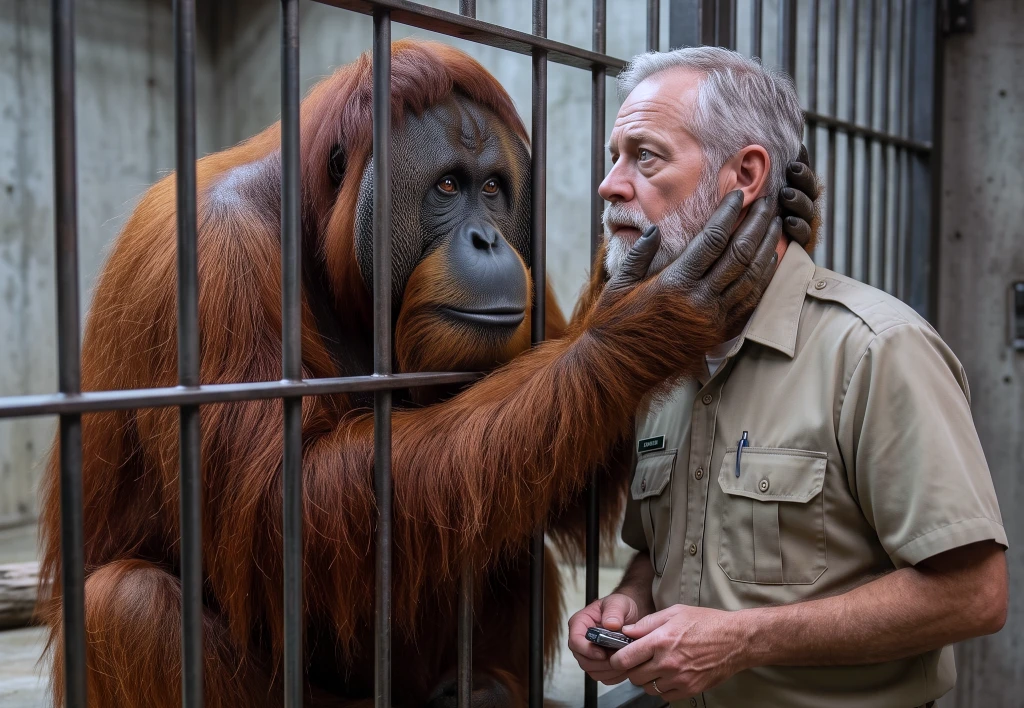
He sat at the training glass with both palms pressed flat against it, waiting for Ray Whitaker.
Not food. Not enrichment. Not attention from anyone else. Ray.
I was halfway through my first cup of coffee when Maya Torres called me from the primate corridor and said, “Dr. Ellison, I think you need to come down here.” Her voice had the forced calm keepers use when panic would only make an animal more certain that something is wrong.
By the time I reached the indoor rainforest building, the public lights were still dimmed. Outside, the Oregon rain tapped against the high glass roof in a steady gray rhythm. Inside, artificial mist moved through the upper canopy ropes, catching the low light and turning the habitat into a dream of trees that had been built by engineers.
Batu was not in the canopy. He was not in his sleeping nest or by the heat rock or near the feeding ledge where he usually inspected breakfast like a retired judge.
He was at the protected-contact window, waiting.
Batu was a flanged male, broad-faced and copper-red, with cheek pads that made his dark eyes look even deeper. His arms were long enough to fold around a hanging fire hose and make it look like a ribbon. Even sitting still, he had the weight of an old forest in him.
He rarely wasted movement, and he rarely asked twice for anything.
That morning, he tapped the glass twice.
Tap. Tap.
Maya stood in the keeper aisle with a bucket under one arm and the uneaten mango in her gloved hand. She was twenty-six, bright, careful, and still new enough to believe every strange behavior could be solved if you found the right column on the observation sheet. She looked from Batu to me as if one of us might translate.
“He’s been doing that for forty minutes,” she said. “I offered mango, figs, the blue feeder, even the cardboard tube with honey. He looked at everything and went right back to the glass.”
“Any changes overnight?” I asked.
“No construction. No new cleaners. No vet treatment. No aggression. No pacing.” She lowered her voice, though Batu could hear far better than visitors ever imagined. “He just wants Ray.”
I stepped closer to the glass. Batu’s eyes shifted to me, then away. He knew me. He tolerated me. He had once stolen my pen through a training slot and spent twenty-three minutes taking it apart with the concentration of a surgeon. But I was not the person he was waiting for.
“Where is Ray?” I asked.
“Locker room. He came in ten minutes ago.” Maya hesitated. “He was late again.”
Again.
I heard the word, small and careful, and did not ask about it yet. In animal care, staff learn to speak around things until someone with authority forces the shape into daylight. A missed radio call becomes “busy.” A forgotten key becomes “distracted.” A senior keeper staring too long at a gate he had opened ten thousand times becomes “tired.”
Batu tapped the glass again.
Tap. Tap.
The sound traveled through the corridor with a strange, patient insistence. It was not loud. It was not dramatic. It was worse than that. It sounded practiced.
The door at the end of the keeper hall opened, and Ray Whitaker came in wearing his faded Cascade Rainforest Zoo cap, rain still darkening the shoulders of his jacket. He was fifty-six, tall in a weathered way, with gray in his beard and hands that had spent thirty years carrying buckets, ropes, crates, medication cups, infant bottles, and frightened animals that did not know humans could be gentle.
The building seemed to recognize him before any of us did. Radios quieted. Maya straightened. Batu lifted his head.
“Morning, old man,” Ray said.
For one second, everything in Batu changed. He did not rush. Orangutans did not waste dignity on human impatience. But he leaned forward until his forehead almost touched the glass, and both of his hands spread wider, palms open.
Ray walked to the window and set his hand against the glass opposite Batu’s left palm.
“Hey, Batu,” he said softly. “I’m here.”
Batu did not move away. He stared at Ray’s face as if searching it for something that had slipped behind the eyes. Ray smiled, but the smile worked too hard. I had known him for nine years, and I had never seen Ray perform comfort until that winter.
Comfort, for Ray, had always been something he gave without showing the effort.
“You two starting early today?” I asked.
He looked at me and blinked. “Mara. Sorry. Didn’t know you were coming in.”
“You didn’t answer your radio.”
He touched the radio clipped to his belt, then frowned. The volume was turned all the way down.
“Must’ve bumped it,” he said.
Maya looked at the floor.
Batu tapped the glass with the edge of his right hand, once this time, not the two-beat call. Ray looked back immediately. That was the part that made my skin tighten. Batu was not trying to get attention. He already had it.
He was correcting the direction of Ray’s attention, bringing him back to the one ritual he seemed to trust.
Ray set both hands against the glass. Batu covered them from the other side, his fingers wider than Ray’s whole palm. They stayed like that while the rain clicked against the roof and the air system hummed above us. In any other context, a visitor would have called it beautiful.
Visitors loved easy words. They liked to flatten animal behavior into feelings they already understood.
But I had spent most of my adult life studying primates, and I knew better than to call something love just because it hurt to watch.
“How many times this week?” I asked Maya.
She opened the tablet and swiped to Batu’s behavior chart. “Seventeen documented glass contacts where he specifically waited for Ray. Nine two-tap events. Four refusal-to-shift events. Three times he carried the old blue towel to the training window.”
“The towel from holding room three?”
She nodded. “The one Ray keeps trying to throw away.”
Ray heard us. His jaw shifted, but he did not turn around.
Batu’s eyes never left him.
For the next twenty minutes, we tried to move through the morning routine. Maya offered the visual cue for Batu to shift to the side enclosure so staff could inspect the main habitat. He ignored her. Ray gave the same cue, and Batu watched his hand, then looked at his face.
Ray tried again.
“Batu, side,” Ray said. “Come on, buddy. Side.”
Batu remained at the glass.
Ray glanced toward the hanging cue board on the wall, then back at the shift door. His brows pulled together. It was only a pause, no more than three seconds, but in a building run by routine, three seconds could become a flare in the dark. He reached for the wrong pouch on his belt, found the clicker where the grapes should have been, then laughed under his breath.
“Too early,” he said. “Haven’t had enough coffee.”
Maya did not laugh. Neither did Batu.
The orangutan rose, unfolded himself with slow precision, and moved along the glass until he was directly opposite Ray. Then he tapped twice.
Tap. Tap.
Ray went still.
I watched his face, not Batu’s. The color had drained from beneath his beard. He looked less embarrassed than caught, as if Batu had said something aloud that everyone else had been politely refusing to hear.
“Ray,” I said carefully, “do you know why he does that?”
He took too long to answer.
“It’s just a thing,” he said. “He gets stuck on things sometimes.”
“No,” Maya said before she could stop herself.
Ray turned toward her. “What?”
She swallowed. “I’m sorry. I just mean—it doesn’t look random.”
He looked back at the glass. Batu was still waiting with those enormous hands pressed open.
Ray set his own hand against one of them again. “He was little when he started that,” he said after a while. “Tiny. Loud as a car alarm. Wouldn’t sleep unless somebody sat by the nursery window.”
“You sat with him?” I asked.
“Everybody did.”
“But he remembers you.”
Ray’s mouth moved as if he had a joke ready, but it failed him before it could become sound. He leaned closer to the glass, and Batu leaned with him, separated by two inches of reinforced acrylic and twenty-seven years of a relationship that no chart could fully hold.
The Cascade Rainforest Zoo had acquired Batu as an infant through a conservation breeding transfer from another accredited facility. His mother had rejected him within the first forty-eight hours. It was not the romantic story visitors imagined when they saw a large male orangutan reclining above them in the canopy.
There had been no jungle rescue with moonlight and hero music. There had been incubators, hand-warming cloths, feeding schedules, veterinary alarms, and a rotation of exhausted keepers trying to keep a fragile infant alive without turning him into a human child.
Ray had been one of those keepers.
In the early photographs, he looked almost painfully young. His hair was dark then, and his face had the stubborn softness of a man who had not yet learned how many animals could leave him. He held baby Batu in a towel against his chest during medical checks, fed him with a bottle no larger than a travel shampoo container, and sat outside the nursery glass at 2:00 a.m. while the infant screamed himself hoarse.
I knew some of that history. Everyone in the building knew some of that history. But I had not known about the tapping.
“Show me,” I said.
Ray shook his head once. “Mara.”
“I’m not asking as a supervisor.”
“I know exactly how you’re asking.” He lowered his hand from the glass, and Batu immediately followed it with his eyes. “You’re asking because you think something’s wrong.”
I did not deny it. “Is there?”
He looked toward the habitat, toward the ropes and platforms and artificial fig trees, then toward the staff door beyond us. For a moment, he seemed unsure which direction belonged to the answer.
Before he could speak, Batu tapped twice again.
Tap. Tap.
Ray closed his eyes.
That was the moment I stopped thinking about stress behavior, enrichment frustration, seasonal routine disruption, or a male orangutan developing a new preference for one keeper’s attention. Animals notice what we hide inside patterns. They notice the limp before the doctor, the anger before the words, the pregnancy before the announcement, the grief on a jacket that has not yet been taken off.
And sometimes, if they know us well enough, they notice the beginning of our disappearance before we can bear to name it.
“Maya,” I said quietly, “pull the old nursery archive.”
She looked at me. “From Batu’s intake?”
“All of it.”
Ray’s head came up fast. “No.”
The word landed sharper than anything else he had said that morning.
Maya froze with the tablet against her chest. I kept my voice low. “Ray, if this is an old learned behavior, we need to understand it. That helps him. It helps you.”
He gave a short laugh, but there was fear inside it. “You don’t need twenty-seven-year-old videos to tell you he’s attached to me.”
“That isn’t what I’m trying to prove.”
“What are you trying to prove?”
Batu made a soft breathy sound against the glass. Ray turned back before I could answer, and the anger left his shoulders at once. He raised his hand again, but this time he missed Batu’s palm by several inches and placed it too high on the panel.
Batu gently lifted his own hand to match.
Maya saw it. I saw it. Ray saw that we had seen it.
No one spoke.
The archive room at Cascade sat behind education storage, in a cramped office where old exhibit signs, donor plaques, and obsolete VHS tapes shared shelves with boxes of laminated school worksheets. It took Maya until lunch to find the digitized files from Batu’s first months. She brought her laptop into the observation office with the look of someone carrying something breakable.
Ray did not come. He said he needed to check the diet prep sheets, though he had checked them twice already that morning. Through the interior window, I could see him in the keeper hall, standing beside the refrigerator with one hand on the handle and no reason to open it.
Maya set the laptop on the desk.
The first videos were ordinary in the way old animal-care footage can be ordinary: a tiny orange infant on a towel, gloved hands, bottle charts taped to the wall, a young Ray adjusting a heat lamp while another keeper wrote notes. Then came a file labeled NIGHT FEED / 2:13 A.M.
The image was grainy, the color washed almost blue. Baby Batu clung to a towel on the other side of the nursery glass, mouth open in a cry the microphone could barely handle. He looked impossibly small, all eyes and elbows and need.
Young Ray sat on the floor outside the glass in scrub pants and a zoo sweatshirt. His hair stuck up on one side. There was a paper cup of coffee beside his knee, untouched. He lifted two fingers and tapped the glass.
Tap. Tap.
The infant stopped crying.
Young Ray did it again, softer.
Tap. Tap.
Baby Batu crawled toward the sound, pressed one tiny hand to the glass, and stared at Ray as if the world had narrowed to that one answer. Ray smiled, tired and tender, and put his palm against the other side.
Behind me, in the present, Batu tapped the training glass.
Tap. Tap.
Maya covered her mouth. Out in the hall, Ray turned at the sound. He looked from Batu to the laptop screen and back again, his face suddenly bare of every defense he had carried into the building. “I forgot that,” he said…
To read the rest of the story – CLICK the NEXT button 👇👇👇