


The call came at 3:17 in the morning, when the whole house was dark except for the little green numbers glowing on my stove. I still had a landline because my late wife, Evelyn, used to say a house should have one thing that rang loud enough to wake the dead. That night, it nearly did. The sound cut through the old brick house, sharp and ugly, echoing down the hallway and up the stairs as if someone were standing in my kitchen with a hammer.
I picked up on the fifth ring.
“Walter Mercer?” a man asked.
“This is him.”
“My name is Detective Paul Rourke with the Cleveland Police Department. I’m sorry to wake you, sir, but we need you to come downtown. It concerns your daughter.”
I was seventy-seven years old, and I had buried enough illusions in my lifetime to know when a sentence did not belong in a room. Daughter was one of them.
“You have the wrong man,” I said.
There was a pause on the other end, not long enough to be confusion and not short enough to be confidence. I heard papers move near the receiver. Somewhere behind him, a phone rang once and stopped.
“Sir, the deceased had you listed as her emergency contact.”
“The deceased,” I repeated.
“I’m sorry.”
I stood in my kitchen in my bare feet, one hand on the counter and the other clamped around the receiver. The rain had started sometime after midnight, tapping against the windows in uneven bursts. Cleveland rain is not pretty rain. It comes off the lake mean and cold, and it finds every crack in an old house.
“I have one child,” I said. “A son. Graham Mercer. He’s forty-five, he answers to nobody, and he is very much alive unless he finally drove that electric sports car of his into a bridge pillar.”
“This isn’t about Graham.”
“You just said daughter.”
“Yes, sir. Her ID says Nora Mercer.”
The name meant nothing at first. It landed like a stone in shallow water and did not sink. Nora Mercer. I knew the Mercer part, of course. I had built half my life around that name. I had put it on construction trailers, blueprints, bid forms, payroll checks, the brass plaque outside Mercer Development downtown.
But Nora?
“No,” I said. “No, you listen to me. I don’t have a daughter named Nora. I don’t have a daughter at all.”
Detective Rourke’s voice stayed low. “There was a card in her coat pocket. It had your number on it. Under contact, it said Dad.”
That word made my grip tighten.
Dad.
Not father. Not Mr. Mercer. Not emergency contact. Dad.
I had been called many things in my life. Marine. Builder. Bastard. Boss. Sir. After Evelyn died, even Graham had stopped calling me Dad unless he needed something signed. But a dead woman, a woman I did not know, had walked around with my number in her coat and that word beside it.
“How did she die?” I asked.
“We’ll discuss that when you arrive.”
“You woke me up at three in the morning. You can discuss it now.”
Another pause. “She was found in a motel room near Brook Park. Preliminary scene suggests suicide.”
I looked toward the dark window over the sink. My reflection stared back at me: white hair flattened from sleep, old Marine shoulders gone stiff with age, the same hard mouth Evelyn used to soften by touching two fingers to my cheek.
“Send a car,” I said, then hated how weak that sounded. “No. Don’t bother. I’ll drive myself.”
“Mr. Mercer—”
“I said I’ll drive.”
I hung up before he could argue.
For a minute I stayed where I was. The house around me felt too large, the way it had felt since Evelyn’s funeral five winters earlier. She had filled every corner without trying. Her sewing basket still sat beside the living room chair, though I had not seen her thread a needle in years before she died. Her reading glasses were still in the drawer by the phone. I had built towers that could stand in lake wind, but I had never learned how to move a dead woman’s things.
I went upstairs and dressed the way I had dressed for bad news all my life: clean shirt, work pants, boots, jacket. I did not rush. Panic is for men who have no training and no tools. I had both, though they had gone rusty from disuse.
Before leaving, I called Graham.
It rang seven times before his polished voicemail picked up.
“You’ve reached Graham Mercer, Mercer Development. Leave a message and I’ll return your call.”
No he would not.
“It’s me,” I said. “Police called. Some woman is dead, and they’re saying she was my daughter. Call me back.”
I ended the call and stood in the mudroom with my truck keys in my hand.
Some woman.
That was what I told myself as I stepped into the rain. Some woman with the wrong ID. Some woman who had stolen my name, or been given it, or used it because lonely people sometimes build families out of scraps and lies.
The problem was the name Nora.
Halfway down West 25th, with the wipers thudding across the windshield, the name stopped being nothing. It turned around in my mind and showed me its face.
Nora.
Not Nora Mercer. Just Nora.
She worked mornings at the Blue Lantern Diner on Lorain Avenue, a narrow old place with cracked blue vinyl booths and a pie case that hummed louder than the radio. I had been eating breakfast there almost every morning for two years because a man alone needs somewhere to be expected.
Nora was the waitress who brought my coffee before I ordered it.
She was not young, not in the way people are careless with youth. She was in her forties, maybe, though some days she looked younger when she laughed at the cook through the pass window, and some days she looked older when she thought no one was watching. She had brown hair she kept pinned back with a pen, careful hands, and a way of listening that made you foolish enough to answer honestly.
“Black coffee, wheat toast, two eggs over easy,” she would say, setting the cup down exactly where my right hand reached for it.
“You trying to get promoted?” I asked her once.
“To what?” she said.
“Breakfast colonel.”
She smiled then, not big, but real enough that I remembered it.
I had not known her last name. I had never asked where she lived, whether she had family, why sadness sat behind her eyes like a second shadow. She was a waitress. I was an old man in a booth. We had a ritual, not a relationship.
Except she had missed work the morning before.
The manager, Deena, had said Nora called in sick. I remembered being irritated by the unfamiliar girl who poured coffee too weak and brought rye toast instead of wheat. I remembered thinking, absurdly, that I hoped Nora was all right.
I pressed harder on the gas.
The medical examiner’s office was a square concrete building near the county justice center, the kind of place designed by someone who believed grief should be efficient. A police cruiser idled by the curb. Water streamed along the gutters, carrying cigarette butts and leaves toward the drain.
Detective Rourke met me inside.
He was younger than I expected, late thirties maybe, with tired eyes and a tie loosened at the neck. He had the look of a man who had learned that bad news does not get easier with practice. He offered his hand. I ignored it.
“Where is she?” I asked.
“This way.”
We went down a hallway that smelled of floor cleaner and burned coffee. A vending machine hummed near a set of double doors. Somewhere behind them, a cart squeaked across tile, and the sound made the skin between my shoulders tighten.
Rourke stopped before a steel door and looked at me.
“I know you said you don’t have a daughter,” he said. “But if you recognize her, I need you to tell me.”
“I’ll tell you exactly what I know.”
The room was colder than the hallway. A white sheet covered the body on the table. I had seen dead men before, in uniforms and mud, in hospitals and funeral homes, but there is something about a sheet over a stranger that makes your mind search for an exit.
Rourke nodded to the attendant.
The sheet came back.
For a second, the room lost all sound.
It was Nora from the Blue Lantern. The same high cheekbones. The same small scar near her eyebrow. The same mouth that had asked me last Thursday whether I wanted apple pie even though I always said no and she always brought it anyway.
Only now her skin had a gray cast, and the life that used to gather carefully in her eyes was gone.
I reached for the table and missed. Rourke caught my elbow, but I shook him off.
“No,” I said.
It was a useless word. It did not change her face.
“You know her,” he said.
“She served me breakfast.”
“Only breakfast?”
I looked at him then. “What the hell is that supposed to mean?”
He took a clear evidence bag from the counter. Inside was a driver’s license. The photo showed Nora, tired but alive. The name printed beside it was Nora Mercer.
“That isn’t possible,” I said.
“There was also this.”
The second bag held a folded piece of paper. The ink had bled a little at the edges, but the words were readable.
I’m sorry, Dad. I couldn’t keep doing this.
My first feeling was anger because anger is easier than fear.
“She didn’t write that to me,” I said.
“You recognize the handwriting?”
“No.”
“Then how can you be sure?”
“Because I am sure of my own life.”
Rourke’s expression did not change. That was the worst part. He had heard grieving people deny facts before, and he thought that was what I was doing. He thought I was an old man cornered by a secret.
“She had a tattoo,” he said.
I turned back toward the table.
“On her wrist,” he added. “It looked recent.”
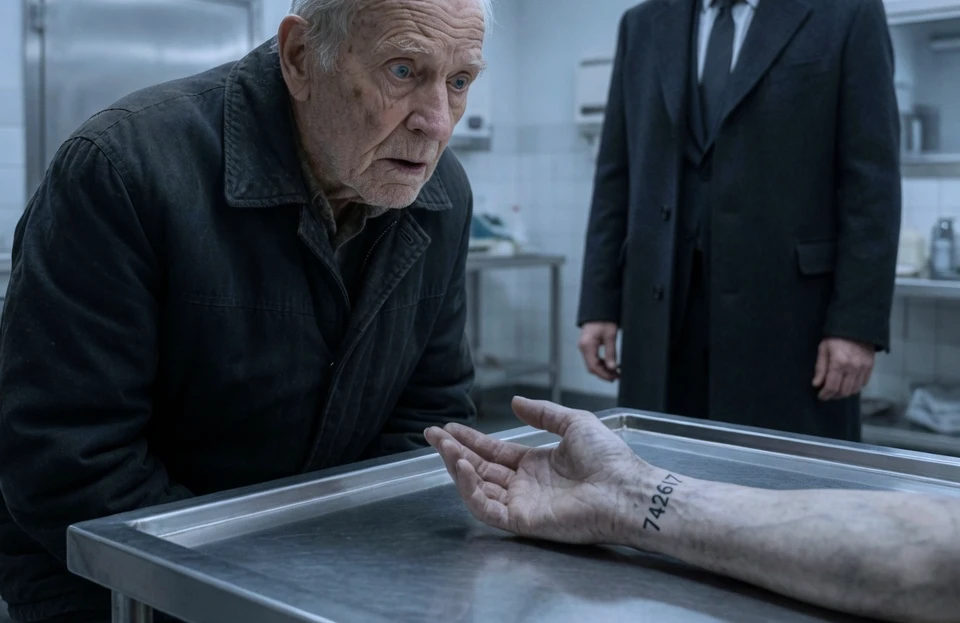
The attendant drew the sheet down enough to expose Nora’s right arm. Her hand lay palm-up, fingers relaxed. On the inside of her wrist, just below the pulse, black numbers were inked in a clean, plain line.
6-14-47.
My knees went unreliable.
Plenty of people could have found out my birthday. I had been in enough business profiles and charity programs over the years for that. But those numbers were not just my birthday. They opened the old floor safe behind the furnace in my basement, the one I had not touched in almost a decade.
I had chosen that combination when I was twenty-nine and too proud to believe I would ever forget anything. Evelyn was the only person I had told. She had teased me for using my own birthday.
“If someone wants your secrets,” she had said, “they’ll start with the obvious.”
Then she had kissed me and promised she would never need them.
No one else knew.
Not Graham. Especially not Graham.
I moved closer to Nora’s body, drawn by dread more than choice. Beneath the stillness and the bruising and the wrongness of the room, I saw something I should have seen before. The soft angle of her jaw. The faint cleft in her chin. A shadow of Evelyn around the eyes.
My wife’s face was not there exactly, but grief is a merciless architect. It took the pieces and built a door.
I stepped back.
“Mr. Mercer?” Rourke said.
“I need her held here.”
“Her next of kin will have to—”
“I said held here.”
“Legally, if her father is identified—”
“I am not identifying myself as her father,” I snapped. “I am telling you something is wrong.”
Rourke watched me for a long moment. “We found a gun in her hand.”
“Which hand?”
He glanced down at his notes. “Right.”
Nora poured coffee with her left hand. I remembered it as clearly as I remembered my own service number. Left hand on the pot, right hand bracing the cup if the table wobbled. Left hand on the order pad. Left hand sweeping crumbs into her palm.
“Did you test her hands for residue?” I asked.
“We’re processing the scene.”
“You’re processing a story somebody set down in front of you.”
His eyes narrowed. “That’s a serious accusation.”
“I have lived long enough to know when a room has been arranged.”
I took out my phone and scrolled to a contact I had not used in years. Dr. Miles Keene had once been the best forensic pathologist in northern Ohio before he embarrassed too many important men by refusing to mistake convenience for truth. He owed me nothing, which made him more trustworthy than most people who did.
He answered on the fourth ring, voice thick with sleep.
“Walter?”
“I need you at the county morgue,” I said. “Bring your kit.”
“What happened?”
“I don’t know yet.”
“Then why am I coming?”
I looked at Nora’s wrist again. The numbers seemed darker now, almost wet. They were not decoration. They were a key.
“Because a dead woman left me a message,” I said. “And I think whoever killed her expects me to be too old to read it.”
Before Miles could answer, the steel door behind me swung open so hard it struck the wall. Graham stood in the doorway in a charcoal overcoat, his hair combed, his face pale in a way that looked practiced. Outside, rain was still flooding the city, but there was not a drop of water on his shoulders. His shoes were dry too, polished black leather shining under the morgue lights. He did not look surprised to see the body. He looked at me and said, “Dad, I’m sorry you had to find out this way…”
To read the rest of the story – CLICK the NEXT button 👇👇👇