


The first time Maggie refused to leave the shelter, everyone thought she was scared. I did, too. I was standing in the lobby of Riverbend County Animal Services with her adoption folder tucked under my arm, a brand-new leash looped around my wrist, and a paper bag of donated kibble sitting by my shoe. The front doors kept sliding open and shut behind me, letting in strips of cold Ohio sunlight and the smell of wet pavement from the parking lot. Outside, my car was waiting with a folded blanket across the back seat and a little blue collar tag on the console that said MAGGIE in white letters.
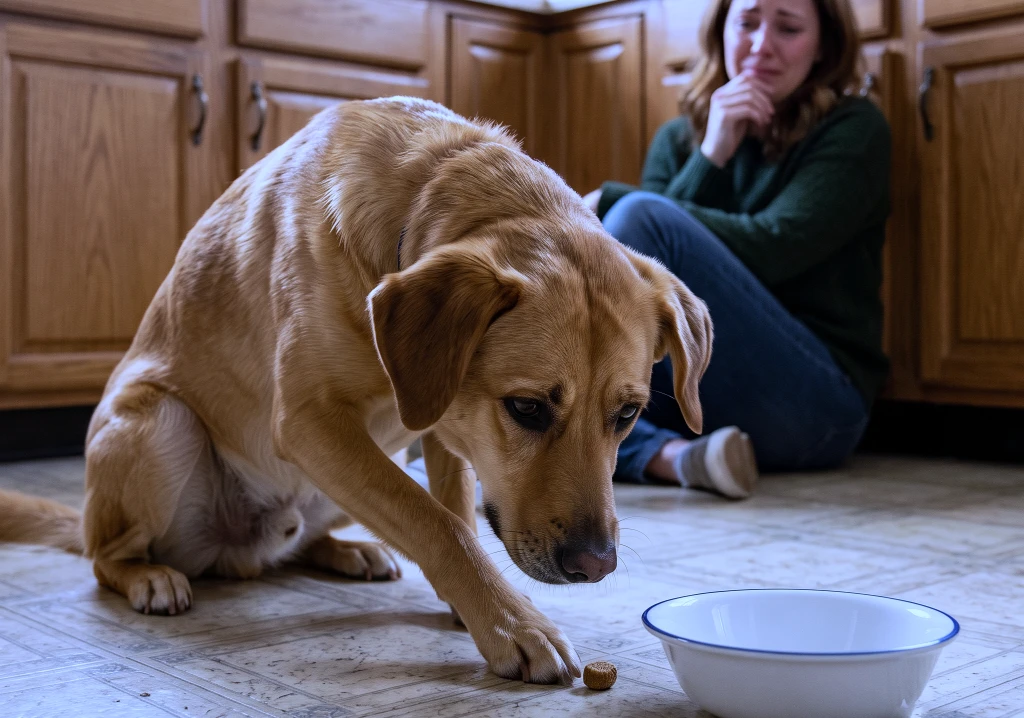
All she had to do was walk through the door.
Instead, she sat down on the beige tile and planted all four paws as if the floor had turned to concrete beneath her.
“Maggie?” I said softly.
Her ears flicked toward my voice, but her eyes never left the hallway behind the reception desk. She wasn’t looking at the exit. She wasn’t looking at me. She was staring past the adoption posters, past the donation bin, past the wall of smiling photos labeled FOUND THEIR FOREVER HOMES, toward a red door at the back of the shelter.
A door with a sign that read: MEDICAL — STAFF ONLY.
The adoption coordinator, Tessa, gave a small laugh that didn’t quite land. “She’s probably overwhelmed. Happens sometimes.”
Maybe it did. I had been warned that shelter dogs could shut down, hesitate, panic, or seem different once the moment came to leave. I had read every article I could find in the weeks before I came here, because research was what I did when I was afraid. I researched dog beds, decompression periods, crate training, leash anxiety, rescue-dog patience, and the best way to introduce a nervous animal to a quiet house.
What I had not researched was what to do when the dog you had just adopted looked back into the shelter as though she was leaving someone to drown.
I crouched beside her and loosened the leash. Maggie was a golden-brown mixed breed, maybe thirty-five pounds, with a white patch on her chest and a face that made people lower their voices without meaning to. Her eyes were amber, soft at the edges, and older than the shelter had guessed she was. They told me she was probably four, maybe five, brought in as a stray after a call from a property manager on the west side of the county.
“She’s shy,” Tessa had said when I first stopped in front of her kennel. “But sweet. Very gentle. She just needs someone patient.”
Patient was one thing I knew how to be. At least, I used to think I did.
Eight months earlier, my father had died in the small front bedroom of my house, the one that faced the maple tree and got the best afternoon light. For nearly a year before that, my life had narrowed to pill organizers, insurance calls, soup he barely touched, and the soft mechanical sigh of an oxygen machine beside his bed. When the hospice nurse told me his breathing had changed, I had already known. I had been listening to it for weeks the way some people listen for storms.
After he was gone, my house did not feel peaceful. It felt emptied out.
I work from home processing medical billing claims, which means most of my day is spent alone at a desk while other people’s emergencies move through spreadsheets and codes. For months after the funeral, I kept expecting to hear Dad call from the bedroom. I would pause with my hand on the coffee pot, waiting for a sound that was never coming. My older sister, Beth, said I needed to get out more. My neighbor said I should join a church group. My therapist said grief had made my world too small.
I said I was thinking about adopting a dog.
What I meant was that I wanted something alive in the house again, but not something that needed me the way Dad had needed me at the end. I wanted a companion, not another crisis. I wanted morning walks, not midnight panic. I wanted warmth in the kitchen, toenails clicking on hardwood, a reason to come home from the grocery store and say, “I’m back,” even though no one had asked.
Then I met Maggie.
She had not rushed the front of the kennel like the younger dogs. She had not barked, jumped, spun, or pressed her body against the chain-link gate. She sat at the back on a faded towel, watching the aisle with an expression that was not fear exactly. It was more like waiting.
I stopped before I understood why.
“Hi, sweetheart,” I whispered.
Maggie blinked once. Her tail moved against the towel, barely more than a brush of fur.
Tessa noticed me lingering. “That’s Maggie. She’s been here almost three weeks. She’s quiet, but she’s done well with volunteers. No aggression, no resource guarding, no major behavior notes. She may take a little time to warm up.”
“She looks tired,” I said.
“A lot of them are.”
Tessa said it gently, not as an excuse, but as a fact. Around us, the kennel room rang with barking, metal bowls, the scrape of paws against concrete, the constant restless sound of animals trying to be chosen. Maggie stayed silent through all of it. Her head lifted when Tessa opened the gate, but she did not come forward until Tessa clipped a slip lead over her neck and murmured, “Come on, girl.”
We went to a small fenced yard behind the shelter where the grass had been worn thin by hundreds of uncertain feet. Maggie moved carefully, nose low, shoulders tight. When I sat on the bench, she stood several yards away, watching me as if deciding whether I was another temporary thing.
I did not reach for her. I had learned during Dad’s illness that sometimes the kindest thing you could do was sit still.
“My name is Claire,” I told her. “I live about twenty minutes from here. It’s a small house, but it has a fenced backyard and too many blankets. I don’t have kids. I do have a neighbor who will probably offer you turkey slices through the fence, and I’ll have to pretend to be firm about it.”
Maggie’s ears tilted forward.
“I’m not looking for perfect,” I said. “Just someone who wants a quiet place to land.”
She took one step, then another. When I held out a treat, she sniffed it for a long time before taking it with a careful mouth. After a few minutes, she sat close enough that her shoulder brushed my knee. When I rested my hand against her back, I felt her whole body tremble once, then slowly settle.
Tessa watched from the gate. “She likes you.”
I wanted to believe that. Maybe I needed to believe it. By the time Maggie laid her chin on my shoe, some part of me had already imagined her sleeping by my desk, walking beside me under the maple trees, lifting her head when I came in from the mailbox.
The paperwork took less than an hour.
I filled out my address, my vet reference, my emergency contact. I initialed the sections about decompression, leash safety, heartworm prevention, and the possibility of hidden medical issues. Tessa explained that Maggie might not eat well the first day, might hide, might have accidents, might need weeks before her real personality came out.
I said yes to all of it.
I meant yes to patience. I meant yes to fear. I meant yes to giving a shy dog a soft place to become herself.
I did not know I was also saying yes to a secret nobody had decided to tell me.
When Tessa brought Maggie into the lobby wearing the new teal harness I had bought from the shelter store, I felt the first fragile lift of happiness I had felt in months. It was small and almost painful, like sunlight through a bruise. I signed the final line on the adoption contract, tucked Maggie’s vaccination records into the folder, and thanked the receptionist twice because I suddenly did not know what to do with my hands.
Then we turned toward the doors.
Maggie took three steps with me. Four.
On the fifth, she stopped.
At first I thought the leash had snagged on something. I looked down, expecting to see it caught around a chair leg or twisted under her paw. It wasn’t. Maggie had simply stopped walking. Her body had gone rigid, ears high, nose pointed toward the hallway behind the desk.
“Come on, girl,” I said. “We’re going home.”
She did not move.
Tessa came around the counter with a treat. “Maggie, look what I’ve got.”
Maggie turned her head enough to sniff it, but she didn’t take it. Her gaze slid back to the hallway. A kennel attendant passed through with a mop bucket, and Maggie stood so quickly the leash tightened in my hand. For one hopeful second, I thought she had decided to follow me out.
Instead, she pulled toward the back.
“Not that way,” Tessa said, still gentle, but firmer now. “The exit’s over here.”
Maggie lowered her body and leaned into the leash.
A woman waiting with a tabby cat in a carrier watched us from the bench. The receptionist looked up from her computer. Somewhere behind the lobby wall, a dog barked in a hard, repetitive rhythm, and Maggie’s ears twitched at every sound. She was not panicking. She was not spinning or trying to bolt. She seemed painfully focused, as though she had been given one task and every human in the room was preventing her from doing it.
I knelt again. “What is it?”
Maggie’s eyes met mine for the first time since we had reached the lobby. There are people who will tell you not to assign human feelings to dogs, and maybe they’re right most of the time. But what I saw in her face was not simple fear. It was pleading.
“She keeps looking back there,” I said.
Tessa followed my gaze. “That hallway goes to intake and medical. She was probably housed back there when she first came in. Some dogs get attached to routines.”
“Can we let her look?”
Tessa hesitated. “The medical wing isn’t open to adopters.”
“I don’t need to go into medical. Just the hallway, maybe? She’s not going to leave until she checks something.”
Tessa pressed her lips together. I could tell she wanted this adoption finished neatly. She had other people waiting, phones ringing, dogs to move, forms to file, and I was standing in the lobby with a newly adopted dog who had turned departure into a negotiation.
Still, something in Maggie’s posture made it hard to dismiss.
“Let me ask Ellen,” Tessa said.
Ellen Marsh, the shelter manager, came out a few minutes later. She was in her fifties, with gray hair pulled into a low ponytail and the permanently tired kindness of someone who had learned to triage heartbreak for a living. She looked from Maggie to me, then down the hallway.
“She wants the back?” Ellen asked.
“Seems like it,” I said.
Ellen sighed. “We can let her walk as far as intake. Not medical. There are sick animals back there, and I don’t want to stress anyone.”
“That’s fine.”
It was not fine with Maggie. The moment we turned away from the front doors, her body changed. Her tail lifted slightly. Her steps became quicker, almost urgent. She passed two storage closets, a bulletin board of volunteer schedules, and a rolling cart stacked with towels. At the end of the hall, she stopped in front of a room with a half-window in the door.
“Intake,” Ellen said. “She spent her first night there.”
She opened the door.
The room was smaller than I expected, with stainless steel counters, a scale, a stack of plastic crates, and the sharp clean smell of disinfectant. Maggie went straight to the far corner where a folded blue blanket sat on top of an empty crate. She pressed her nose into it so hard the crate rattled. Then she made a sound I had not heard from her before.
It was not a bark or a whine.
It was a low, broken noise that seemed to come from somewhere below her ribs.
I looked at Ellen. Her face had changed. Not much, but enough.
“What is that blanket?” I asked.
“Laundry probably missed it,” she said too quickly. “We’ll take care of it.”
Maggie pawed at the blanket. When I reached to help, my fingers brushed a laminated intake card tucked halfway beneath it. It slid onto the floor faceup.
The top line read: STRAY HOLD — PROPERTY CLEANOUT.
Under that was Maggie’s intake number.
A-4172.
Beneath it, in the same handwriting, was another line. The name had been partly covered by a black marker stroke, but not well enough. I could still make out the first two letters.
OT—
Before I could read the rest, Ellen bent and picked up the card.
“Is there another dog?” I asked.
The room went very still around us.
Tessa shifted in the doorway. Ellen held the intake card against her clipboard, her thumb pressed over the blacked-out line. Maggie stood between us, her nose lifted toward the red medical door at the far end of the hall. From behind that door came a faint metallic sound. A tag tapping once against the side of a crate. Maggie heard it, too. Her whole body leaned toward the sound, and when I looked back at Ellen, the answer was already on her face…
To read the rest of the story – CLICK the NEXT button 👇👇👇