


By 5:12 p.m., the yellow dot on Joseph Mulenga’s laptop had not moved in fourteen hours. It sat in the same brown square of the map, pulsing beside a dry creek bed in the southern part of Kafue, where the grass had turned the color of old rope and even the vultures had begun flying lower than usual. Joseph had refreshed the collar feed three times. He had checked the battery. He had checked the last satellite pass. He had even blamed the weather, though the sky over the operations center was as empty and hard as a tin roof left in the sun.
The dot stayed still.
Across the room, a ceiling fan clicked on every third rotation. A radio murmured with reports from an evening patrol, and someone laughed softly near the doorway, but Joseph did not turn his head. On the screen, the animal’s ID read KF-17. To the donors and reports, she was a monitored adult female lion, estimated five years old, part of the park’s predator-tracking program. To the field team, she was Mara.
Joseph had helped dart her the year before, just long enough for Dr. Emma Reed to fit the satellite collar and check an old scar along her shoulder. He remembered Mara waking in the shade of a mopane tree, blinking once at the half-circle of humans, then gathering herself with that quiet, offended dignity lions seemed to keep even under sedation. She had walked away without looking back.
Since then, her dot had moved almost every day.
Sometimes she covered only a mile or two, circling the edges of her territory in the slow rhythm of a mother with a cub too young to travel far. Sometimes she wandered farther at night, following the shifting trails of impala and puku toward whatever water remained. But she moved. Even when she rested, the collar showed small changes as she shifted shade, approached a kill, or dragged herself away from the heat.
This dot had gone dead still before sunrise.
“Maybe she dropped the collar,” Caleb Banda said from behind him.
Joseph did not answer right away. Caleb was twenty-four, lean and serious, with a clean notebook in his pocket and a habit of hoping for the least terrible explanation because he had not yet learned how often the field punished optimism. He had joined the response unit six months earlier, and he still said “maybe” before every bad thing.
Joseph zoomed out on the map. A pale line showed the old creek bed. Another line, thinner and broken, marked a game trail that led toward a waterhole that had not held real water in weeks. On the last sweep, the patrol had found three wire snares near that trail, all empty. Joseph had ordered another patrol for the morning.
Morning suddenly felt too far away.
“She didn’t drop the collar,” he said.
Caleb stepped closer and looked at the screen. “How do you know?”
“Because if she had, we’d still see heat movement from the collar cooling and warming. It would shift a little when the wind moved the grass. This is different.” Joseph tapped the track log. “She stopped at 3:41 a.m. No drift. No range change. Nothing.”
Caleb’s eyes moved from the map to Joseph’s face. “Mortality?”
Joseph hated that word. The software used it because software did not have to walk into the grass and find what it meant. Mortality was clean on a screen. In the field, it had flies in it. It had blood drying black on sand and cub tracks circling a body. It had the silence afterward, when even experienced men found reasons to check straps, radios, rifle chambers, anything but each other’s faces.
“Not yet,” Joseph said. “But she’s in trouble.”
He reached for the radio and called for Emma.
Dr. Emma Reed answered on the second call, her voice clipped and tired. “I’m at the holding pens. What do you have?”
“KF-17. Stationary since early morning. South creek bed, three miles west of the old Nanzhila track.”
There was a pause. He heard metal clatter on her end, then the faint sound of an animal shifting inside a crate. “Mara?”
“Yes.”
“Cub with her?”
“Likely.”
Another pause, shorter this time. Emma understood the math as well as he did. A mother lion caught in a snare was bad. A mother lion with a young cub was worse. If she died, the cub might last days, maybe less in this drought. If scavengers found them first, the cub’s loyalty would become the thing that killed him.
“I’ll get the kit,” Emma said.
Joseph closed the laptop with more force than he meant to. “Caleb, Mapalo, Mercy. Truck in five minutes. We go light, no siren, no engine once we’re close.”
Caleb glanced toward the western windows. The sun had started to fall, turning the dust outside the operations center orange. “We’re going in at dusk?”
Joseph was already reaching for his field vest. “We’re going in before night makes the decision for us.”
Outside, the air smelled of hot rubber, dry grass, and smoke from a cooking fire somewhere beyond the staff housing. The Kafue dry season had always been hard, but this one had begun to feel personal, as if the land itself were tightening its grip around every living thing. Seasonal pools had shrunk into cracked bowls. The riverbanks were stamped with prints from animals that no longer had the strength to waste steps. Herds had moved, then moved again, dragging the predators behind them like shadows.
Mara had not moved with them.
Joseph knew why. Her cub had been seen twice on camera traps, a small tawny male with oversized paws and ears too large for his narrow face. He was old enough to stumble after his mother for short distances, old enough to chew at meat, but not old enough to survive the long, punishing treks other lions were making toward the north. Mara had stayed near the dry creek bed because the thorn thickets there offered cover, and because mothers made terrible bargains when their young could not keep up.
As the team loaded the truck, Emma came out of the clinic with two bags slung over one shoulder and a hard case in each hand. She was sunburned across the bridge of her nose, and her shirt had a dark crescent of sweat at the collar. Joseph had seen her work through heat, broken equipment, angry buffalo, sedated lions waking too soon, and donors asking soft questions after hard days. She never rushed unless rushing was necessary.
She was rushing now.
“What was the last movement pattern?” she asked as she slid the medical cases into the back.
“Short loops for three days. No long hunt. Stayed within two miles.”
Emma’s mouth tightened. “She’s weak, then.”
“She may have made a kill.”
“In that country?” Emma shook her head. “Not unless something was already dying.”
Caleb climbed into the rear seat with the spotlight and extra water. Mapalo, the tracker, checked the winch cable with the same care he gave to a rifle. Mercy, who usually ran comms but had enough field experience to make Joseph trust her in bad country, took the seat behind Emma and clipped a handheld GPS to her belt.
No one said much after that.
The truck left the operations center and headed west, bumping over a track that had been rutted hard by months without rain. Dust rolled behind them like a second vehicle. On either side, the savanna opened in long sheets of brittle grass and gray-green thorn, beautiful from a distance and merciless up close. Joseph drove with one hand on the wheel and the other resting near the radio, listening to the changing sounds of the evening.
A fish eagle called somewhere far off, though Joseph could not imagine what water it had found. Guinea fowl burst from the track ahead in a panicked scatter. Twice, they passed giraffes standing still among the trees, their long necks angled toward the west like weather vanes. The animals watched the truck but did not run; every creature out here was saving energy.
Emma studied the map on her tablet. “The collar puts her just beyond that bend?”
“Yes. Maybe six hundred yards from the track.”
“Wind?”
Joseph slowed and watched the dust drift left. “Coming from the east. If hyenas are close, they’ll scent her before we scent them.”
Caleb shifted in the back seat. “You think they’re already there?”
“If she’s bleeding, they’ll come.”
He did not say the rest. Hyenas were not villains. They were survivors, intelligent and patient and built for exactly this kind of opportunity. In another story, Joseph would have admired them. Tonight, they were a clock.
The last mile took longer than it should have. The track narrowed into thorn scrub, and Joseph killed the headlights twice to scan the ground ahead by the fading wash of sunset. The collar coordinate blinked on Emma’s tablet, closer now, still unmoving. At three hundred yards, Joseph stopped the truck behind a low stand of brush and cut the engine.
The silence rushed in.
Without the diesel vibration, the savanna sounded larger. Dry seedpods clicked in the wind. Something small moved through grass near the left rear tire. Farther away, a jackal called once and was answered by nothing. Joseph opened his door slowly and stepped down, letting his boots find the ground without scraping.
“From here, we walk,” he said.
The team moved with the careful rhythm of people who had done dangerous things together. Mapalo took the lead, reading prints and bent grass in the dim light. Joseph followed, rifle slung but not in his hands; it was there for worst-case protection, not as a plan. Emma walked behind him with the dart rifle and medical bag, Mercy beside her with the spotlight still off. Caleb came last, breathing quietly through his nose in the way Joseph had taught him.
They had gone perhaps fifty yards when Mapalo raised his fist.
Everyone stopped.
Joseph listened. At first, he heard only wind. Then came a sound so faint he almost dismissed it: a low, uneven rasp, not a growl and not quite a cough. It came again from ahead, followed by a small chuffing noise that made Emma’s face change.
“Cub,” she whispered.
Joseph nodded. His mouth had gone dry.
They moved another few steps. The smell reached them next: blood, cat, old dust, and the sour edge of stress. Then Mapalo pointed to the ground. In the sand between the roots were drag marks, deep and uneven, as if something heavy had been hauled across the earth. Beside them were paw prints. One set was broad, adult, staggering. The other was small, frantic, circling again and again.
Emma crouched and touched the sand near the drag mark. “She was moving after whatever caught her.”
Joseph looked along the line. The trail led toward a break in the thorn, where the last sunlight pooled in a small open patch of ground. Above the brush, he could see the dark shape of a fallen log where no log should have been.
The cub called again.
This time it was not a chuff. It was a thin, hoarse sound that made Caleb look away.
Joseph lifted one hand, signaling everyone to hold. Then he eased through the last screen of grass and saw Mara.
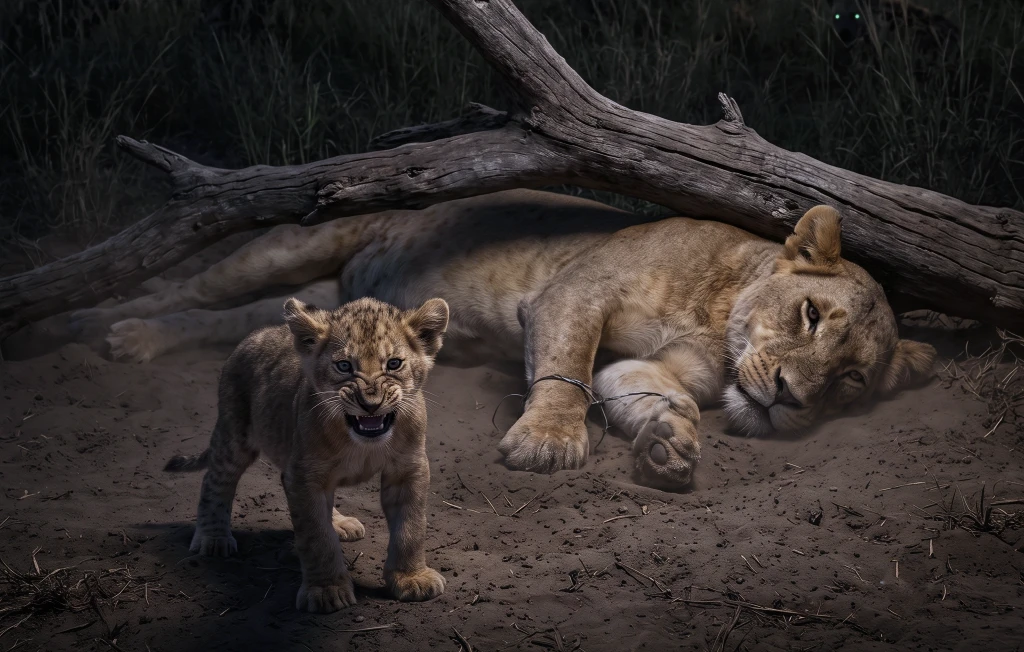
For one second, his mind refused to arrange the image into sense. The lioness lay on her side beneath a heavy dead limb, her body half hidden by dust and crushed grass. One foreleg was stretched at an unnatural angle, bound by a dark loop of wire that had cut deep into the flesh above the paw. The wire ran back through weeds to the dead limb, which had dragged with her until it had rolled against her shoulders and pinned her to the ground.
Her eyes were closed.
Beside her stood the cub.
He was smaller than Joseph remembered from the camera trap, or maybe fear made him look smaller. Dust clung to his whiskers. His ears were flattened, and his belly moved fast with each breath. When he saw Joseph, he did what every wild cub should have done in the presence of humans.
He did not run.
The cub stepped in front of his mother and opened his mouth. The sound that came out was barely a growl, cracked from hours of calling, but he held his ground. His paws shook. His tail tucked once, then lifted stiffly behind him as if his body could not decide between terror and duty.
Emma came up beside Joseph and raised the binoculars. For a moment, she said nothing. The field had gone dim around them, and in that thinning light Joseph could see the first flies gathering near the wound.
“Emma,” he said quietly.
“I need closer.”
“The cub—”
“I know.”
The cub turned toward his mother, touched his nose to her cheek, then faced the humans again. He did not understand medicine, or collars, or men with radios and winches. He understood only that something large and wrong had fallen onto the body that kept him alive, and that now other animals were coming.
Emma lowered the binoculars. “I can’t tell if she’s breathing.”
Joseph felt the old memory rise before he could stop it: another collar, another still signal, another animal found too late because the team had waited for morning light. He swallowed it down and looked at the cub instead. The little lion’s eyes were fixed on him, bright and wild and exhausted.
Behind them, in the tall grass beyond the clearing, something laughed. It was a low, broken sound, almost human in the wrong light. Caleb’s hand tightened around the spotlight, but Joseph kept his eyes on the cub. A second laugh answered from farther off, then a third. The hyenas had found them. Emma took one slow step forward, and the cub bared his tiny teeth. At the movement, Mara’s chest gave the faintest lift beneath the weight of the log. Emma saw it too. “She’s alive,” she whispered. Joseph did not look away from the cub. The little lion stood between his mother and every danger left in the world, including the people who had come to save her. Then Emma’s flashlight caught the wire around Mara’s leg, and her voice dropped lower than Joseph had ever heard it. “Joseph,” she said, “that snare is still tightening…”
To read the rest of the story – CLICK the NEXT button 👇👇👇