


The first person to see the dog was the security guard posted outside the maternity elevators. He looked up from the visitor log just as the automatic doors slid open and a man came in from the rain with a golden retriever pulling hard at the leash. The dog was soaked across the shoulders, his paws leaving dark prints on the polished hospital floor. The man behind him looked worse. His shirt was buttoned wrong, his hair was wet at the temples, and one of his hands was pressed flat against his chest as if something inside him might come apart if he let go.
“Sir,” the guard said, already stepping around the desk, “you can’t bring a dog in here.”
The man didn’t slow down. “Please.”
The word came out barely louder than breath.
A nurse at the admissions station turned. “Sir, stop right there. Animals are not allowed past this point.”
The dog stopped before the man did.
That was what made the guard hesitate. The retriever was not barking, lunging, or dragging like an excited pet. He stood with all four paws planted, head lifted toward the elevators, ears forward, body still in a way that made him seem less disobedient than certain. A red leash cut across his chest. From his collar hung a small metal tag in the shape of a bone: MURPHY.
The man swallowed. “My wife is upstairs.”
“Then we’ll get someone for you,” the nurse said, coming closer. “But the dog has to go outside.”
“My son is upstairs too.”
The nurse’s face changed then. Not softened exactly, but altered, the way a person’s expression changes when ordinary rules suddenly collide with something no rulebook can make easy. The guard glanced from her to the man, then to the dog.
“What’s your name?” the nurse asked.
“Ethan Miller.”
She knew the name. Ethan saw it before she said anything. It was in the quick drop of her eyes, the small tightening at the corners of her mouth, the way her fingers closed around the badge clipped to her scrub pocket.
Miller. Emergency delivery. Room 312.
The baby who had not cried.
Ethan saw all of that move through her face, and for one terrible second he thought his knees might actually fail. He tightened his fist around Murphy’s leash instead.
“Mr. Miller,” the nurse said gently, “I’m sorry. I really am. But I can’t let him up there.”
Murphy made a sound then, low and broken, not a bark and not quite a whine. Ethan had heard that sound only once before.
Six hours earlier, it had come from the kitchen.
Grace had been standing barefoot at the sink in Ethan’s old Ohio State sweatshirt, rinsing a mug she had not finished drinking from. Thirty-seven weeks pregnant, she moved with the cautious patience of someone who had learned not to trust good news too quickly. The house was quiet except for the steady ticking of the wall clock and the rain tapping against the window above the sink.
Murphy had been pressed against her legs.
“Buddy,” Grace said, trying to shift around him, “I love you, but you’re not helping.”
He did not move. He stayed wedged between her and the counter, his head turned toward her belly, his eyes anxious and fixed.
Ethan had been in the dining room assembling a car-seat base for the third time, because the first two times did not feel secure enough. On the table beside him lay the instruction manual, a half-empty cup of coffee, and a little blue knit cap Grace had found in a box of her mother’s things. It was soft, old-fashioned, with a tiny folded brim. Grace said her mother had bought it years before, back when hope was something she could say out loud.
“Ethan?” Grace called.
He looked up. “What?”
“Murphy’s being weird.”
“He’s always weird.”
“No. Not like this.”
When Ethan came into the kitchen, Murphy didn’t wag. He didn’t bring a toy, didn’t bump Ethan’s hand for attention, didn’t do any of the goofy things that made Grace call him their seventy-pound toddler. The dog stood braced in front of Grace, blocking her every attempt to move.
“Murph,” Ethan said, forcing lightness into his voice. “Come here.”
Murphy didn’t look at him.
Grace placed one hand on the round front of her sweatshirt. “He’s been doing this since I got up. He followed me into the bathroom, then the laundry room, then he tried to climb into the shower.”
“He’s protective.”
“He’s scared.”
Ethan wanted to dismiss that, because fear had become too familiar in their house. For most couples, the final month of pregnancy was nursery photos, packed bags, cheerful countdowns. For Ethan and Grace, every small ache opened the door to memory. Two years earlier, they had lost a daughter at twenty-one weeks. Afterward, Grace stopped sleeping through the night, and Ethan learned how long a person could stand in a hallway listening to someone cry without knowing whether comfort would help or hurt.
Murphy came four months after that loss.
They had gone to the shelter “just to look,” which both of them understood was a lie. Grace had walked past the kennels with her arms folded tightly across her chest until one underweight golden retriever pressed his head against the chain-link door and did not bark. He had simply watched her with tired brown eyes. On the drive home, he laid his head in her lap and stayed there for forty miles.
Now that same dog stood between Grace and the kitchen doorway like he was guarding her from something neither of them could see.
Grace tried to laugh. “Maybe he knows I’m finally going to clean the pantry and he’s staging an intervention.”
Then she stopped.
The mug slipped from her fingers and broke in the sink.
Ethan reached her in two strides. “Grace?”
Her hand tightened on the edge of the counter. The color drained from her face so fast he felt it in his own body, a cold rush from throat to stomach.
“Something’s wrong,” she said.
The pain came in a wave that bent her forward before he could catch her. Murphy barked once, sharp and violent, then began circling them, not with excitement but with panic. Ethan lowered Grace carefully to the floor, his hands clumsy and shaking, and called 911 with a voice he barely recognized.
The paramedics came in less than nine minutes. Ethan remembered odd fragments afterward: the rain on their jackets, the orange strap across the stretcher, Grace asking for the blue cap, him not understanding what she meant, Murphy trying to climb into the ambulance after her.
“No animals,” one paramedic said, blocking him with a knee.
“He knows something,” Grace whispered from the stretcher.
Ethan leaned close. “I’m right behind you.”
She grabbed his wrist with surprising strength. “The cap. Don’t forget the cap.”
He nodded, though he had already forgotten everything except the terror in her eyes.
The ambulance doors closed. Murphy stood in the driveway as the siren started, rain darkening the fur along his spine. Then he threw his head back and howled, a long, wounded sound that followed Ethan all the way to the hospital.
At Maple County Regional Medical Center, the day folded into lights, doors, forms, and people asking questions too quickly. A nurse took Grace one way. A doctor took Ethan’s consent another. Someone said “possible abruption.” Someone said “OR.” Someone told him to sit, then forgot him standing there.
He kept looking down at his phone because he thought he should call someone. Grace’s sister. His father. The neighbor who had a spare key. But every contact name looked like it belonged to a life that had ended while the rain kept falling outside.
At 11:43 a.m., Dr. Elena Ortiz came into the small family room.
Ethan knew before she spoke. He had seen bad news on television, in movies, in other people’s faces at funerals, but he had never understood that it had a shape. It made a person smaller before the words arrived. Dr. Ortiz was a calm woman in her forties with dark hair pulled back at the nape of her neck and tired, kind eyes. When she stepped through the door, she did not carry the brisk authority she had brought into the operating room. She carried silence.
“Mr. Miller,” she said.
He stood. “Grace?”
“She’s stable. She lost blood, but we have her. She’s being monitored closely.”
He waited for the rest.
Dr. Ortiz’s hands were folded in front of her. “Your son was born without detectable signs of life. We worked on him. We did everything we could.”
“No.”
“I’m so sorry.”
“No, he was fine this morning.” Ethan heard his own voice rising, thin and childish. “He was fine. She was fine.”
“I know.”
“You don’t know. You can’t know. Check again.”
“We did.”
“Then do it again.”
Dr. Ortiz held his eyes, and the compassion in her face was worse than anger would have been. “Ethan, we tried.”
He sat down because his legs would not continue the argument.
The next hour did not move in order. It came in pieces. Grace in a recovery room, pale and shaking, her eyes open but not really seeing. A nurse named Elaine Brooks explaining bereavement photographs in a voice so careful it sounded practiced against her will. A small bundle wrapped in a white hospital blanket. A face no bigger than Ethan’s palm. Ten fingers. A mouth shaped like Grace’s.
Their son.
They had chosen the name Noah three weeks earlier and had not told anyone. Grace said she wanted to speak it first when he was on her chest. Ethan had teased her for being sentimental, then written it secretly on the inside of the nursery closet in pencil, low near the baseboard, where no one would see it unless they knew to look.
Now he could not say the name.
Grace tried once. Her lips formed the first letter, but no sound came. She turned her face toward the window and stared at the rain.
Ethan sat beside the small bassinet with his hands between his knees. The blue cap was not there. He remembered that suddenly, with a pain so specific it felt absurd. Grace had asked for it. He had forgotten.
Then his phone buzzed.
He ignored it.
It buzzed again, then again. Finally he looked down and saw Mrs. Alvarez from next door. She was seventy-two, retired from the post office, and the only person Murphy obeyed almost as well as he obeyed Grace.
Ethan stepped into the hall and answered without speaking.
“Ethan?” Mrs. Alvarez’s voice shook. “Honey, I’m sorry. I wouldn’t call if I didn’t have to.”
“What happened?”
“It’s Murphy. He broke the screen door. I tried to calm him, but he won’t settle. He keeps going upstairs to the nursery and coming back down with something in his mouth. I think it’s the little hat. The blue one.”
Ethan closed his eyes.
“He keeps sitting at the front door,” she said. “Like he’s waiting for you to take him somewhere.”
When Ethan returned to the room, Grace had not moved. Elaine Brooks stood near the foot of the bed, quietly adjusting a blanket that did not need adjusting.
“I have to go home,” Ethan said.
Grace looked at him then. Really looked. Her face was hollow. “What?”
“Murphy’s losing it. Mrs. Alvarez says he found the cap.”
For one second, anger crossed Grace’s grief like a spark. “You’re leaving?”
“I’ll come right back.”
“Our son is here.”
“I know.”
“Do you?”
The question hit him harder than shouting would have. He opened his mouth, but nothing useful came out. Grace turned away again, and he understood that there were kinds of leaving that could not be explained while they were happening.
He went anyway.
At home, Murphy was waiting at the door with the blue cap in his mouth. The screen behind him hung torn from the frame. Rain had blown into the entryway, wetting the rug Grace had ordered because she said the house needed cheerful things. Mrs. Alvarez stood on the porch in a plastic rain bonnet, wringing her hands.
“I’m sorry,” she said. “I tried everything.”
Murphy pushed past her and came straight to Ethan. He did not jump. He did not wag. He pressed the cap into Ethan’s hand and stared at him.
“Murph,” Ethan whispered.
The dog turned, ran to the car, and put both front paws against the passenger door.
“No.”
Murphy barked once.
“You can’t go in there.”
Another bark.
Ethan stood in the rain with the cap in his fist and thought of Grace saying, He knows something. He thought of Murphy blocking her path that morning, of the howl in the driveway, of the way the dog had not acted frightened of death but furious at being separated from something he believed was still his job to protect.
By the time Ethan understood what he was doing, he had Murphy in the back seat and was driving too fast toward the hospital.
Now, in the maternity lobby, the security guard lifted both hands. “Mr. Miller, I’m not trying to be cruel. But you can’t take a dog upstairs.”
“Then arrest me after,” Ethan said.
The nurse stared at him. “Please don’t make this harder.”
“It’s already harder.” His voice cracked, and he hated the sound of it. “My wife asked me for that cap. I forgot it. He found it. He brought it to me.”
Murphy stood motionless beside him, the damp blue cap now clenched gently in his teeth.
The nurse’s gaze dropped to it.
Behind her, another woman came out of the elevator. She was older than the first nurse, with silver threaded through her brown hair and reading glasses hanging from a cord around her neck. Ethan recognized her from the recovery room: Elaine Brooks, the nurse who had placed a box of tissues near Grace but had not told her to use them, which Ethan had somehow appreciated.
“What’s going on?” Elaine asked.
The first nurse answered quietly. “Mr. Miller brought his dog.”
“I can see that.”
“He wants to take him up.”
Elaine looked at Ethan. She looked at Murphy. Then she looked at the blue cap.
For several seconds no one spoke. The guard shifted his weight. The elevator doors opened behind Elaine and closed again without anyone getting on.
“Five minutes,” Ethan said. “I’m not asking you to understand it. I’m asking you for five minutes so Grace can see him. So he can—” He stopped because he did not know how to finish without sounding insane.
Elaine’s face tightened with the private pain of a person weighing a rule against a human being.
“The dog stays on the leash,” she said at last.
The first nurse turned. “Elaine—”
“He stays on the leash,” Elaine repeated. “He doesn’t go near any other patient. He doesn’t touch any equipment. If anyone asks, I made the call.”
The guard stared at her. “You sure?”
“No,” she said. “But I’m doing it anyway.”
Ethan almost dropped the leash.
In the elevator, Murphy stood facing the doors, the cap still in his mouth. Ethan could feel water dripping from the hem of his jacket onto the floor. Elaine said nothing. Her jaw was set, but her hands were trembling slightly where they rested against the medication scanner clipped to her pocket.
When the doors opened on the third floor, Murphy stepped out first.
Ethan expected to lead him.
He didn’t have to.
The dog moved down the hallway with his nose low and his pace steady. He passed the nurses’ station, passed two closed patient rooms, passed a linen cart. A young resident looked up from a chart and froze.
“Elaine, is that—”
“Not now,” Elaine said.
Murphy did not turn toward Grace’s recovery room.
Ethan felt the first wrongness of that like a hand closing around his throat. “Murphy,” he whispered. “Grace is this way.”
The dog kept walking.
Elaine slowed beside Ethan. “Mr. Miller?”
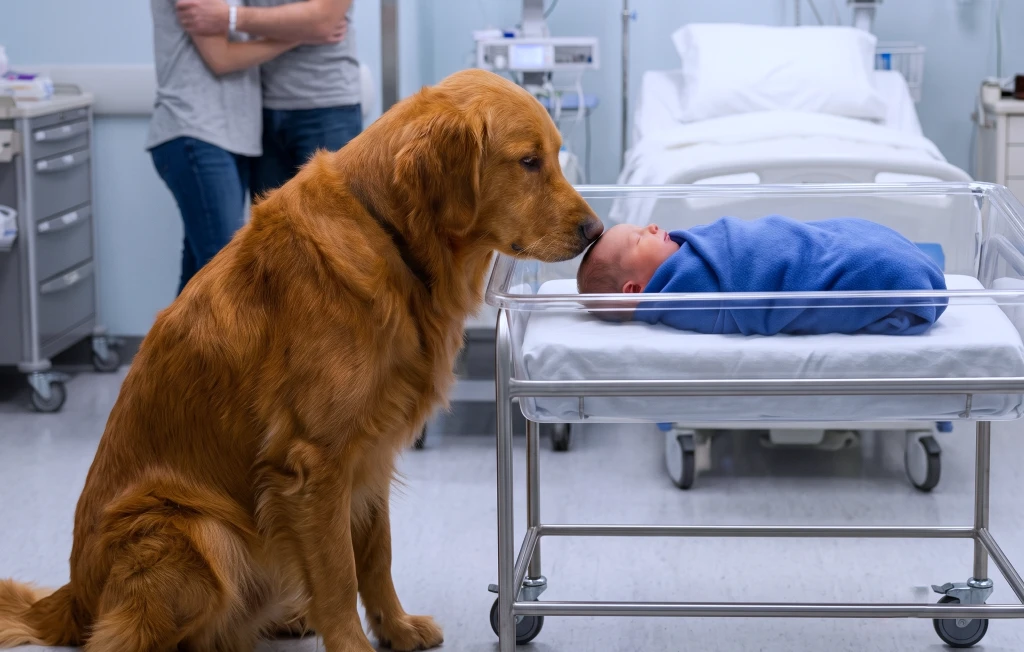
Murphy stopped at the end of the hall outside a door with a small brass number: 312. It was not Grace’s room anymore. It was the quiet room they had moved Noah to after the delivery, the room with the dim lamp and the white blanket and the bassinet Ethan had not been able to look at for more than a few seconds.
Murphy raised one paw and scratched once at the door.
Then he lowered the blue cap to the floor and nudged it toward the threshold.
Elaine went very still.
Ethan stared at the dog. “How did he know this room?” – From the other side of the door came Grace’s voice, hoarse and barely human. “Let him in…”
To read the rest of the story – CLICK the NEXT button 👇👇👇