


The sound came from the old lambing shed after midnight, thin enough to be mistaken for wind and wrong enough that Warren Keller set his coffee down without taking a sip. He stood in the kitchen of his Montana ranch house with one hand on the counter and the other pressed against the ache in his left hip, listening. Outside, a late-April snowstorm had erased the yard, the truck, the fence line, and most of the world beyond the porch light. The calendar said spring, but the storm had come down from the Canadian line with winter’s old temper, piling snow against the barn doors and rattling the gutters like loose bones.
There it was again.
Not a calf. Not a coyote. Not one of the barn cats trapped somewhere it shouldn’t have been. It was a low, raw cry, almost swallowed by the wind, and something in it made Warren reach for his coat before he had time to talk himself out of it.
His daughter’s name still glowed on the phone screen by the sink. Claire had called twice that evening from Denver, and Warren had let both calls go to voicemail because he knew what she would say. The same thing she had said for three years, ever since her mother died.
Dad, you can’t keep doing this alone.
He pulled on his insulated coveralls, shoved his feet into boots stiff with dried mud, and took the heavy flashlight from the hook beside the back door. On the chair near the woodstove lay Elaine’s old star quilt, folded with the care he gave to very few things now. Warren looked at it for half a second, then looked away.
“Just the horses,” he said to the empty kitchen, because talking to himself had become easier than admitting he was talking to the woman who wasn’t there. “Check the horses, check that sound, come back in.”
The wind nearly took the door out of his hand.
Snow came sideways, stinging his face with hard little grains of ice. He lowered his head and crossed the yard by memory, the flashlight beam catching only white movement and the occasional black rib of fence rail. The barn appeared all at once, broad and dark, and the horses inside shifted when he slid the door open.
They were fine. Old Blue stamped once and blew warm breath over the stall gate. The two younger mares stood hip to hip near the hay rack, annoyed by the weather but safe enough. Warren took his time with them anyway because habit mattered on a ranch, especially when grief had hollowed out most other habits and left only chores behind.
Then the cry came again.
This time it did not come from the barn. It came from beyond it, from the low shed where Warren stored broken panels, rusted buckets, and the tractor attachments he kept promising himself he would haul to scrap. The lambing shed had not held lambs in fifteen years, but Elaine had never let him tear it down.
“Something always needs a wall in a storm,” she used to say.
Warren stepped back into the snow, pulled the barn door shut, and turned toward the shed.
The drifts were already knee-deep in places. His boot caught under a buried length of chain, and he nearly went down hard, catching himself on the fence post with a grunt that sent pain up his shoulder. At seventy-two, he knew the inventory of his body too well: the repaired knee, the hip that hated cold weather, the lungs that still belonged to a man who had never been smart enough to quit cigarettes until Elaine got sick and made him promise.
He almost turned back.
Then something moved beside the shed.
Warren lifted the flashlight.
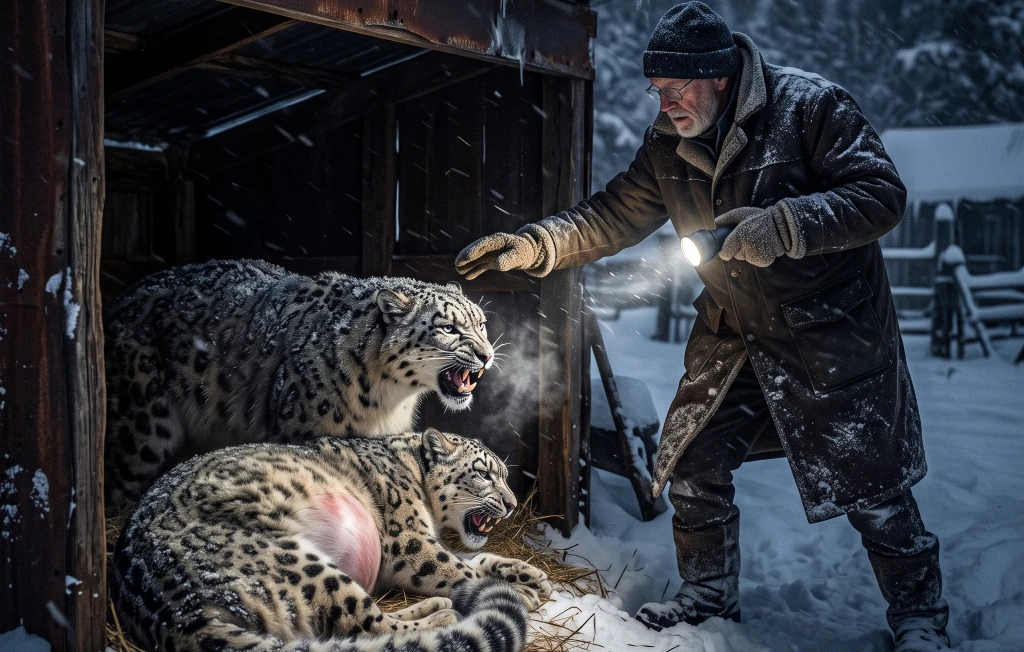
At first his mind refused to name what he was seeing. The beam struck pale fur, dark rosettes, a long thick tail curled stiffly over another body. Two cats lay pressed into the narrow shelter between the shed wall and an old plow blade, their bodies filmed with ice, their breath coming in faint bursts that disappeared almost as soon as they formed.
Not mountain lions. Not bobcats.
Snow leopards.
Warren had seen them only in nature programs Elaine liked to watch on Sunday evenings, those silent ghost-cats moving over cliffs somewhere on the other side of the planet. They did not belong under his lambing shed in northern Montana. They did not belong in a storm that had already buried the stock tanks and snapped one of his cottonwood limbs in half.
The larger cat lay half over the smaller one, his front legs braced weakly around her shoulders as if he had tried to become a wall. His head lifted when the light touched him. His eyes were pale and unfocused, but the sound that came from his chest was a warning, even exhausted.
Warren stopped where he was.
“Easy,” he said, though the word shook in his mouth. “I see you. I’m not coming any closer yet.”
The smaller cat moved then. The female’s head rose only an inch from the snow, enough for Warren to see the ice crusted along her whiskers and the dark hollows above her eyes. Her sides were rounded under the matted fur, not with strength, not with winter weight, but with the unmistakable heaviness of late pregnancy.
“Oh, sweetheart,” Warren whispered before he could stop himself.
The male tried to push up. One paw slid out from under him. He collapsed against the female with a broken sound, and the effort seemed to spend whatever fight he had left.
Warren stood in the blowing snow with the flashlight shaking in his gloved hand. Every sensible part of him knew what he should do. Back away. Call the sheriff. Call wildlife officers. Leave apex predators outside where predators belonged, no matter how strange or pitiful they looked.
But sensible men did not always survive long enough to become old ranchers. Compassionate ones sometimes did, if they were lucky. Warren had buried calves he could not save, bottle-fed foals through bad nights, splinted a barn cat’s leg with popsicle sticks because Elaine had refused to let him “wait and see.” He knew the look of an animal that had crossed from fear into pleading because its body had no choices left.
The female made the cry again. Softer this time.
Warren lowered the flashlight and looked back at the house. The porch light was a dim yellow blur through the storm, maybe sixty yards away and feeling farther with every gust. Between here and there were snow, ice, his bad hip, and two wild cats that could kill him if warmth brought them back wrong.
He thought of Claire’s unanswered calls. He thought of Elaine’s quilt. He thought of waking in the morning to find two frozen bodies and whatever unborn lives they carried gone with them.
“Damn it,” he said.
He backed away slowly, then turned and fought his way to the barn. The old plastic feed sled hung from two nails near the tack room, cracked along one side but still usable. Warren dragged it down, grabbed three horse blankets, a coil of soft rope, and a pair of leather gloves thick enough for barbed wire. His hands knew what to do long before his mind caught up.
When he returned to the shed, the male had shifted again, pulling his body tighter around the female. Warren could see now how thin both cats were under the fur. Their hips showed wrong. Their paws were enormous, but their legs trembled like old branches.
“I’m going to help her first,” Warren said. “You can hate me for it if you’ve got the strength.”
The male’s lips lifted, but the snarl did not last. His head dropped, and for one strange second, Warren felt the animal watching him not as a threat, but as a final possibility.
He laid the sled beside the female and spread a horse blanket over it. The first touch was the worst. The male gave a hoarse growl and struck weakly toward Warren’s sleeve, missing by inches. Warren froze, heart slamming against his ribs, then waited until the cat’s head sagged again.
“Fair enough,” Warren murmured. “I’d bite me too.”
He worked slowly, speaking the whole time in the low voice he had used with frightened horses. He slid one blanket under the female’s shoulders, then another under her hips. The snow around her had frozen to her fur, and when he eased her sideways, little shards of ice cracked free. She was lighter than she should have been, terrifyingly light for an animal carrying young.
The first pull barely moved the sled.
Warren set his boots, gripped the rope, and pulled again. Pain burned through his hip and down his thigh. The sled shifted six inches, then stuck in a ridge of snow. He cursed under his breath, dug the plastic edge free with his boot, and pulled until his breath came harsh and hot inside his scarf.
By the time he got the female halfway to the house, his chest hurt badly enough to make him pause. He bent over with both hands on his knees, watching snow collect on the leopard’s ears. Behind him, the male had begun to crawl after them.
That nearly undid Warren.
The big cat dragged himself through the trench left by the sled, moving a few feet at a time, collapsing, then lifting himself again. He was not chasing Warren. He was following her.
“All right,” Warren said, though his throat had tightened. “All right. I’m not leaving you.”
He got the female into the mudroom first. The back door banged against the wall, and warm air rolled out into the storm. Warren dragged the sled over the threshold, then shoved the door nearly closed to hold in the heat. The female lay on the old boot rug, sides rising and falling in uneven waves.
The male was still fifteen yards from the porch.
Warren took the sled back out, every muscle in his arms shaking now. He expected the male to fight him. Instead, the cat lifted his head once, looked toward the mudroom where the female lay, and let Warren work the blanket under him.
“You’re a stubborn old thing,” Warren said, and for the first time that night, the words almost sounded like they were meant for himself.
Getting the male inside took longer. He was heavier, even half-starved, and Warren slipped twice on the porch steps. The second time, he went down on one knee hard enough to see white behind his eyes. For a moment he stayed there with one hand gripping the rope and the other braced against the rail, thinking that this was how Claire would find him: frozen beside two animals that should never have been on his land.
Then the female cried from inside the house.
Warren pulled.
The sled lurched over the threshold, and he kicked the door shut behind them with the last strength he had. For several seconds, he could do nothing but lean against the wall and breathe. Snow melted from his hat onto his face. His gloves were wet. His hip throbbed. The two leopards lay on the mudroom floor, alive but barely.
He knew enough not to put them too close to the woodstove. Sudden heat could kill what the cold had not. He opened the inner door, dragged the rugs aside, and pulled the sleds into the living room, stopping near the edge of the braided rug where the warmth reached gently. Then he turned down the lamp, added one split log to the stove, and stood there in the dim room with his hands hanging at his sides.
Elaine would have known what to do next.
That thought sent him moving.
He called county dispatch first because it was the number he knew by heart. The dispatcher kept her voice level until he said “snow leopards,” and then there was a pause long enough for him to hear wind hiss against the kitchen windows.
“Sir,” she said carefully, “did you say snow leopards?”
“I know what it sounds like.”
“Are you in immediate danger?”
Warren looked toward the living room. The male had shifted close enough to press his back against the female’s side. His eyes were half-open, fixed on Warren, but the firelight caught no strength in them.
“Not as much as they are,” Warren said.
The dispatcher patched him through to a wildlife veterinarian named Dr. Lena Ortiz, who was stuck on the other side of a closed county road with a state response team. Her voice was younger than Warren expected and steadier than the storm deserved.
“Mr. Keller, I need you to listen carefully. Keep them quiet. Keep the room dim. Don’t offer food. If they can lift their heads, you can put water in a shallow dish, but don’t force it. And do not get between the male and the female.”
“I brought them in on feed sleds,” Warren said. “I don’t plan on wrestling them now.”
“That was dangerous.”
“So is freezing to death.”
Dr. Ortiz exhaled, not quite a laugh. “I’m not arguing with you. I’m trying to keep you alive until I get there.”
Warren tucked the phone between his shoulder and ear, then knelt stiffly to push a shallow saucer of water across the floor with a broom handle. The female did not move at first. The male’s nose twitched. After a long moment, he lowered his muzzle and lapped once, then again.
“Good,” Warren whispered.
“What happened?” Dr. Ortiz asked.
“I heard one crying by the old shed. Found them curled up behind some scrap equipment. The male was covering her.”
“How close are they to the stove?”
“Across the room. Warm, not hot.”
“Good. Any visible injuries?”
Warren moved to answer, then stopped.
The ice along the female’s neck had begun to melt. Under the clumped fur, a dark rubbed line circled her throat. It was too even to be a wound from brush or fence wire. When she shifted, something small and metal slid from under her ruff and struck the floor with a faint, hard tap.
Warren stared.
A tag.
He leaned forward just far enough to read the stamped words by the firelight. The letters were scratched, but clear.
SILVER RIDGE EXOTICS
F-12
Warren knew that name. Everyone in the county knew it. The private animal park two towns over had been on the local news the previous fall after inspectors found problems and the owner announced he was “relocating” his animals out of state.
“Mr. Keller?” Dr. Ortiz said in his ear. “What do you see?”
Warren did not touch the tag. He looked from the metal to the female’s swollen belly, then to the male lying between her and the door as if he had spent every last scrap of himself trying to protect her from a world that had already failed them.
“They weren’t lost,” Warren said quietly.
Before Dr. Ortiz could answer, the female’s body tightened. A deep shudder rolled through her, and the sound she made was no longer the cry of an animal freezing in a storm. It was lower, older, and full of pain. Warren gripped the phone. – “And I don’t think we have until morning…”
To read the rest of the story – CLICK the NEXT button 👇👇👇