


The first time Ranger heard the dead man’s name again, he was muzzled, bleeding at the gums from fighting the restraint, and six feet away from a girl who had no business being inside the red safety line. Maya Mercer had $2,312 in a bank envelope folded into the pocket of her father’s old denim jacket. It was diner tips, textbook money, two months of careful saving, and the last of what she had promised herself she would never touch unless there was no other choice.
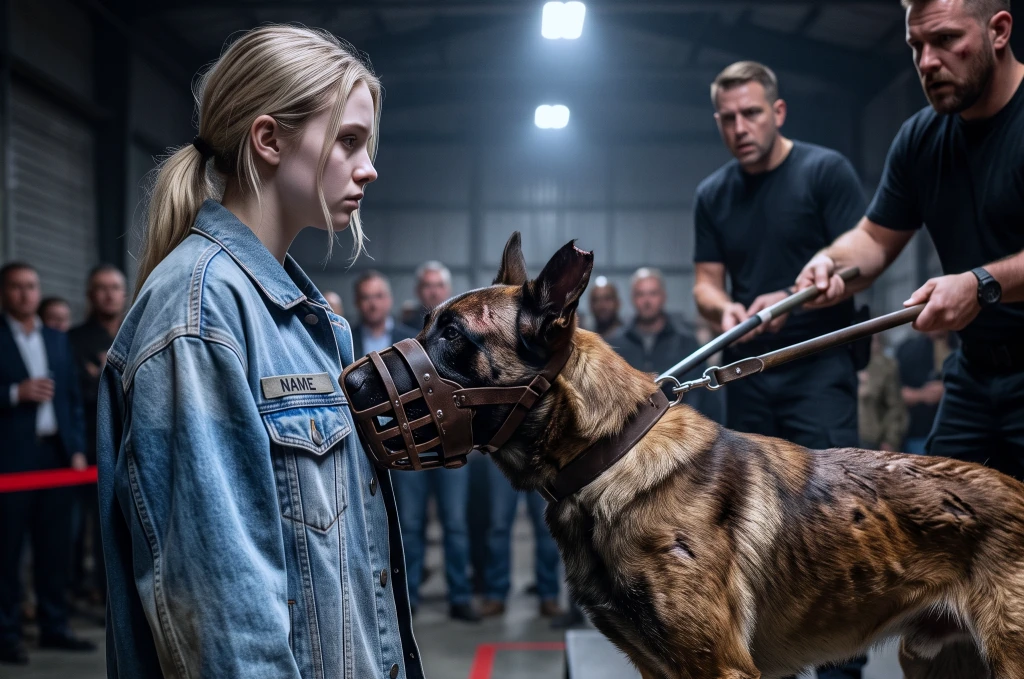
The bid on Ranger had just passed five thousand.
Across the concrete floor, a man in a charcoal sport coat lifted one finger as if he were ordering coffee. “Five,” he said, bored enough to make the number cruel.
Cal Bennett, the auctioneer, paused with the gavel in his hand. He was a wide, tired man with a former handler’s posture and a voice that could bounce off steel rafters without a microphone. Behind him, two kennel techs leaned their full weight against the poles attached to Ranger’s collar and harness. Neither one looked bored. Both had sweat darkening their shirts.
“Five thousand to Mr. Vale,” Cal called. “Going once.”
Maya’s hand tightened around the numbered paddle she had been given at the registration table after three different people asked whether she was lost. She stood in the front row among men who smelled like coffee, leather, expensive cologne, and gun oil. Some wore suits. Some wore contractor polos. A few had the watchful stillness of men who had spent too long in places where doors could become threats.
Maya looked like someone’s kid sister who had wandered in from the parking lot.
She was nineteen, slight, and pale from working breakfast shifts before school. Her hair was pulled back in a plain elastic, and the jacket on her shoulders was too broad for her frame. The patch marks had been picked off years ago, but the fabric still held the faint, stubborn smell of cedar, salt air, and the laundry soap her father used when he came home from deployment.
Lot 38 had gone for nine thousand. Lot 40, a black shepherd trained in explosive detection, had gone for fourteen. These dogs were not being adopted by families with fenced yards and children who wanted a best friend. This was the Pacific Ridge Tactical K9 Disposition Sale, a private transfer auction tucked inside a warehouse park north of San Diego. The dogs here were too intense, too expensive, too damaged, or too specialized for ordinary placement.
Buyers came looking for perimeter animals, warehouse deterrents, convoy dogs, and status symbols with teeth.
Maya had come for one dog.
Ranger stood on the raised platform under fluorescent lights that made every scar visible. He was a Belgian Malinois, seventy-four pounds of coiled muscle and old grief. A strip of fur along his left shoulder grew back unevenly where shrapnel had once torn through him. The tip of one ear was gone. A thick agitation muzzle wrapped his jaws, but the sound coming from his chest still made people shift their feet.
He did not look like the dog Maya remembered.
In her memory, Ranger was all elbows, ears, and impossible energy, racing the surf on a winter morning while her father laughed from the wet sand. He used to slam his head into Maya’s lap on the porch of their rented duplex and groan until she scratched the spot behind his collar. He had once stolen half a turkey sandwich from her plate and then sat at perfect attention beside her father, as if discipline could erase evidence.
Her father, Senior Chief Aaron Mercer, had never called him a pet.
“That dog’s my teammate,” Aaron would say, tapping two fingers against Ranger’s chest. “He just lets us live in his house.”
For most of Maya’s childhood, her father existed in pieces. A duffel bag near the door. A pair of boots by the mat. A voice on a bad connection from somewhere she was not allowed to ask about. When he was home, he filled the little house with warmth so completely that his leaving seemed to pull the air out of the rooms.
Ranger always knew before anyone else. He would press close to Aaron’s leg the night before a deployment and become quiet in a way that made Maya angry. She was too young then to understand that animals could dread goodbye without knowing the date.
Three years earlier, Aaron Mercer had not come back.
The official story arrived in folded flags, careful words, and men in dress uniforms who stood in the living room like sorrow had procedures. There had been a night operation overseas. There had been an ambush. Aaron’s team had pulled back under fire. He had stayed long enough for others to make it out.
The only living thing found beside him was Ranger.
The dog had been wounded, dehydrated, half-conscious, and still guarding Aaron’s body when the recovery team reached the ridge. Maya learned that part from a man who called from a blocked number after the funeral and cried once, silently, before he could speak again.
She had begged to take Ranger home. She had written letters to offices that answered with forms. She had called numbers that sent her to other numbers. Every answer sounded almost kind until it reached the same wall: Ranger was still government property, still operational, still too valuable, still not available.
Then he disappeared into another contract, another handler, another job.
For three years, Maya collected rumors the way some people collected photographs. Ranger had been reassigned. Ranger had failed out of a border detail. Ranger had bitten a handler who tried to drag him into a transport crate during a thunderstorm. Ranger had stopped bonding. Ranger had started waking from sleep with his teeth already bared.
Then, two weeks ago, an old friend of her father’s found her after closing at the diner and told her there was going to be a sale.
Not an adoption event. Not a ceremony.
A sale.
“Lot Forty-Two,” he had said, sliding a printed page across the counter. “If you’re going to try, don’t wait.”
So Maya came with the envelope, the jacket, and a promise she had whispered at her father’s grave that morning.
Cal Bennett glanced at Ranger’s file and rubbed the back of his neck before speaking into the microphone. “Full disclosure on Forty-Two. Male Malinois, seven years old. Former military working dog, later federal and contract security placement. Highly trained, but not cleared for civilian family adoption without specialized review. Reactivity concerns. Two bite incidents on record. Recommended for restricted-site perimeter work only.”
A murmur moved through the buyers. To most of them, that warning lowered the price. To Maya, it felt like hearing strangers discuss a wounded person as if he were a cracked tool.
“Opening at one thousand,” Cal said.
Maya raised her paddle before fear could talk her out of it.
Several men turned to look at her. One smiled faintly, not kindly. Cal noticed her, hesitated, and pointed. “One thousand to the young woman in front.”
“Two,” said the man in the charcoal sport coat.
Maya did not know his name yet. She only knew the way he barely glanced at Ranger. Later she would learn he was Graham Vale, acquisitions director for a private security logistics company that ran fenced compounds and supply yards in places most people never saw.
To him, Ranger was not Aaron Mercer’s partner. He was a cheap alarm with a heartbeat.
Maya lifted her paddle again. “Twenty-three hundred.”
Her voice came out thinner than she intended. She heard it disappear into the rafters and hated how young she sounded.
Graham Vale looked up then. His eyes moved over her jacket, her worn sneakers, the envelope peeking from her pocket. His smile sharpened.
“Five thousand,” he said.
That was all it took.
The number hit Maya with a physical force. Her hand dropped. She had known she might lose, but knowing did not make the moment survivable. Ranger strained against the poles, claws scraping the platform, his muzzle wet at the edges where he had fought the leather. He did not see her. He saw only pressure, light, hands, threat.
“Five thousand going once,” Cal said.
Maya stepped forward until her toes touched the red safety line.
“Going twice.”
The gavel lifted.
Maya ducked under the line.
Shouts broke from three directions at once. A security guard lunged from the side aisle. One kennel tech cursed and threw his weight backward. The second reached for the yellow stun device clipped to his belt, his face going white with urgency.
“Miss, back up!” Cal shouted.
Ranger snapped toward her movement. The old dog came alive with terrifying speed, all muscle and memory. The poles bowed under the force of him. The handlers stumbled and caught themselves, boots skidding on concrete. Every buyer in the front row moved back at once.
Maya stopped six feet from Ranger.
Her knees wanted to fold. Her hands wanted to protect her throat. Some small animal part of her understood exactly what his body could do to hers if those poles failed.
But she also saw his eyes.
Not rage. Not really.
Ranger was trapped inside a war that had never ended for him.
Maya drew in a breath so deep it hurt. Then she reached for the voice she had practiced alone in her bedroom until her throat ached: lower, steadier, with the clipped certainty her father used only with Ranger.
“Ranger.”
The dog’s ears flicked.
The handlers froze, not trusting the pause.
Maya took one careful step closer. “Stand easy,” she said, her voice shaking at the edges but holding the shape of the command. “For Senior Chief Mercer.”
The change went through Ranger before anyone could explain it. His body locked, not with aggression this time, but recognition. The growl broke off. His weight shifted back from the poles. His eyes stayed fixed on Maya’s jacket as if the fabric itself had spoken.
Behind the platform, the holding pens had been a constant racket all morning: barking, pacing, metal tags striking wire. One dog stopped. Then another. The noise thinned in uneven pieces until the whole warehouse seemed to be listening to the space Ranger had made.
It was not magic. Dogs read tension, command, surrender, and fear faster than people do. But to the men in that room, it looked as if thirty working dogs had noticed the same ghost.
Ranger lowered his hindquarters to the platform and sat.
One of the handlers let out a breath that sounded almost like a prayer. The guard who had been coming for Maya slowed with both hands still raised. Graham Vale’s smile disappeared.
Cal Bennett set the gavel down.
“Miss,” he said, his voice no longer carrying the rhythm of an auction. “Who are you?”
Maya tried to answer, but Ranger moved first. Still muzzled, still scarred, he leaned forward until the leather at his nose pointed toward the old denim jacket, toward the place where Aaron Mercer’s faded name tape was stitched inside the collar. And in front of a room full of men who had paid fortunes for obedience, the most dangerous dog in the building began to whine…
To read the rest of the story – CLICK the NEXT button 👇👇👇