


The first sound was not a knock. It was a scrape. Caleb Mercer heard it through the wind while the old cabin groaned around him, a thin, deliberate dragging sound against the mudroom glass. Not a branch. Not ice sliding off the roof. Something alive was outside his back porch in forty-below weather, using claws on a window like it knew exactly where the warmth was.
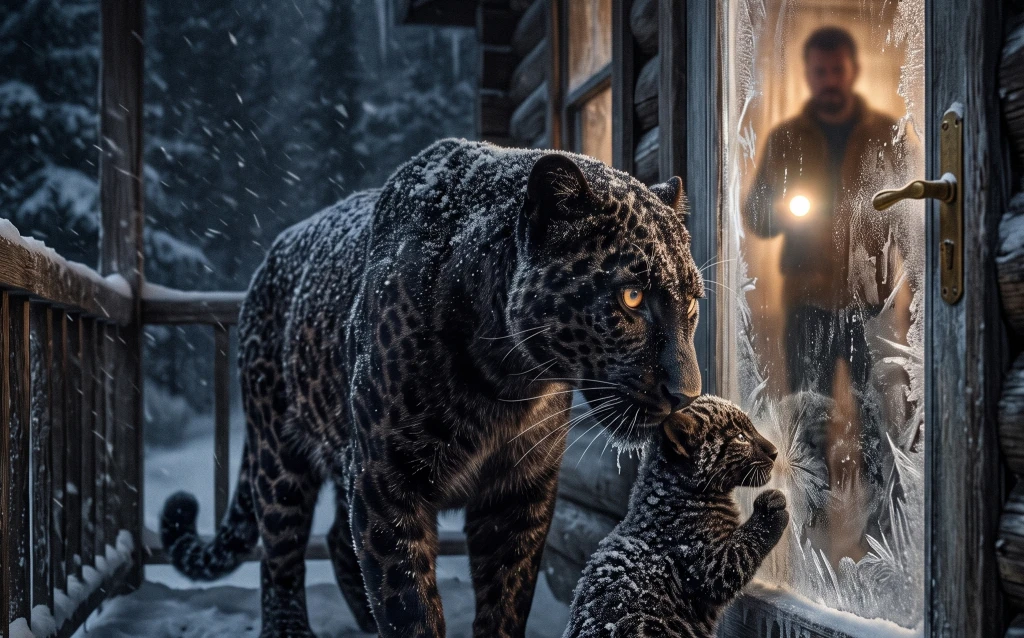
He lowered his mug of coffee before the liquid could spill across his hand. For a few seconds, he stayed in the worn armchair beside the woodstove and listened. Out here, ten miles beyond the last county road in northwestern Montana, sounds could play tricks on a man. Frost split fence posts with cracks like gunshots. Pine limbs rubbed together and made voices in the dark.
Then it came again.
Slow. Hard. Desperate.
Caleb stood with a stiffness that belonged to a man older than forty-seven. The scar along his left forearm pulled when he reached for the flashlight on the table, the old burn and claw marks tightening under the cuff of his sweater. He flexed his fingers until the ache settled back into the background, where it had lived for six years.
“Probably a half-frozen dog,” he muttered.
Even as he said it, he knew he was lying to himself. Dogs barked. Coyotes yipped. Raccoons rummaged and fled. Whatever waited outside had not made a single sound except that careful, pleading scrape.
The cabin had been built by a logger in the 1970s, back when people still believed a man could disappear into the mountains and make a life out of silence. Caleb had bought it after the fire, after the news crews stopped calling, after the agency review ended with polite language that did not say what he already knew.
Failed rescue attempt.
Unavoidable loss.
No procedural violation.
None of those words had changed the weight of the grizzly cub in his arms, or the smell of burned fur, or the sound the mother bear made when she came out of the smoke.
The scrape came a third time.
Caleb crossed the kitchen without turning on more lights. The cabin was warm near the stove and bitter everywhere else. His boots thudded softly over pine boards as he moved toward the mudroom, past the hooks where his old field jacket still hung because he had never been able to throw it out.
At the little window in the mudroom door, his reflection stared back at him first: gray in his beard, sleepless eyes, one hand braced against the doorframe. Then he lifted the flashlight.
The beam caught two yellow eyes.
Caleb stopped breathing.
A black shape stood on the covered back porch, so large it seemed to swallow the weak porch light behind it. At first his mind refused to name it. The animal was too sleek for a bear, too long for a mountain lion, too dark and impossible against the snow. Its coat was black, but not flat black. When the flashlight trembled over its shoulders, faint rosettes moved under the surface of the fur like shadows beneath water.
A black leopard.
A panther, people would have called it, though Caleb’s training knew better. A melanistic leopard, female, underweight, ribs showing with each breath. Her paws were crusted with ice. Snow clung to her whiskers. She stared directly through the glass, and there was no wild rage in her face.
Only exhaustion.
Only a terrible, intelligent urgency.
She lifted one paw and dragged her claws down the glass again.
Caleb took one step back. Every rule he had ever learned moved through him at once. Do not corner a stressed predator. Do not open a door to a dangerous animal. Do not assume an animal asking for help will understand help when a human hand reaches for it.
Then the leopard turned her head and nudged something in the drift beside her.
The something moved.
A cub lay half-buried in snow at the edge of the porch, no bigger than a house cat but built differently, with oversized paws and a heavy little head. Its black coat was dulled white with frost. One hind leg stuck at an angle Caleb did not like, and when the mother pushed her nose beneath the cub’s body, it barely responded.
Caleb’s hand fell from the doorframe.
“No,” he whispered.
The word was not for the leopard. It was for the part of himself that had already started reaching for the deadbolt.
He had come to this cabin so no living thing would need him. That had been the bargain. He would split wood, repair fences, read old paperbacks, answer his daughter’s calls when he could, and let the world save itself without him. There had been a time when people called him calm under pressure. A wildlife veterinarian who could work beside fire crews, sheriff’s deputies, and search teams without raising his voice.
That man had died somewhere in a canyon full of smoke with a cub wrapped in his jacket and a mother grizzly screaming in the trees.
The leopard scratched the glass again. Not harder this time. Weaker.
Caleb looked at the cub, then at the mother. Her eyes did not leave his face. She was trembling so subtly he would have missed it if he had not spent half his life reading animals that could not afford to show weakness.
“You understand what you’re asking?” he said softly.
The leopard’s breath fogged the glass.
Caleb unlocked the door.
The cold hit first, a hard white blade across his lungs. He pulled the door inward and stepped back, keeping his shoulders turned, hands open, flashlight lowered. The leopard did not rush him. She stood there in the blowing snow, looking from him to the space inside and back again, as if measuring whether a human house could be less dangerous than a frozen night.
“It’s all right,” Caleb said, though his voice had thinned. “I’m not coming at you.”
The mother bent and took the cub carefully by the loose skin at the back of his neck. The tenderness of it nearly undid him. She stepped over the threshold with a soundless grace that made the small mudroom feel suddenly breakable, then laid the cub on the braided rug just inside the door.
Caleb closed the door behind her.
The click of the latch sounded final.
For one suspended moment, man and leopard stood inside the same house, with six feet of air and one injured cub between them. The mother lowered herself around the cub, her body curved like a wall. Her ears stayed forward. Her tail twitched once, slow and warning.
Caleb sank to one knee.
“I used to be good at this,” he murmured.
He did not know why he said it. Maybe because the leopard was watching his face with the unnerving steadiness of an animal that had made a decision no wild creature should have had to make. Maybe because the cub’s breathing looked too shallow. Maybe because, for the first time in years, the old part of him had moved before fear could stop it.
He reached one hand toward the cub.
The mother’s lips lifted.
Caleb froze. The growl that came from her did not sound loud at first. It sounded deep, like a storm gathering under the floorboards.
“Okay,” he said. “Fair enough.”
He backed away without standing fully upright and went into the kitchen. The medical kit was not in the kitchen, of course. It was in the hall closet beneath a stack of old blankets, where he had put it after the last agency letter came. For six years, he had not touched it.
His fingers hesitated on the latches.
When he opened the kit, the smell came out first: antiseptic, gauze, plastic, field dust, and the faint ghost of smoke his memory supplied all by itself. Everything was where he had left it. Stethoscope. Syringes. Thermal blanket. Saline. Bandage rolls. Antibiotic ointment. Pain medication labeled for large mammals, still within date because some habits had survived even his surrender.
He carried the kit back with a basin of warm water and towels fresh from the dryer. The leopard watched every inch of him. Caleb set the supplies down well beyond her reach and sat on the floor, making himself smaller than instinct wanted him to be.
“Your baby’s freezing,” he said. “I need to warm him first. That’s all.”
The mother did not move.
Caleb soaked a towel in warm water, wrung it out, and extended it slowly. When she growled, he stopped. When the growl eased, he moved another inch. It took almost five minutes to cross four feet of floor.
At last, the towel touched the cub.
The mother’s whole body tightened, but she did not strike.
Caleb worked without looking directly at her for too long. Predators hated being challenged. Mothers hated being ignored. He kept his gaze soft, his hands visible, his voice low. The cub felt colder than any living animal should feel. His gums were pale. His tiny body gave a weak tremor when Caleb rubbed warmth into him.
“That’s it,” Caleb whispered. “Stay with me, little man.”
The cub made no sound.
Caleb changed towels, then wrapped the cub loosely in a dry one and slid a warmed water bottle near his belly. The mother leaned close enough that Caleb could feel her breath over his knuckles. She sniffed the bottle, the towel, Caleb’s wrist. Her nose paused at his scar.
He did not move.
The leopard inhaled once, deeply, as if reading every old fear in his skin. Then she lowered her head beside the cub and let him continue.
Only when the cub’s shivering began did Caleb allow himself to examine the leg.
The injury told its own story. A deep, torn groove above the ankle. Swelling. Tissue bruised and angry beneath the fur. Not a clean break from a fall. Not frostbite alone. Something had cinched tight around that little leg and held him there while the temperature kept falling.
A snare.
Caleb’s jaw hardened.
“So that’s what happened to you,” he said.
The mother’s eyes flicked to his face. He wondered whether she recognized anger when it was not aimed at her. He hoped she did. Because the longer he looked at that wound, the less impossible the night felt and the more human it became.
Someone had set the trap.
Someone had left it out in a killing cold.
Someone had turned a mother predator into a beggar at a stranger’s door.
Caleb cleaned the wound as carefully as he could. The cub whimpered once, the smallest broken sound, and the leopard’s head came up so fast that Caleb’s hand stopped in midair. He waited until her breathing slowed, then went back to work.
The leg needed real imaging. Surgery, maybe. Certainly antibiotics and supervised care. But there were things he could do now. Stabilize. Warm. Ease pain. Keep shock from taking the cub before morning.
He splinted the leg with padded tongue depressors from the kit, trimming and wrapping until the joint could not twist further. The cub’s breathing strengthened by degrees. A shallow inhale. A pause. Another.
Caleb found himself counting each one.
When he reached for the small vial of pain medication, the mother watched the syringe as if she understood exactly what a needle meant. Caleb drew the smallest measured dose his training allowed, checked it twice, then set the vial aside. His own hand was steady now.
That frightened him more than the leopard had.
“It’s for the pain,” he told her. “He needs it.”
The mother’s ears angled back.
Caleb looked at the cub and saw another small body against another dark floor, another frantic effort to bargain with time. The memory rose so sharply he nearly lost the room. He could feel the grizzly cub’s ribs under his palm, could hear the helicopter above the canyon, could hear someone shouting his name through smoke.
Not this one.
He slid the needle into the cub’s thigh.
The cub cried out.
The leopard came up in one black, silent surge. Her lips peeled back from teeth as long as Caleb’s fingers, and the sound that rolled out of her made the windows tremble in their frames. Caleb did not pull away. The empty syringe was still in his hand. And the mother was staring at that hand as if deciding whether to take it from him…
To read the rest of the story – CLICK the NEXT button 👇👇👇