


Noah Whitaker first noticed the tire because it moved against the weeds. From the service road behind Cedar Run Wildlife Park, it looked like something someone had dumped years ago and forgotten: a black tractor tire sunk halfway into Johnson grass, dust baked into its cracked sidewall, flies resting on the rim. The whole property had that abandoned look. A cotton-candy sign leaned sideways near the old ticket booth. Feed buckets lay bleached and split beside a padlocked gate. Somewhere inside the shuttered park, a metal roof ticked in the heat.
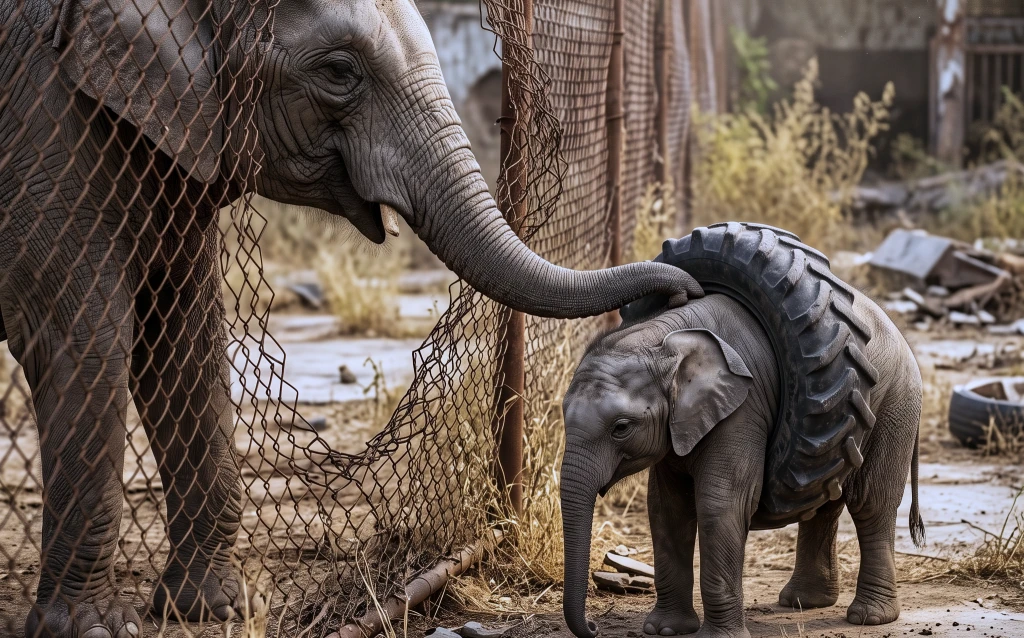
Then the tire shifted again.
Noah lowered his camera without realizing he had done it. Beyond the slats of the back gate, in a pasture that had gone dry around the edges, a young elephant stood with her head hanging low. She was small for an elephant but still too large for the word baby to feel right at first glance. Her legs were knobby, her forehead soft and unfinished, her ears too loose for her tired face. When she tried to take a step, the tire moved with her.
It was not beside her.
It was around her.
The rubber had slipped over her shoulders and settled behind her ribs, locked around the middle of her body like a black iron belt. It pressed into her sides where her belly should have rounded. Beneath it, a raw band circled her skin, swollen and dark and rubbed nearly hairless. Noah had filmed neglect cases for seventeen years, but there were certain sights the mind refused to accept quickly. This one arrived in pieces: tire, calf, wound, locked gate.
He took one step closer. The chain wrapped around the gatepost clicked under his fingers, and the calf lifted her head.
She did not bolt. She did not trumpet or swing her trunk. She simply looked at him, eyes dull with heat and caution, as if strangers had been appearing at fences for a long time and leaving with nothing changed.
“Hey, sweetheart,” Noah said, keeping his voice low. “I see you.”
The sentence was useless, but he said it anyway. He had come to Cedar Run because Heartland Animal Rescue Network had been trying for weeks to document what was left behind after the roadside park closed in early spring. The owner had blamed weather, debt, inspectors, and “online lies,” depending on who asked. The front entrance had been locked since April. The billboards along the highway still showed smiling families feeding giraffes that were no longer there.
Noah had expected thin goats, unsafe fencing, maybe a big cat pacing behind rusted chain link. He had expected sadness arranged in ways he already knew how to film.
He had not expected an elephant calf trapped inside a tire.
He pulled his phone out. One bar appeared, disappeared, then came back as if it had changed its mind. He called the rescue coordinator, turned his back just enough to shield the screen from the sun, and kept his eyes on the calf.
“Ruth, it’s Noah. I’m at the west service gate behind Cedar Run,” he said when she answered. “I need the county out here. I need a large-animal vet. Right now.”
On the other end, Ruth stopped talking to someone else. “What did you find?”
“There’s a young elephant in the back pasture. Tire around her torso. Not loose. It’s cut into her.”
A pause opened on the line. Noah could hear office noise behind Ruth, then a chair scraping.
“Do not go inside that fence,” she said.
“I’m not inside.”
“Is the mother visible?”
Noah scanned the pasture. The land dipped toward a creek bed choked with cane and cedar. A second fence cut across the back, patched in places with cable and old livestock panels. He saw no other elephant, but that meant nothing. Elephants did not need to be visible to be dangerous.
“I don’t see her.”
“Then assume she sees you,” Ruth said. “Stay outside. Keep filming. I’m calling Dr. Kline and the county judge’s office again.”
“Again?”
“They’ve had complaints. They’ve had delays. I’m done with delays.”
Noah looked at the tire, at the way the calf held herself as if breathing took planning. “Hurry,” he said.
After he hung up, the park settled back into the kind of quiet that did not feel empty. It felt watched. Heat pressed down on the pasture. The calf tried to lower her trunk toward a patch of brittle grass, but the tire stopped her from bending far enough. She touched the stems, missed the mouthful, and stood there as if deciding whether the effort was worth the pain.
Noah reached through the gap in the gate and tested the lock. There were two, one new and one rusted, both threaded through a chain wrapped twice around the post. Someone had not merely closed Cedar Run. Someone had made sure no one entered without permission.
A footstep crackled in the ditch behind him.
Noah turned fast, one hand already on the strap of his camera. A teenage girl stood in the weeds beside the service road, frozen as if she had meant to leave before being seen. She had a sunburn across her nose, mud on her boots, and a red bandanna tied around her wrist. In both hands she held a dented feed scoop, the way a person might hold a tool or a warning.
“You’re not supposed to be back here,” she said.
Noah glanced at the calf. “Neither is that tire.”
The girl’s mouth tightened. For a second she looked older than she was. Then she looked past him into the pasture, and the guarded expression on her face broke in a small, helpless way.
“You saw Poppy,” she said.
“Is that her name?”
The girl nodded. “Poppy. She was born Memorial Day weekend last year. They used to put bows on the fence and let people take pictures with her in the background.”
Noah had heard enough roadside-zoo stories to know how quickly a miracle could become inventory. “What’s your name?”
“Harper.”
“Harper, how long has that tire been on her?”
The girl pressed her thumb into the handle of the scoop until her knuckle whitened. She looked at the locked chain, not at him.
“How long?” Noah asked again.
“Since November.”
The answer seemed to take the sound out of the afternoon. November meant cold rain and frozen mud. It meant the calf had grown for months inside something that never grew with her. It meant every pound she gained had become another kind of pressure.
Noah turned back to the pasture, and for a moment he could not find a professional thought. “Who knew?”
Harper laughed once, but it was not laughter. “Everybody who still came back here. My mom called. I called. Mr. Tully called before he quit. They said the owner had a plan. They said there had to be a proper order. They said we couldn’t trespass on private property.”
“Who owns the park?”
“Dale Mercer.” She said the name quietly, with practiced caution. “He says the animals are assets until a court says otherwise. Most of the staff left when he stopped paying them. My mom still comes when she can because somebody has to feed the ones he didn’t move.”
Noah looked from Harper’s feed scoop to the calf. “And Poppy?”
Harper’s eyes filled, but she blinked hard and held it back. “She’s the reason my mom kept coming.”
The calf took a small step toward them. The tire scraped against the wound, and her front legs trembled until she froze. Noah opened a bottle of water from his backpack. Harper knelt without being asked and slid the scoop through a low gap under the gate.
“Slow,” she whispered, though whether she meant him or Poppy was not clear.
Noah poured water into the scoop. Poppy reached for it with her trunk, missed once, then found the rim. She drank carefully, not with the frantic greed of an animal that trusted help, but with the careful patience of one that had learned every good thing might be taken away if she wanted it too much.
“Does a vet ever check her?” Noah asked.
Harper shook her head. “Dr. Kline came once. Dale wouldn’t let her past the office unless somebody paid the balance from the last bill. He told her the tire was loose.”
Noah stared at the swollen ring of flesh around the calf’s middle. “That isn’t loose.”
“No.”
“How did it happen?”
Harper leaned her shoulder against the gatepost. The story came out in pieces, as if she had replayed it too many times and still could not make it make sense. “They had a fall festival. Pumpkin patch, pony rides, cider stand, all of it. Dale wanted videos of Poppy playing because people shared those clips. Somebody put tires in the elephant yard for enrichment. She crawled through one, and everyone thought it was cute until she got stuck.”
Noah looked at the tire again. “They didn’t cut it off then?”
“They tried to pull it. Poppy screamed. Her mother tore through a side fence and knocked two keepers down. Not badly, but enough to scare everyone. Dale closed the exhibit and sent the crowd home. After that, he said nobody was touching the calf unless the mother was moved first.”
“And was she moved?”
“They tried.” Harper lifted her chin toward the cedar line beyond the back fence. “Maple kept breaking back toward Poppy. She won’t leave her.”
As if the name had traveled through the dust, Poppy turned her head toward the cedars. Her ears lifted for the first time.
Noah heard nothing at first. Then a sound moved through the ground more than through the air: a deep, rolling vibration that passed under his boots and into the gate beneath his hand. Poppy answered with a small rumble, cracked and thin.
The cedar branches shifted.
A grown elephant stepped out from behind them, so quiet that her size seemed impossible. She stood on the far side of the secondary fence, gray with dust, one ear ragged at the lower edge, her eyes fixed on the calf. She did not look at Noah. She did not look at Harper. Every part of her attention was on Poppy.
“That’s Maple,” Harper whispered.
Poppy tried to move toward her mother. The first step was slow. The second pulled the tire hard against her ribs, and she stopped with a sound that made Noah’s jaw tighten. Maple came to the fence, slid her trunk through a bent place in the wire, and reached as far as she could.
Poppy stretched back.
The tips of their trunks touched.
Harper turned away and wiped her cheek with her sleeve, but Noah saw her shoulders shake. Maple moved her trunk over Poppy’s face, then down to the tire. She touched the rubber once, lightly, as if she were checking whether it had finally changed its mind. Then she made that low sound again, softer this time and worse because of it.
Noah had spent much of his career believing cameras mattered because people could ignore a report, but they had a harder time ignoring what they had seen. Standing at that fence, he was not sure his camera was enough. Maple had been showing the truth every evening to anyone who bothered to look, and still the tire remained.
A metallic clank came from the front of the property.
Harper went rigid.
Past the boarded concession stand, a dark pickup rolled into view through the heat shimmer. It stopped near the old pony ring, and the driver’s door opened before the engine cut off. The man who stepped out wore a faded cap, work boots, and the kind of anger that arrived before he did.
Harper backed toward the weeds.
Noah kept his hand on the camera.
“That’s Dale,” she whispered. “If he knows the county’s coming, he won’t wait for them.”
The pickup door slammed. Behind the fence, Maple lifted her head from Poppy’s wound and turned one dark eye toward the sound. Harper’s voice dropped to almost nothing. “Last time inspectors came, he hid her behind the equipment shed…”
To read the rest of the story – CLICK the NEXT button 👇👇👇