


The old German Shepherd had ignored every bowl of food for two days, but when a patrol car door shut outside the shelter, he lifted his head as if somebody had called him by name. Maya Collins saw it from the front desk and stopped writing mid-sentence. Kennel seventeen had been silent since Animal Services brought him in: no barking, no pacing, no begging visitors to notice him. The dog had simply lain on a folded blanket in the last run on the left, his body too thin beneath a faded black-and-tan coat, his amber eyes fixed on the entrance like he was counting every person who failed to come back.
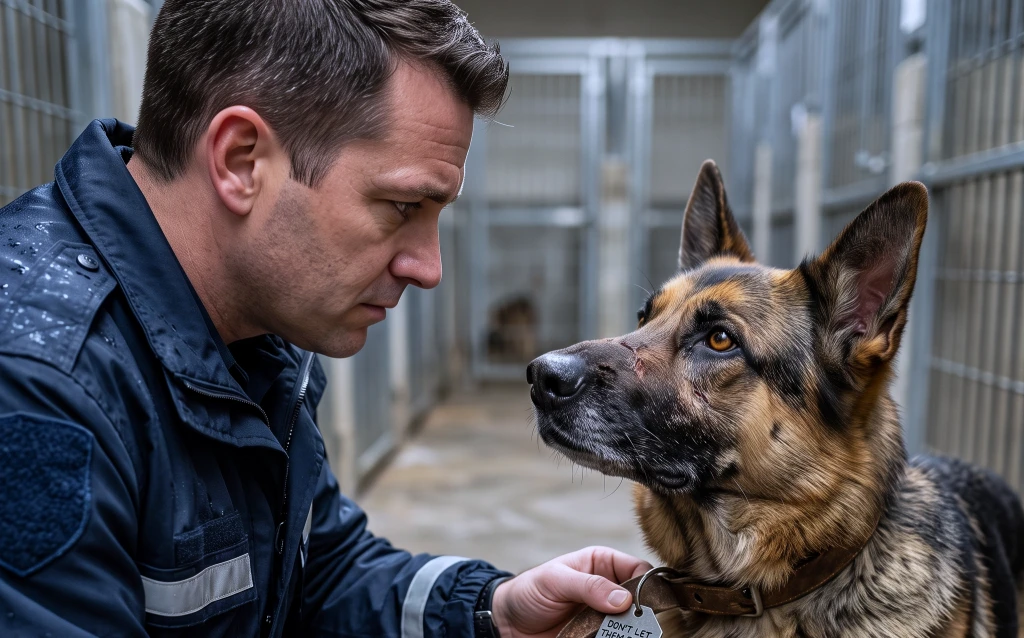
Then the front bell gave its weak metallic jingle, and the dog stood.
Not quickly. Not eagerly. He rose with the careful discipline of an animal trained not to waste motion, his back legs stiff, his ears forward, his scarred muzzle pointed toward the lobby. The other dogs erupted at the sound of boots on concrete, barking and spinning at their gates, but kennel seventeen stayed quiet. That was what made Maya’s stomach tighten.
Officer Noah Mercer stepped inside with rain on the shoulders of his uniform jacket. He was off duty—Maya knew that before she looked at the clock—because he always came on his off days. He would walk the rows, scratch a few noses through the fencing, ask which dogs were eating and which ones were scared of thunder, then leave without taking one home.
Some people came to the shelter because they wanted a pet. Noah came because grief had made his apartment too quiet.
“Morning,” Maya said, softening her voice. “You’re early.”
“Couldn’t sleep,” he answered.
He gave the same faint half-smile he had been giving for almost a year, ever since Officer Mark Delaney’s name went up on the memorial wall at the Riverton Police Department. Noah never talked about that day. Maya never asked. But she had seen him stand in front of empty kennels longer than anyone else, as if he understood the particular ache of waiting for a voice that would not come down the hall again.
Noah was halfway past the intake board when kennel seventeen’s gate rattled once.
He stopped.
Maya looked over his shoulder toward the far row. The German Shepherd had moved to the front of his run. He wasn’t wagging. He wasn’t baring his teeth. He was staring at Noah with a kind of still attention that made the barking around him seem suddenly childish.
“That’s new,” Maya murmured.
Noah turned slowly. “Who’s that?”
“We’ve been calling him Ranger,” she said. “He came in with no active ID in the county system. Retired K-9, from what we could piece together.”
Noah’s eyes changed at the word. He walked toward the kennel without asking another question, his steps measured, his hands visible at his sides. The dogs nearest him pressed against their gates, hoping for touch, but he barely noticed them. Ranger did not move away as Noah approached. He only stood straighter, the old training rising through exhaustion like memory through fog.
The chart clipped to the gate read: Senior male. German Shepherd. Retired police K-9. Caution: unknown trauma history. No bite record on intake.
Someone had added a second note in Maya’s handwriting: Refuses most food. Sleeps lightly. Watches main door.
Noah crouched several feet from the gate. He did not reach in. He did not coo or whistle or make the bright little sounds people made when they wanted animals to like them immediately. He lowered himself until he and Ranger were almost eye level, and he waited.
“Hey, buddy,” he said quietly.
Ranger’s ears twitched.
Maya folded her arms against a chill that had nothing to do with the weather. “He hasn’t done that for anybody.”
“Done what?”
“Listened.”
Noah kept his gaze on the dog. “He’s not listening. He’s deciding.”
Ranger’s eyes moved over Noah’s face, his badge, the radio clipped to his belt, the worn crease where Noah’s hand rested near his knee. There was no fear in him, but there was no trust either. He looked like an animal who had once known exactly where he belonged and had spent too long trying to understand why the world had gone silent.
Noah’s throat tightened. He knew that look better than he wanted to.
“How long has he been here?” he asked.
“Three weeks tomorrow,” Maya said. “Animal Services picked him up near the old Riverton Freight terminal on the east side. No one claimed him. We reached out through the department contact listed in an old K-9 file, but all we got back was a release form saying he wasn’t active property anymore.”
Noah looked over. “They released a retired K-9 to a county shelter?”
“That’s what the paperwork says.”
“That doesn’t make sense.”
“No,” Maya said. “It doesn’t.”
She had tried to tell herself the same thing every morning. Retired police dogs usually had handlers, families, formal placements, or at least someone from the department who cared enough to make a phone call. Ranger had arrived with a cracked leather collar, old pressure sores beneath the fur on his neck, and paws worn raw from walking on pavement. He had been hungry but too guarded to eat. Exhausted but too watchful to sleep.
Visitors noticed the words “police K-9” and stepped backward.
“He’s probably dangerous,” one man had whispered.
“My kids want a friendly dog,” a woman had said, tugging her little boy toward the puppies.
“What if he only listens to cops?” another visitor asked, already turning away.
Maya had stopped explaining after the first week. People did not want a dog with history. They wanted easy love, clean paperwork, bright eyes, a tail that promised no complications. Ranger had watched them all leave with the same calm, terrible patience.
Noah read the chart again, then looked at the untouched bowl inside the kennel. “Has a vet cleared him?”
“Physically, mostly. Underweight, stiff joints, old scars, stress. Emotionally…” Maya let the sentence go. “He wakes whenever the lobby door opens. Every single time. Like he’s expecting someone.”
Ranger shifted his weight, and something at his throat clicked softly against the gate.
Noah noticed the sound. His eyes dropped to the collar. The leather was old but not neglected. Someone had oiled it once, probably for years. The edges had softened where a hand would have grabbed it in crowds, in alleys, at training yards, at scenes where a handler needed his dog close and steady.
A flat metal tag hung beneath the buckle. It was not the polished brass kind departments ordered in bulk. This one was dull steel, uneven at the edges, as if it had been cut from something larger and filed by hand. Scratches ran across the front, deep enough that Maya had assumed the markings were just damage.
Noah leaned a little closer. Ranger did not retreat.
“Can I see that?” Noah asked, though it was not clear whether he was asking Maya or the dog.
Maya took a key from her belt but hesitated at the latch. “He hasn’t snapped at anyone, but he doesn’t like people reaching for his neck.”
Noah nodded. “Then I won’t.”
He turned back to Ranger and held his hand low, palm loose, fingers curled slightly so nothing looked like a grab. Ranger watched the hand for several long seconds. The barking in the other rows rose and fell around them, and the fluorescent lights hummed above the kennels, but the space between Noah and the dog seemed to narrow into something private.
Ranger stepped forward.
Maya drew in a quiet breath.
The dog pressed his shoulder against the gate, not affectionately, not yet, but with enough trust to bring the tag within reach. Noah moved with the care of someone handling evidence at a scene and pain in the same gesture. He did not pull the collar. He only lifted the tag between two fingers and angled it toward the strip of gray light coming through the high window.
The front had an old number. Most of it had been scratched away.
Noah turned the tag slightly. On the back, under years of wear, somebody had carved words into the steel with uneven pressure. They were small, crowded, and almost hidden beneath the scratches. Not a label. Not a phone number. Not a joke or a sentimental message.
His face went still.
Maya stepped closer. “What is it?”
Noah did not answer right away. His thumb moved once over the carving, and Ranger’s body changed. The dog’s ribs expanded on a slow breath. His ears flattened, not in fear, but in recognition, as if he had been waiting for a person to find that exact place on the collar and understand what it meant.
“Noah?” Maya whispered.
He read the words once more, making sure he had not mistaken them. Six words. Ragged, deliberate, and impossible to explain away. Don’t let them erase what happened…
To read the rest of the story – CLICK the NEXT button 👇👇👇