


The phone inside the sandwich bag lit up against Lily Hart’s wet palm with four percent battery left. She had wrapped it in three bags from her mother’s kitchen drawer and tied the whole thing shut with a purple hair elastic. It still felt damp. Everything felt damp: her pink hoodie, her socks, the rope cutting into her waist, the muddy water pressing against her legs while the current tugged at the broken dock planks behind her.
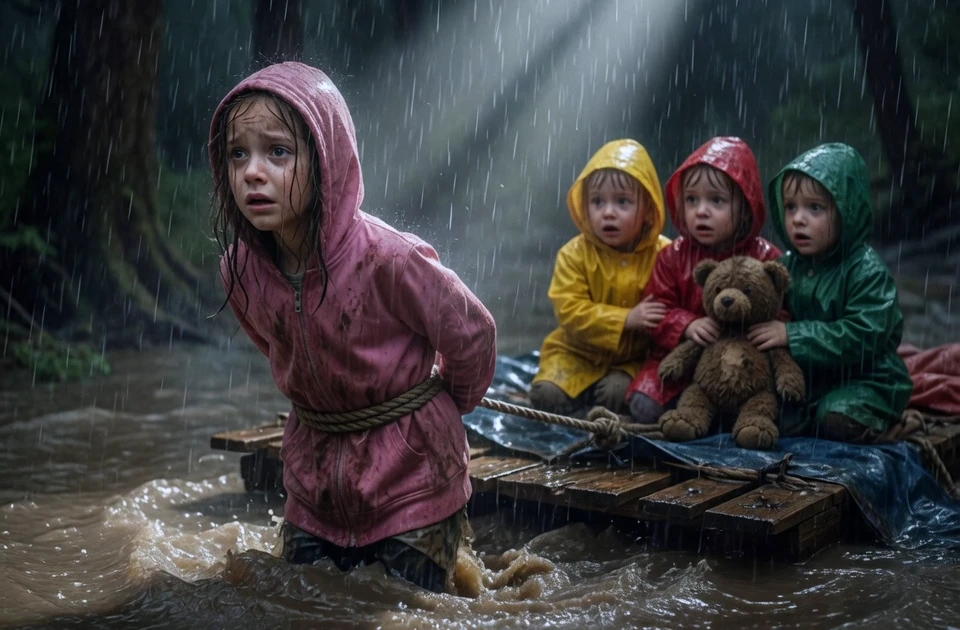
On those planks sat three two-year-olds in raincoats too bright for the darkening woods. Ben wore yellow. Mia wore red. Noah wore green. Lily had lined the planks with a torn tarp she found near an old boat launch and tied the whole thing together with rope from a maintenance shed. It wasn’t a raft the way people made them in movies. It was a desperate little island made by a seven-year-old who knew the babies would not survive long if they had to walk through the water themselves.
“Stay sitting,” she called back, trying to sound like her mother. “Hands inside. No standing.”
Mia’s lower lip trembled. Ben clutched his stuffed bear against his chest, the bear’s head soaked flat from the rain. Noah watched Lily without making a sound, which scared her more than crying would have.
Lily turned the phone sideways because her fingers were shaking too badly to swipe. She had already tried her mom twice. No answer. She had tried Travis once, even though Travis was the reason they were here, and the call had gone straight to voicemail.
The only contact left with a star beside it said: Emergency. Call if you can’t reach me.
Her mother had shown it to her one time after a bad night when Travis had punched a hole in the pantry door and then bought donuts the next morning like that fixed anything.
“If you ever can’t find me,” Emily Hart had whispered, kneeling in front of Lily so the little ones wouldn’t hear, “you press the star. You don’t wait. You don’t worry about grown-up rules. You just call.”
Lily pressed it.
Twelve miles away, Julian Mercer was in the back seat of his black town car, telling his general counsel that a four-billion-dollar acquisition did not get to die over one indemnity clause. Rain chased itself down the windows, turning Portland’s downtown lights into blurred gold ribbons. His suit jacket lay folded beside him, his tie was still knotted, and his calendar for the next three days had no empty space in it at all.
“No, Caleb,” Julian said, keeping his voice calm because calm made people move faster. “Tell them we sign Friday or we walk. They know exactly what they’re—”
A second phone rang.
Not the one in his hand. Not the business line. The small private phone in the console between the seats, the number so restricted that even his assistant had to go through security before using it.
Julian stopped speaking.
“Caleb, hold.” He reached for the phone, already bracing for news of a family emergency, a security breach, or his mother making one of her rare calls that began with polite language and ended with a demand.
He answered. “Mercer.”
For half a second, there was only rain and rushing water.
Then a child whispered, “Daddy?”
Julian sat forward. “Who is this?”
“You left us by the river,” the little girl said. Her voice was thin, strained, fighting to be brave and losing ground one syllable at a time. “The babies are cold. It’s getting dark. Please come back.”
Julian’s driver glanced at him in the mirror. Julian lifted one hand, and the driver pulled toward the curb without being told why.
“Sweetheart,” Julian said, letting the word come out slowly, carefully, “I’m not your dad. But I’m going to help you. What’s your name?”
The child’s breathing hitched. “Lily.”
“Okay, Lily. I’m Julian. Are you hurt?”
“No. I mean, I fell. But I’m okay.” There was a scraping sound, then a tiny grunt of effort. “The rope hurts but I can still pull them.”
Julian went still. “Pull who?”
“My brothers and my sister. They’re two. Ben and Mia and Noah. I made them sit on the wood because the water got too deep. Travis said we were taking a shortcut to the food pantry, but he walked away when it started raining. He saw us go the wrong way. He didn’t come back.”
Julian’s hand closed around the edge of the console. He had spent twenty years building a technology company that sold emergency coordination software to hospitals, dispatch centers, and cities. He knew the sound of real panic. He also knew when someone was too young to understand how much danger she was in.
“Lily, listen to me,” he said. “I need you to stay where you are if you can. Don’t pull them farther into the river.”
“I can’t stop,” she said, and for the first time her voice broke. “The wood keeps moving when I stop. I tied it to me.”
“Can you see anything around you? A road, a sign, a bridge, a building?”
“Trees. A big tree fell over the water. There was a sign with a bird on it before, but I can’t see it now. I can hear cars sometimes. Not close. Travis said the stores were right through the woods, but I think he lied.”
Julian lowered the phone from his ear just long enough to speak to his driver. “Riverview Preserve. North entrance. Fast.”
The driver’s eyes widened, but he pulled back into traffic.
Julian switched the call to speaker and opened a secure emergency location interface on his other phone. The private line had only a partial signal, but it was enough to give him a shifting circle near the preserve’s service road. He called 911 on the business line and gave dispatch the coordinates, his name, and the fact that four children were in moving water with possible exposure.
Then he returned fully to the child.
“Lily, you’re doing very well,” he said. “I have firefighters and paramedics coming. I’m coming too.”
“Are you sure?” she whispered.
“I’m sure.”
“My mom always comes when I call,” Lily said. “But her phone isn’t working. I think she doesn’t know.”
“Then we’ll find her after we find you.”
The answer seemed to steady her. In the background, one of the toddlers began to cry. Lily turned away from the phone and used a voice so gentle Julian had to close his eyes for a moment.
“Ben, don’t stand up. Remember pancakes? Mommy said Saturday pancakes if everyone keeps their socks on. Mia, hold Noah’s sleeve. Good girl. Noah, look at me. I’m right here.”
Seven years old, Julian thought. Seven, and already negotiating with fear like an adult.
“What color are your clothes?” he asked.
“My hoodie is pink. Ben is yellow. Mia is red. Noah is green.”
“Good. That helps. How much battery do you have?”
There was a pause. “Two percent.”
Julian saw the preserve entrance coming up ahead, a dark cut in the tree line beyond the headlights. The town car was not built for the service road, but he didn’t care. “Lily, if the phone dies, I want you to watch for a light. I’ll have a flashlight. I’ll call your name.”
“Will you be mad?”
The question landed wrong. Too small. Too practiced.
“Mad?” Julian asked.
“Travis gets mad when we make things hard.”
Julian looked out at the rain-slick road and felt something colder than anger move through him. “No. I won’t be mad. You did exactly what you were supposed to do.”
The town car jolted hard as it left pavement. His driver cursed under his breath and kept going.
Lily’s voice dropped to nearly nothing. “My legs are shaking.”
“I know. But you don’t have to be brave for much longer. Can you hear me?”
“Yes.”
“I’m close.”
The phone crackled. He heard a toddler whimper, the slap of water against wood, Lily’s sharp little breath as she pulled against the rope.
Then the line went dead.
Julian was out of the car before it fully stopped. He grabbed the emergency kit from beneath the rear seat, took the flashlight, and ran. Mud swallowed his dress shoes. Branches slapped his face and shoulders. Behind him, his driver shouted that rescue crews were two minutes out, but Julian kept moving toward the river noise.
He had walked this preserve only once, years earlier, during a Mercer Foundation ribbon-cutting where his mother had smiled for cameras and spoken about protecting natural spaces for children. He remembered a marked path, a wooden overlook, the polite applause of donors under white tents. None of that existed now. In the storm, the preserve had become black trunks, slick rocks, and water moving faster than it looked.
“Lily!” he called.
For a moment, there was only rain.
Then, from somewhere downstream, a child’s voice answered, “Here!”
Julian angled toward the sound and nearly slid down the bank. His flashlight beam swung wildly, catching wet leaves, a broken warning sign, a strip of orange rope tied around a sapling. Then he saw her.
A little girl in a soaked pink hoodie stood thigh-deep in the water, leaning backward with all her weight against a rope around her waist. Behind her, three toddlers huddled on a platform of broken planks and tarp. The makeshift raft had wedged near a fallen tree, but the current kept nudging its back corner, trying to twist it loose.
Lily saw the flashlight and stopped pulling. For one fragile second, her face showed only surprise, as if help had been something she had invented to keep the babies quiet.
Then her mouth folded in, and she began to cry without making a sound.
“I’m here,” Julian said, stepping into the water.
The cold hit above his knees and stole his breath, but he kept his eyes on the child. He moved slowly so the current would not knock him sideways. When he reached Lily, he crouched enough to put himself at her level, though the water filled his shoes and climbed his trousers.
“You got them this far,” he said. “That was you.”
“I didn’t know where else to go,” she said.
“You went toward help.” He untied the rope from her waist with fingers that had negotiated board seats and hostile takeovers but fumbled now because the knot was small and tight and made by a terrified child. “That was enough.”
The first firefighter reached the bank as Julian pulled the raft free and guided it toward shallow water. Within seconds, the woods filled with voices, lights, blankets, and the controlled urgency of people trained to move quickly without frightening children. A paramedic wrapped Lily in foil and fleece, but she twisted back toward the raft.
“The babies,” she said.
“They’re right here,” Julian told her.
“Noah doesn’t talk when he’s scared.”
“I’ll tell them.”
He did not know why she believed him, but she let him lift her. Her arms went around his neck with the exhausted trust of a child who had run out of choices. Julian carried her up the bank while firefighters carried the toddlers behind them, Ben still clutching the ruined bear, Mia crying into a paramedic’s sleeve, Noah silent and watchful beneath his green hood.
At the ambulance, Lily refused to release Julian’s hand.
The paramedic, a broad-shouldered woman named Denise, glanced at him. “Sir, family rides in front or follows behind.”
Julian looked at Lily’s white fingers wrapped around his. “Then write me down as what you need to write me down as.”
Denise studied his face for half a beat. “Get in.”
The ride to Cascade Regional Medical Center was loud with sirens and quiet with fear. Lily fought sleep in jerks, opening her eyes every few seconds to count the toddlers strapped into pediatric seats across from her. Julian counted with her each time, pointing gently.
“Ben. Mia. Noah. All here.”
“I’m supposed to keep them together,” she mumbled.
“You did.”
“My mom will be scared.”
“Then we’ll help her be less scared.”
Lily looked at him as though that was an enormous promise, bigger than he had meant it to be. Before he could soften it, her eyes closed and her grip loosened, though her fingers stayed hooked around two of his.
At the hospital, nurses took the children into adjoining treatment bays. Julian stood soaked and out of place in the pediatric emergency unit, water dripping from the hem of his pants onto the polished floor. Someone offered him scrubs. Someone else asked for his information. A police officer requested a statement. He answered what he could without taking his eyes off Lily’s curtain.
Dr. Lena Patel examined Lily first. She moved with the calm efficiency of someone who had learned that frightened children watched every adult face before deciding whether to panic. She checked Lily’s temperature, her breathing, the rope marks at her waist, the scrapes on her shins and palms.
Julian had just stepped closer to ask whether the toddlers were stable when Dr. Patel lifted Lily’s sleeve.
The doctor’s expression did not change much. It changed just enough.
Julian saw the marks before the nurse drew the curtain halfway closed. Four faint bruises above Lily’s elbow, placed in a pattern no rock, root, or fall would have made. They looked like fingers. Lily saw him see them. She pulled her arm under the blanket and whispered, “Those aren’t from tonight…”
To read the rest of the story – CLICK the NEXT button 👇👇👇