


Mason Hale saw the tire before he understood the elephant. At first, through the slats of the old service gate, it looked like another piece of trash left behind at Red Creek Wildlife Park: a black rubber ring half-buried in weeds, sun-cracked and rimmed with red Oklahoma dust. The place was full of things like that. Splintered pallets. Plastic feed buckets turned brittle from heat. A faded sign with a cartoon giraffe still smiling at cars that no longer stopped. Then the tire moved.
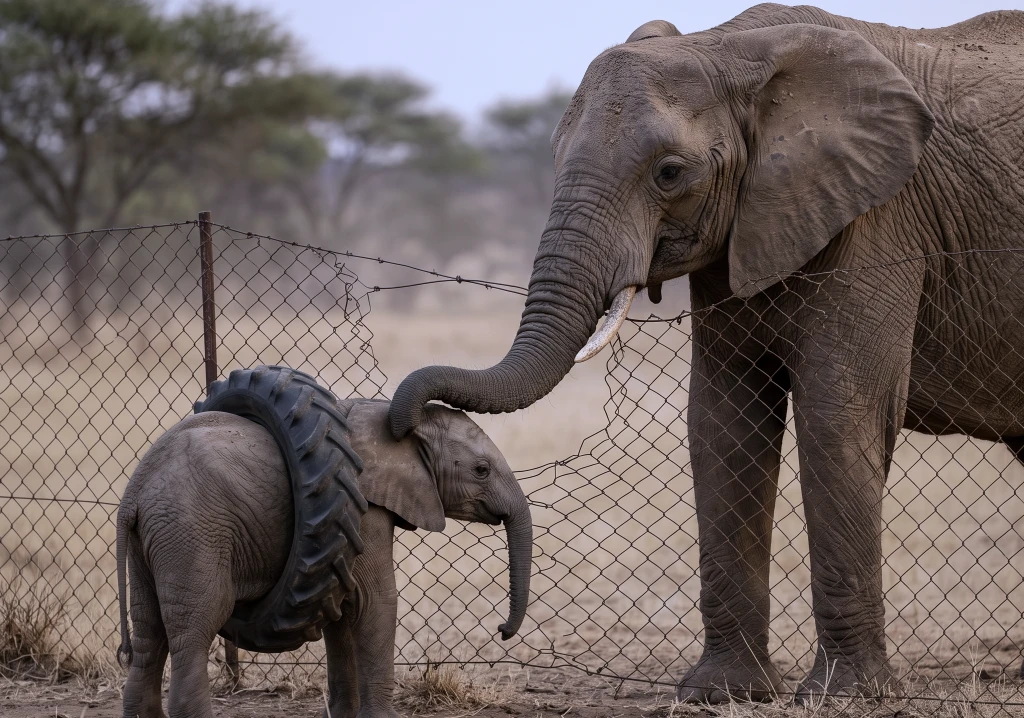
Mason lowered his camera without meaning to. Across the empty back pasture, near a patch of Johnson grass gone silver in the July sun, a young elephant stood with her head down and her ears hanging loose. She was small enough to still look unfinished, all knees and forehead and awkward grace, but her body had narrowed in ways no calf’s body should. Her shoulder blades rose like handles beneath the skin.
The tire was around her middle.
Not hanging from her neck. Not caught on one leg. It was wedged around her rib cage and belly like something she had grown through, a hard black circle biting into a body that had kept getting bigger while the rubber stayed the same.
Mason took one step closer to the gate. The old chain rattled under his hand, and the calf lifted her head.
She did not run. She did not trumpet. She only looked at him with a stillness that made him feel as if he had walked into a room where someone had been waiting too long.
“Hey,” he said quietly, though there was no reason for her to understand him. “Easy now.”
His voice sounded too human in that heat, too small against the wide, neglected acreage behind the fence. Red Creek had once been the kind of roadside animal park families passed on the way to the lake: pony rides, feed cups, a petting barn, a couple of aging elephants advertised on billboards for thirty miles. The front entrance had been locked since spring, after a run of bad inspections and unpaid bills. Mason had come because a rescue group in Tulsa had asked him for footage—proof, maybe, or pressure, depending on who had the courage to use it.
He had expected thin horses, filthy water troughs, maybe a tiger pacing himself crazy behind chain link.
He had not expected a baby elephant wearing a tire.
The calf shifted her weight. The rubber dragged against her skin with a dry scraping sound, and Mason saw the wound beneath it: a dark, raw groove where hair had vanished and the flesh had swollen around the pressure. The tire did not just sit on her. It had become part of the problem her body had learned to carry.
Mason looked toward the nearest building. The old concession stand was boarded up. A string of empty feed sacks snapped softly against a nail by the barn. No staff moved anywhere he could see.
He pulled out his phone. One bar appeared, vanished, returned. He dialed the number the Tulsa rescue coordinator had given him, then pressed the phone tight to his ear and kept his eyes on the calf.
“This is Mason Hale,” he said when the line picked up. “I’m at Red Creek, back service road, west fence. I need a large-animal vet and someone with legal authority out here now.”
The woman on the other end asked him to slow down.
“There’s an elephant calf,” he said. “She’s got a tire around her body. It’s been there long enough to cut into her.”
The line went quiet for half a second.
“Do not enter the enclosure,” the woman said. “Do not try to remove it. Is the mother nearby?”
Mason scanned the pasture. Beyond the calf, the grass dropped toward a shallow creek bed. A few cottonwoods stood still in the heat. Farther back, another fenced section disappeared behind a row of cedar trees, but he could not see movement there.
“I don’t know,” he said.
“Then stay outside the fence.”
He almost laughed, not because anything was funny, but because the instruction was so reasonable and the sight in front of him was not. He had spent twenty years filming wildlife and livestock rescues. He knew what frightened animals could do. He knew a grown elephant could fold a gate, a truck door, or a man’s ribs without effort.
Still, the calf took another short step, and the tire caught against her skin. Her knees trembled until she stopped trying to move.
“I’ll stay out,” Mason said. “Just hurry.”
After he hung up, the pasture went back to its terrible quiet. The calf lowered her trunk toward the grass, but the tire seemed to restrict how far she could bend. She nosed at the dry stems without getting much into her mouth.
Mason reached through the gate and tested the chain. Locked. A newer padlock hung beside an older rusted one, both threaded through links that had been wrapped twice around the post. Someone had not forgotten this place. Someone had made sure other people couldn’t get in.
A soft crunch came from behind him.
Mason turned quickly, one hand still on the camera strap at his shoulder. A girl stood on the service road, half-hidden by the weeds along the ditch. She looked about sixteen, maybe seventeen, with sunburned cheeks, muddy work boots, and a red bandanna tied around one wrist. She held a dented feed scoop like she had picked it up as a shield and already knew it would not help.
“You’re not supposed to be back here,” she said.
“Neither is that tire,” Mason answered.
The girl’s mouth tightened. She looked past him at the calf, and the guarded look on her face cracked just enough for him to see the grief underneath.
“You saw her,” she said.
“I saw enough.” Mason kept his voice low. “What’s your name?”
She hesitated. “Lena.”
“Lena, how long has she been like that?”
The girl rubbed one thumb over the scoop handle. She did not answer right away, and that was answer enough to make Mason’s stomach go cold.
“How long?” he asked again.
“Since last fall,” she whispered.
The words seemed to flatten the air between them.
Mason turned back to the calf. Last fall meant months of cold rain, frozen nights, spring mud, and now this punishing summer heat. It meant the calf had grown inside a fixed circle until the circle became a trap that tightened a little every week.
“That’s not possible,” he said, though he knew it was. “Somebody would’ve called.”
“I did.” Lena’s voice was small but sharp. “So did my mom. So did Mr. Parker before he quit. They said inspections take time. They said the owner had a compliance plan. They said not to trespass.”
Mason looked at the locked gate again. “Who owns this place?”
“Wes Garrison.” She said the name like it tasted bad. “He says the animals are assets, and assets don’t get touched unless a judge tells him to. He stopped paying most people in March. My mom still comes because nobody else feeds the ones left in the back pens.”
“And the calf?”
“June,” Lena said.
The name landed softly, painfully. Mason looked at the little elephant again. She was standing in weeds taller than her ankles, her thin tail flicking at flies, her trunk moving with slow exhaustion.
“Her name is June?”
“She was born the first week school let out.” Lena looked down at the feed scoop. “Back when this place was still open. Kids used to come see her. They sold little cups of sweet feed and called her the miracle baby.”
Mason had heard enough stories like that to know the shape of them. The miracle became a marketing hook. The animal grew. The money ran out. The cameras left. Then everything alive was expected to wait quietly while adults argued over paperwork.
He knelt near the gate and opened the water bottle from his backpack. The calf watched the movement but did not come closer. Mason poured a little into the feed scoop Lena held out, and she slid it through the gap beneath the gate with careful, practiced hands.
June stepped forward. The tire shifted and scraped. Her trunk reached for the scoop, missed once, then found it. She drank slowly, not greedily, as if she had learned that nothing good should be trusted too quickly.
Mason felt his throat tighten.
“Does anyone check that wound?” he asked.
Lena shook her head. “My mom tried to get close once. June cried, and Hazel came through the side fence so hard she bent a steel post.”
“Hazel?”
Lena looked toward the cedar line beyond the pasture. “Her mother.”
Mason followed her gaze. The back section of the park looked empty from where he stood, but the fence there was patched in three different places. One panel had been bowed outward, then pulled back with cable and chained to a telephone pole sunk into the dirt.
“She’s still here?” he asked.
“They moved the other elephants to the north lot after the last inspection. Hazel kept breaking away. Every time they separated them, she found a way back to this pasture.” Lena swallowed. “She doesn’t come close when people are around. Not anymore.”
The calf finished the water and kept her trunk against the empty scoop for a moment, as if remembering what water felt like. Mason reached for another bottle, but before he could open it, June turned her head toward the cedar trees.
Her ears lifted.
Lena stiffened. “Don’t move.”
At first Mason heard nothing. Then, from somewhere behind the far fence, came a low vibration that seemed to pass through the gate, through the dry ground, through his knees where he crouched. It was not loud. It was deeper than sound should be.
June answered with a thin, broken rumble.
The cedar branches shifted. A shape appeared between them, enormous and gray and impossibly quiet. A grown elephant cow stepped into view on the other side of the secondary fence, dust along her back, one ear notched at the edge, her eyes fixed on the calf.
Mason stopped breathing.
Hazel did not look at him first. She looked at June. The calf took one trembling step toward her mother, then another, but the tire caught against her ribs and forced her to stop. Hazel moved to the fence line and slid her trunk through a bent gap in the wire.
June reached back.
The tips of their trunks touched.
Lena’s face crumpled before she could hide it. “She comes every evening,” she said. “Even when June can’t get to her.”
Hazel’s trunk moved from the calf’s face to the black rubber ring around her body. She touched it once, gently, then let out another low, rolling sound.
This time Mason understood the sound for what it was. Not anger. Not warning. A mother asking the same question she had been asking for almost a year, with no one brave enough to answer…
To read the rest of the story – CLICK the NEXT button 👇👇👇