


The security camera in the maternity lobby later showed Jack Turner coming through the sliding doors at 3:18 p.m. with rain running off his face and a yellow Lab dragging him by the leash. At first, Marcus Tate thought it was just another man having a bad day at a hospital. He saw plenty of them from the security desk: fathers who forgot where they parked, sons arguing into phones, wives walking too fast because they had been told not to run. But this man was different. His shirt was crooked, one sleeve rolled higher than the other, and he held one hand against his chest as if he had to keep himself physically together.
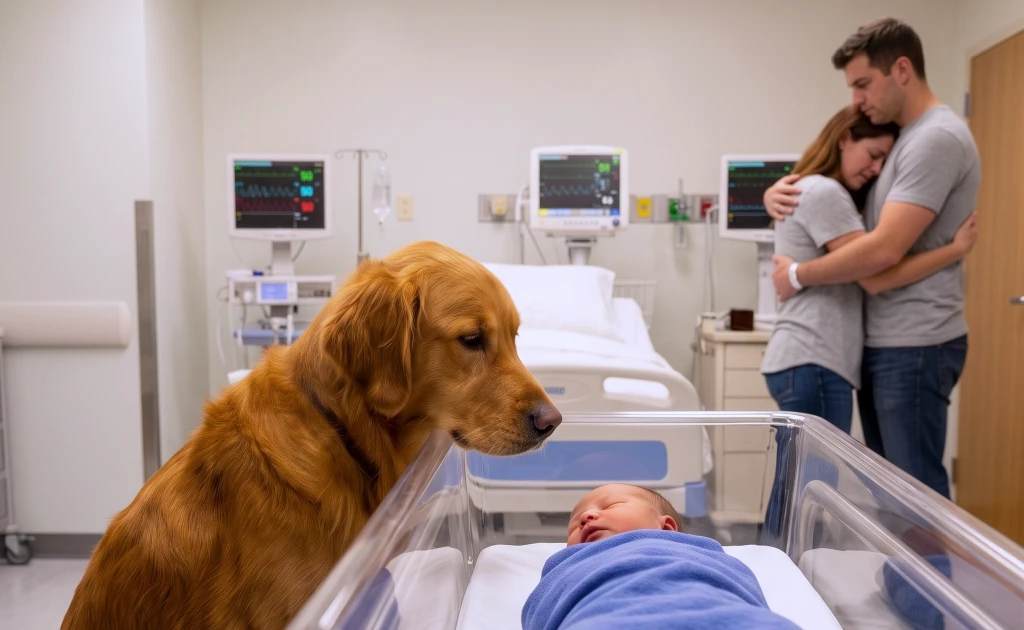
The dog looked worse and somehow steadier. Water streamed from his coat onto the polished floor, but he did not shake, bark, or sniff around like a pet that had slipped inside by mistake. He stood at the mouth of the hallway leading to labor and delivery with his ears lifted and something small and blue clenched carefully in his mouth.
“Sir,” Marcus said, already moving around the desk, “you can’t bring him in here.”
Jack did not stop until the Lab stopped for him. The dog planted all four paws, stared toward the elevators, and made a low sound that seemed to pull the air out of the lobby.
A nurse at the admissions counter turned from her computer. “No animals past this point. Sir, I need you to take him outside.”
Jack tried to answer, but only a broken breath came out first. He wiped rain from his mouth with the back of his hand and said, “My wife is upstairs.”
“We can call the floor,” the nurse said. She was calm in the practiced way hospital people learn to be calm around strangers who are seconds from falling apart. “But the dog still has to leave.”
“My son is upstairs too.”
That changed her face.
Not much. Not enough for someone across the room to notice. But Jack saw the recognition move through her before she said a word. It was in the way her gaze dropped to the visitor log, then returned to him too softly.
Turner. Emergency C-section. Bereavement room.
The baby who had not cried.
Jack felt the floor tilt. He tightened his grip on the leash, not because Boone might run, but because the leash was the only thing in his hand that belonged to the world from that morning.
The Lab’s tag clicked against his collar. BOONE.
“Mr. Turner,” the nurse said, quieter now, “I’m very sorry. But I can’t allow him upstairs.”
Boone turned his head toward Jack and gave the same low, cracked sound he had made in the kitchen before everything split open.
That morning, Emily had been standing barefoot by the stove in one of Jack’s old flannel shirts, stirring oatmeal she did not want. She was thirty-eight weeks pregnant and moving through the house with the careful dignity of a woman who had spent months being told to stay calm by people who did not know what calm cost.
Boone had been pressed against her knees.
“Jack,” she had called, not loudly, but in a tone that made him look up from the dining room table. He had been trying to install the car seat base for the second time because the little green indicator refused to sit exactly where the manual said it should.
“What’s wrong?”
“Your dog is acting possessed.”
“He’s your dog when he’s smart,” Jack said. “Mine when he’s difficult.”
“He won’t let me move.”
Jack came into the kitchen with the manual still in his hand. Boone stood broadside in front of Emily, blocking her from the doorway. His tail was low. His eyes stayed fixed on her belly, and every time she tried to step around him, he shifted with her.
“Boone,” Jack said. “Come.”
The dog did not even look at him.
Emily tried to make a joke. “Maybe he knows I was going to organize the pantry and he’s staging a protest.”
Jack smiled because she smiled, but something was wrong. Boone had been clingy through the pregnancy, especially after dark, especially when Emily woke from dreams she would not describe. This was not clingy. This was alarm.
Two years earlier, they had lost a daughter at twenty-two weeks. They had named her Lucy in the hospital, after she was gone, because Emily said she could not leave the building with her child unnamed. After that, she slept badly. Jack slept lightly. Boone came into their lives four months later, a too-thin Lab mix at a county shelter who put his head on Emily’s lap during the visit and did not take it away until she began to cry.
Now that same dog was trying to keep her from crossing her own kitchen.
Emily’s hand went to the underside of her belly. Her smile disappeared so quickly Jack felt it in his ribs.
“Jack,” she said.
Then the oatmeal spoon hit the floor.
He reached her before she dropped, but not before pain bent her forward with a sound he had never heard from her. Boone barked once, sharp enough to make Jack flinch, and began circling them as Jack lowered Emily to the tile and called 911 with fingers that would not work.
The paramedics arrived in eight minutes. Jack remembered that number later because he hated it. Eight minutes was fast. Eight minutes was forever. One of them asked about bleeding, contractions, the baby’s movement. Another checked Emily’s blood pressure while Boone tried to climb over Jack’s legs to get to her.
“No dogs in the rig,” a paramedic said when Boone lunged toward the stretcher.
Emily gripped Jack’s wrist with surprising strength. Her face was gray with pain, but her eyes were clear enough to frighten him.
“The hat,” she whispered.
“What?”
“My mom’s blue hat. Please don’t forget it.”
He nodded because people nod in emergencies, even when they have already stopped understanding language.
The hat was in the nursery, folded inside the top drawer of the dresser. Emily’s mother had bought it years before she died, back when Emily’s first pregnancy had still been an easy announcement instead of a calendar of losses. It was soft blue cotton with a tiny rolled brim, too small to look real. Emily said the baby would wear it home.
By the time the ambulance doors closed, Jack had forgotten everything except Emily’s hand slipping from his.
At Cedar Ridge Regional Medical Center, the rest of the day came in flashes. A nurse taking Emily away. A doctor saying placental abruption. Someone pushing Jack into scrubs and then pushing him back out. His own signature on forms he did not remember reading. Rain streaking the window of a family room where a coffee machine hummed like it did not know anything had happened.
At 11:56 a.m., Dr. Lila Mercer came in.
Jack knew before she spoke. He had always thought bad news arrived loudly, but it did not. It entered gently. It closed the door behind itself. It sat down before it touched you.
“Emily is stable,” Dr. Mercer said first. “She lost a significant amount of blood, but she’s with us. We’re watching her closely.”
Jack waited.
The doctor’s hands were folded in her lap. “Your son was delivered without signs of life. The team worked on him. We did everything we could.”
“No.”
“I’m so sorry.”
“No, he was moving this morning. Emily said he was moving.” Jack heard his own voice rise and hated how young he sounded. “You need to check again.”
“We did.”
“Then check again.”
Dr. Mercer did not look away. That was almost unbearable. “Jack, I am so sorry.”
The next hour had no order. Emily pale in a recovery bed. A nurse named Claire Donnelly explaining photographs and memory boxes with a gentleness that sounded like it had been built out of other people’s grief. A small white bundle in a bassinet near the wall. Ten fingers. One cheek folded softly against the blanket. A mouth that looked like Emily’s when she slept.
Their son.
They had named him Samuel in secret. Emily wanted to say it first when he was placed on her chest. Jack had laughed at her for being dramatic, then written the name in pencil inside the nursery closet, low near the baseboard, where only the two of them would know to look.
Now neither of them could say it.
Emily tried once, but the first syllable broke before it became sound. She turned her face toward the window, and Jack sat beside the bassinet with both hands hanging between his knees, staring at the place where the blue hat should have been.
His phone buzzed and buzzed until he finally stepped into the hall to answer.
It was Mrs. Kline from next door, seventy-four years old, five feet tall, and the only person Boone minded when Emily was not home.
“Jack,” she said, and her voice shook. “I wouldn’t call if I didn’t have to.”
“What happened?”
“It’s Boone. He tore the screen door. I got inside, but I can’t settle him. He keeps going upstairs and coming back down with something in his mouth.”
Jack closed his eyes.
“It’s that little blue baby hat,” she said. “He keeps putting it by the front door like he wants me to take him somewhere.”
When Jack returned to Emily’s room, Claire was adjusting a blanket that did not need adjusting. Emily looked at him for the first time in almost an hour.
“I have to go home,” Jack said.
Her face changed as if he had slapped her. “What?”
“Boone found the hat. He’s losing his mind. Mrs. Kline can’t hold him.”
“Our son is here.”
“I know.”
“Do you?”
There was no answer that would not make it worse. Jack looked at the white bundle, then at his wife, and understood that some failures happen even when every choice is impossible.
“I’ll come right back,” he said.
Emily turned away.
He went anyway.
At home, Boone was waiting on the porch with the blue hat clenched in his teeth. The screen door hung torn from one hinge. Rain had blown across the entry rug Emily had picked because it was yellow and cheerful and, she said, “harder to be sad near.”
Mrs. Kline stood with a towel in both hands, looking close to tears. “He wouldn’t let me take it from him.”
Boone walked straight to Jack and pressed the hat into his palm. Then he turned, ran to the truck, and put both front paws against the passenger door.
“No,” Jack said.
Boone barked once.
“You can’t go there.”
The dog barked again, not pleading, not angry. Insistent.
Jack stood in the rain with the hat in his fist and thought of Emily whispering, The hat. He thought of Boone blocking her in the kitchen, trying to climb into the ambulance, howling after the siren as if the whole neighborhood needed to know the humans were making a mistake.
Five minutes later, Boone was in the back seat and Jack was driving back toward Cedar Ridge with his hazards blinking in the rain.
Now Marcus Tate blocked the maternity elevators with one hand lifted. “Mr. Turner, I’m sorry. I really am. But I can’t let this dog upstairs.”
“Then write me up. Call the police. Do whatever you have to do after.”
The nurse from admissions looked at the wet blue hat in Boone’s mouth. “Please don’t make this harder.”
“It’s already harder,” Jack said, and his voice finally cracked in public. “My wife asked me for that hat. I forgot it. He didn’t.”
The elevator doors opened behind them, and Claire Donnelly stepped out. She was in her late fifties, with tired eyes, silver at her temples, and a badge turned backward from too many hurried hours. She took in Jack, Boone, the leash, the puddle spreading on the floor, and the blue hat.
“What’s happening?” she asked.
“He brought the dog,” the admissions nurse said.
Claire’s gaze stayed on Boone. “I can see that.”
“He wants to take him up.”
Jack looked at her because she had been there when Emily held Samuel. She had not tried to fill the room with words. She had simply put tissues within reach and left silence where silence belonged.
“Five minutes,” Jack said. “So Emily can see him. So he can bring her the hat. That’s all I’m asking.”
Claire rubbed one hand over her mouth. Marcus waited. The nurse at admissions crossed her arms, but not unkindly. The hospital hummed around them, indifferent and fluorescent.
“The dog stays on the leash,” Claire said at last.
“Claire,” the other nurse warned.
“He stays on the leash,” Claire repeated. “He doesn’t go near another patient. He doesn’t touch equipment. If I say he leaves, he leaves. And if anyone asks, I made the call.”
Marcus stared at her. “You sure about that?”
“No,” Claire said. “Open the elevator.”
Jack nearly lost his grip on the leash.
Boone stepped in first, the hat still in his mouth. He faced the doors and did not move as the elevator rose. Jack could hear water dripping from the dog’s coat and landing in small taps on the floor. Claire stood beside them with her shoulders squared, but he saw her hand tremble once near the badge clipped to her pocket.
On the third floor, Jack expected to lead Boone toward Emily’s recovery room.
Boone led him instead.
He passed the nurses’ station. He passed Emily’s door without slowing. Jack felt cold move up his spine.
“Boone,” he whispered. “She’s back there.”
The dog kept walking.
Claire stopped beside Jack. “Mr. Turner?”
At the end of the hall, Boone halted in front of a small room with the blinds partly drawn and a brass plaque beside the door: Family Room B. It was where they had moved Samuel after the delivery. It was where the bassinet waited beneath the low lamp, because no one had known what else to do with the body of a child whose parents were not ready to let him go.
Boone lowered the blue hat carefully onto the floor. Then he scratched once at the door. Before Jack could speak, Emily’s voice came from the other side, thin and raw from crying. “Open it…”
To read the rest of the story – CLICK the NEXT button 👇👇👇