


The dog reached the maternity elevators before the man did. A wet golden retriever mix, broad through the shoulders and trembling with purpose, crossed the lobby of Mercy Hill Regional Medical Center with a pale blue newborn cap held gently in his mouth. Rainwater ran from his fur and dotted the tile behind him. He did not look at the security desk, the coffee kiosk, the waiting families, or the volunteer who had already half-risen from her stool.
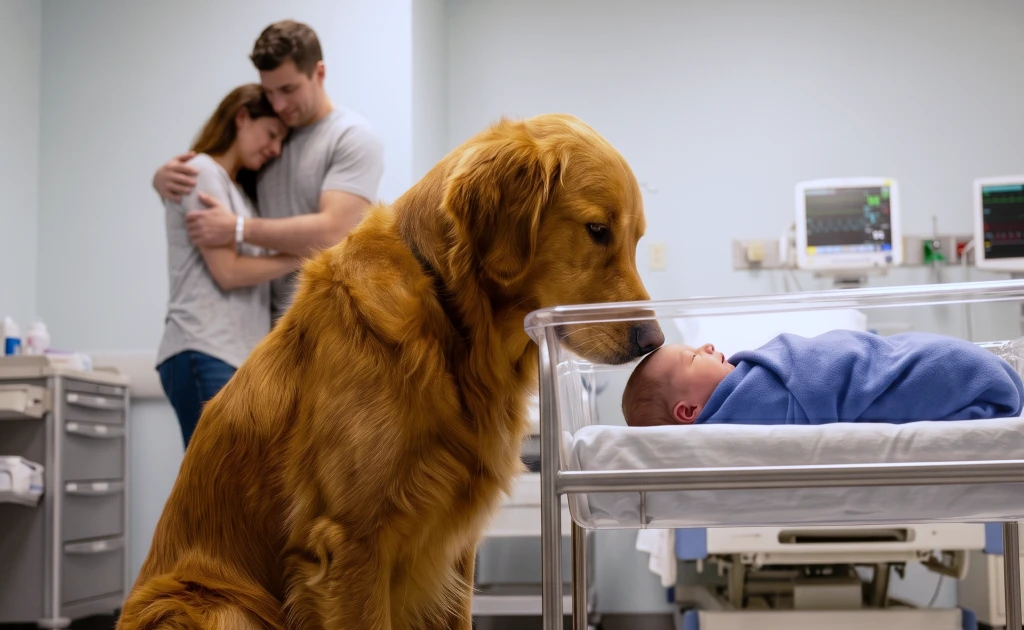
He looked only at the elevator doors.
Behind him, Ethan Whitaker stumbled through the sliding entrance with one hand wrapped around the leash and the other pressed flat against his chest, as if he were trying to hold in whatever remained of himself. His hair was soaked. His shirt had been buttoned wrong. A hospital wristband, meant for visitors, clung to his damp sleeve.
Derek Moss had worked hospital security for nine years. He had stopped arguments in the ER, chased confused patients away from ambulance bays, and talked down fathers who had parked in fire lanes because their wives were already upstairs. He knew panic when it came through the doors.
This was not panic.
This was something past it.
“Sir,” Derek called, already leaving his station, “you can’t bring a dog into maternity.”
The man heard him. Derek could tell by the way his shoulders tightened. But he did not stop until the dog stopped first, directly in front of the elevators, the little blue cap still tucked between his teeth.
A nurse at admissions pushed back from her computer. “No pets beyond the lobby. I’m sorry, but he has to go outside.”
Ethan tried to speak. His mouth moved once before sound came out. “My wife is on three.”
“We can call the unit for you,” the nurse said, glancing from him to the dog. “But the animal can’t go up.”
“My baby is on three too.”
The nurse’s face changed so slightly that Derek almost missed it. Her eyes dropped to the list clipped beside her keyboard, then returned to Ethan with a softness that did not belong in a normal conversation.
Whitaker. Emergency surgery. Quiet room.
The kind of room hospital staff used when there was no cheerful announcement to make.
Ethan saw the recognition. He tightened his grip on the leash, not because Scout was trying to run, but because the leash had become the last straight line in a day that had gone crooked before noon.
The tag on the dog’s collar clicked against the metal ring.
SCOUT.
“Mr. Whitaker,” the admissions nurse said, lowering her voice, “I’m very sorry. Truly. But I can’t let him upstairs.”
Scout made a low sound without opening his mouth. The cap stayed where it was, damp now along one folded edge. Ethan looked down at him and felt the morning come back in pieces he had been trying not to touch.
Nora had been in the kitchen at 7:42 a.m., barefoot and furious at a box of cereal.
She was thirty-eight weeks pregnant and had developed, over the past month, a hatred for anyone who told her she looked ready. Ready was a word other people used when they wanted to sound kind. Nora had been ready once before, two years earlier, and had come home from the hospital with a memory box instead of a baby.
Their daughter had been named Lily after she was already gone.
Since then, Nora had moved through pregnancy like a woman crossing a frozen pond, careful with every step and refusing to look down too long. Ethan loved her for the courage of it and hated that courage was being asked of her at all. That morning, he had been in the dining room trying to install the infant car seat base, because the latch kept clicking in a way the manual insisted it should not.
“Ethan,” Nora had called.
Her voice was not loud. It did not need to be.
He walked into the kitchen with the instruction booklet still in his hand and found Scout standing across the doorway, blocking her from leaving. His tail hung low. His ears were lifted. When Nora tried to step around him, he shifted with her, not touching her but refusing to let her pass.
“Scout,” Ethan said. “Move.”
The dog did not look at him.
Nora tried to smile. “Your son has apparently hired security.”
“He works cheap,” Ethan said, because joking was one of the ways they had survived doctors’ appointments, quiet ultrasounds, and the weeks when Nora would not let herself buy baby socks.
But the joke ended before it landed. Nora’s hand slid beneath her belly, and her face changed with a kind of surprise that frightened Ethan more than if she had cried out. Scout barked once, sharp and final, at the exact moment Nora folded forward.
The spoon she had been holding hit the floor.
Ethan caught her by one elbow and lowered her to the tile. Scout circled them, whining now, pressing in when Ethan tried to keep him back. The 911 dispatcher asked questions Ethan answered badly. Blood. Pain. How far along. Was the baby moving. He kept looking at Nora’s face, waiting for her to tell him this was not happening.
The ambulance arrived in less than ten minutes. Less than ten minutes could still be too long.
“No dogs in the ambulance,” one paramedic said when Scout lunged toward the stretcher.
Nora gripped Ethan’s wrist. Her face had gone gray, but her eyes were terribly clear. “The blue cap,” she whispered.
“What?”
“My mom’s cap. From the dresser. Please.”
He nodded. People nodded during emergencies because it looked like understanding. He had not understood anything after the front door opened and the rain came in behind the paramedics.
The cap was in the nursery, tucked in the top drawer beneath the first outfit Nora had chosen and then returned and then bought again. Her mother had knitted it the winter before she died, back when Nora’s grief over Lily was still so new that everyone around her spoke in quiet voices. Nora had once said the cap looked too small to belong to a real person. Then, at twenty weeks with this baby, she had taken it out of the drawer and whispered, “Maybe this time.”
By the time the ambulance pulled away, Ethan had forgotten the cap entirely.
At Mercy Hill, the day broke into scenes that refused to connect. A doctor saying placental abruption. A nurse handing him paper scrubs. Nora being wheeled away too fast. His own signature on forms he could not remember reading. Rain slipping down the window in the family consultation room while a coffee machine sputtered like an ordinary morning was still happening somewhere else.
At 12:09 p.m., Dr. Allison Grant came in and closed the door carefully.
She told him Nora had survived the surgery. She told him there had been significant bleeding, but they had controlled it. She said those things first, and because she said them first, Ethan knew there was another sentence waiting behind them.
“Your son was delivered without detectable signs of life,” she said.
Ethan looked at her hands. They were folded around a pen she was not using.
“We attempted resuscitation,” she continued. “The team worked on him. I am so sorry.”
“No,” Ethan said.
Dr. Grant did not look away.
“No,” he repeated, because the word was the only one his body still knew. “Nora felt him this morning. He kicked her. She told me.”
“I know.”
“Then check him again.”
“We did.”
“Do it again.”
The doctor’s face tightened, not with impatience, but with pain she could not allow to become the center of the room. “Ethan, I’m sorry.”
He saw Nora afterward in a recovery room where every sound seemed too loud. She was pale and shaking from surgery, her lips dry, one hand open on the blanket as if something had been taken from it. Beside the wall stood a bassinet with a small bundle inside.
Their son.
They had chosen the name Noah but had not told anyone. Nora wanted to say it first when he was placed on her chest. Ethan had written it in pencil on the inside of the nursery closet door, low behind a basket of blankets, because he wanted the house to know before the world did.
Nora tried once to say the name. The first sound caught in her throat. She turned her face toward the window, and Ethan stood beside the bassinet, staring at the place where the blue cap should have been.
His phone began buzzing.
He ignored it until it stopped. Then it started again.
Mrs. Alvarez from next door had watched Scout when they left. She was seventy-three, widowed, and small enough that Scout could have pulled her down the street without effort, except that he adored her and obeyed her when he obeyed no one else.
“Ethan,” she said when he answered. “I’m sorry. I tried everything.”
He stepped into the hall. “What happened?”
“Scout tore through the screen door. I got him back inside, but he won’t settle. He keeps going upstairs.”
Ethan closed his eyes.
“He brought something down,” she said. “A little blue baby hat. He keeps putting it by the front door.”
When Ethan returned to the room, Nora saw his face and knew he was about to do something she would not forgive.
“I have to go home,” he said.
Her mouth opened, but no sound came at first. Then she said, “Our son is here.”
“I know.”
“Do you?”
The words were quiet. That made them worse.
“Scout found the cap,” Ethan said. “Mrs. Alvarez can’t hold him. He’s tearing the house apart.”
Nora stared at him as if he had started speaking from another room entirely. “You’re leaving me with him?”
“I’ll come right back.”
“That isn’t an answer.”
Ethan looked at the bassinet, then at his wife, and understood that sometimes a person failed without choosing failure. He still picked up his keys. He still left.
At home, Scout was waiting on the porch in the rain, the blue cap in his mouth and the torn screen hanging loose behind him. Mrs. Alvarez stood in the doorway with a towel twisted between her hands.
“He wouldn’t let me take it,” she said. “He growled at me, Ethan. At me.”
Scout walked to Ethan, pressed the cap into his palm, and immediately turned toward the truck. He put both front paws against the passenger door and looked back.
“No,” Ethan said.
Scout barked once.
“You’re not coming.”
The dog barked again, short and certain, the same way he had barked in the kitchen before Nora collapsed. Ethan stood in the rain with the blue cap in his fist and saw the whole morning differently: Scout blocking the doorway, Scout fighting the paramedics, Scout howling after the ambulance until the siren disappeared.
Five minutes later, the dog was in the truck.
Now, in the maternity lobby, Derek Moss stepped in front of the elevator buttons. “Mr. Whitaker, I can’t let this happen.”
Ethan’s voice came out rough. “Then file whatever report you need to file.”
The admissions nurse looked at the cap, then at Scout. “Please don’t make us call someone.”
“You already called the people who tell you no,” Ethan said. “Find the one who knows when not to.”
The elevator doors opened behind Derek, and Ruth Harlan stepped out carrying a chart against her chest. She was in her late fifties, with silver threaded through dark hair and the exhausted posture of a woman who had spent too many years standing between families and the worst hour of their lives. She had been in Nora’s room earlier, saying very little and doing exactly enough.
She saw Ethan first. Then Scout. Then the cap.
“What are you doing down here?” she asked.
“He brought the dog,” the admissions nurse said.
“I see that.”
“I need five minutes,” Ethan said before anyone else could speak. “The cap belongs to Nora. Scout brought it. Let him give it to her and I’ll take him out.”
Ruth looked at the elevator, then at the dog, who had not moved away from the doors. “He stays on the leash. He doesn’t approach another patient. He doesn’t touch equipment. If I say he leaves, you leave.”
“Ruth,” Derek warned.
“I heard myself,” she said. “Push three.”
No one in the elevator spoke on the way up. Scout stood between Ethan’s knees, the blue cap back in his mouth, rain dripping from his chest to the floor in small, steady taps. Ruth kept her arms folded, but Ethan saw one hand press briefly against the pocket where her badge hung.
On the third floor, Ethan expected Scout to pull toward Nora’s recovery room.
The dog turned the other way.
“Scout,” Ethan whispered. “She’s there.”
Scout passed Nora’s door without slowing. He moved down the hall toward a smaller room at the end, where the blinds were half-closed and a brass plaque beside the door read Family Quiet Room.
It was where they had moved Noah after the surgery, because his parents were not ready to say goodbye and the hospital had nowhere else gentle enough to put him.
Scout stopped at the door, lowered the blue cap to the floor, and scratched once. Before Ethan could pull him back, Nora’s voice came from inside, thin from crying and sharp with recognition. “Open the door…”
To read the rest of the story – CLICK the NEXT button 👇👇👇