


Walter Harlan had been “broke” for less than twenty minutes when his oldest son asked whether any of the land was still free and clear. He sat at the tiny kitchen table inside a single-wide trailer on the north edge of his own farm, the September wind pressing against the aluminum siding, and held the phone to his ear while Grant talked about liquidation, debt structure, and emergency options. Outside the narrow window, six hundred acres of corn and soybeans stood gold and green under a Kansas sky. Three grain elevators rose beyond the tree line, all still his. The portfolio that his children thought had vanished was sitting untouched in accounts his attorney controlled.
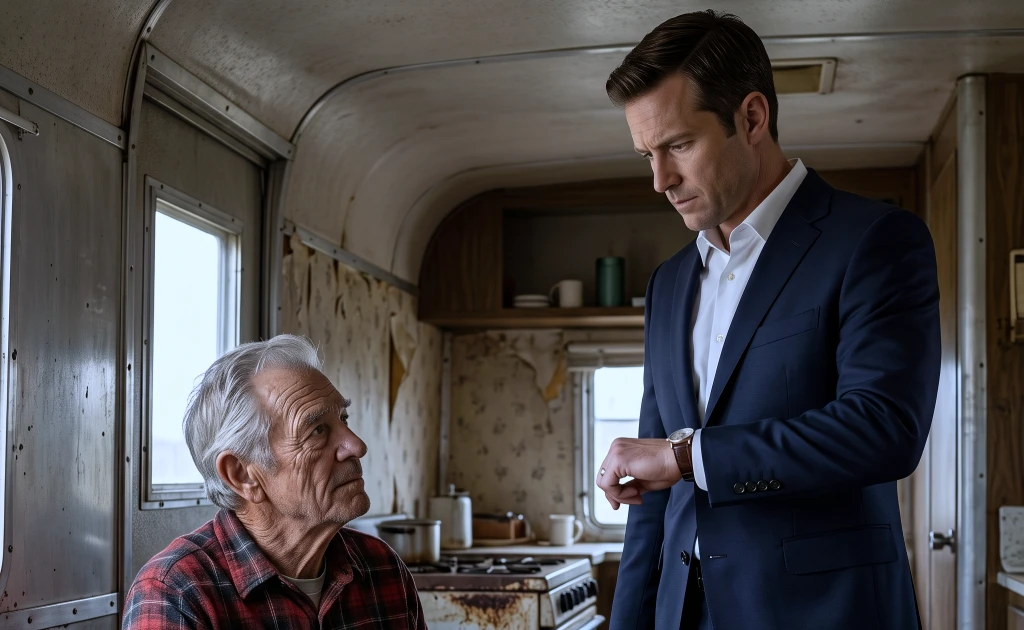
But Grant did not know that.
None of them did.
Walter looked at the photograph of Ruth propped beside the coffeemaker. His wife had been gone fourteen months, and even in the picture she seemed to know exactly what foolish thing he was doing. She wore the half smile she used whenever he made a decision before thinking through the part where people got hurt.
“Dad?” Grant said. “Are you listening?”
“I’m listening.”
“How did this happen? I told you years ago you were too exposed. Grain, land, equipment, elevators—everything tied to one sector. You should’ve diversified.”
Walter closed his eyes. He had expected anger. He had expected panic. He had not expected his first conversation as a ruined man to sound like a disappointed quarterly review.
“I know,” he said.
Grant exhaled hard. “Is there anything left to salvage?”
That was the question Walter wrote down later.
Not, Are you safe?
Not, Have you eaten?
Not, Do you need me?
Is there anything left to salvage?
For almost fifty years, Walter had believed he knew what kind of family he had built. He had started with eighty acres of tired bottomland, a leaking farmhouse, and a mortgage his father left three payments behind. Ruth had married him anyway, wearing a borrowed dress in his mother’s kitchen while twenty relatives ate sheet cake off paper plates and pretended the roof was not dripping into a bucket by the back door.
They built the place from there. Walter worked fields until his hands cracked. Ruth kept the books, learned crop insurance better than most agents, drove parts to him at midnight, and stretched grocery money so no child ever knew when things were tight. They bought the first adjoining eighty acres after six years, the second after eleven. The first elevator came when Grant was in grade school. The second came in the early nineties, the third not long after.
People in Marsh County knew Walter Harlan. They knew he paid on time, kept his word, and could tell by smell whether rain was coming before the radio said a thing. He was not rich in the flashy way people in cities used the word, but he was the kind of wealthy that made bankers stand up when he entered a room. Land. Equipment. Grain contracts. Reputation. A name that meant something.
Ruth had given him four children in that farmhouse. Grant came first, restless from the beginning, always staring toward roads that led away. Celia followed, bright and precise, the child who corrected adults and usually turned out to be right. Matt was third, quiet, grease under his fingernails by age ten, happiest when something broken could be taken apart and put back together. Hannah came last, a surprise born when Ruth was thirty-six, small and stubborn and named after Ruth’s grandmother.
Walter provided. Ruth connected.
That was the arrangement, though he would not have called it that then. He thought he was loving his family by keeping the farm alive. Ruth loved them in the ways they could feel. She called Grant after big meetings. She remembered Celia’s flights, Matt’s loan payments, Hannah’s school plays. She made Thanksgiving happen even when three people complained about the date and one arrived late. She knew who needed advice and who needed soup and who needed to be left alone for one day but not two.
Then pancreatic cancer walked into a beige exam room on a Tuesday afternoon and took nine months to finish what it had come to do.
The children came during those months, but not equally. Grant flew in twice from Kansas City, both visits tucked between obligations. Celia came from Denver for Christmas and spent half the time on conference calls in the guest room. Matt stopped by when he was near Ash Creek for parts, hovering in doorways, talking about the shop, leaving before Ruth got tired enough to ask him to stay.
Hannah drove from Manhattan almost every weekend with two children buckled in the back of her old Subaru. She sat beside Ruth’s bed and read aloud from mystery novels Ruth had already read three times. She painted her mother’s nails when Ruth’s hands got too thin. She learned the medication schedule without being asked.
Ruth died in July with corn shoulder-high outside the bedroom window.
At the funeral, two hundred people filled the little white church on County Road 8. Walter heard almost none of what the pastor said. He remembered only pieces. Grant in the parking lot speaking to a commercial developer about elevator valuations before the flowers had been loaded into cars. Celia at the fellowship hall table, flipping her phone facedown whenever someone approached. Matt near the coat rack, voice low, asking whether the life insurance paperwork had been filed yet.
Hannah found Walter in the church kitchen, standing by the sink with the water running over his hands. She turned off the faucet and took his fingers in hers. She did not say, “It’ll be okay.” Ruth had raised her better than that. She simply stood with him while people ate casseroles in the next room and waited until he could breathe again.
Afterward, the pattern hardened.
Grant called in September to suggest selling the elevators while the market was favorable. Celia missed Thanksgiving because of a client crisis in Dallas and texted three sentences with a turkey emoji at the end. Matt came by in December and, after twenty minutes of weather talk, asked Walter for fourteen thousand dollars to keep his auto shop from falling behind.
Walter wrote the check. That was what Ruth would have done.
Hannah called every Sunday evening at six. She asked whether he had gone to church, whether he was eating real meals, whether he had put fresh sheets on the bed. She told him about Ellie’s spelling test and Jonah’s obsession with naming every tractor they passed. She never asked about the will. She never asked about land. When Walter said he was fine, she said, “I don’t believe you, Dad, but I love you anyway.”
By spring, Walter had begun keeping a notebook in his shirt pocket. Dates. Calls. Visits. What each child said. What each child did not ask. At first, he told himself it was just a record. A lonely man’s habit. Then he found Ruth’s journal on the top shelf of her closet while packing her sweaters for donation.
The entry that changed him had been written three years before her diagnosis.
Ray thinks providing is the same as loving. It isn’t. The children learned his language because it was the only one he gave them. They come to him with transactions because that is how he taught them to reach him.
Walter sat on their bed for nearly an hour with the journal open on his knees.
The next morning, he drove to town and climbed the stairs above Renner Pharmacy to see Paul Renner, the attorney who had handled Harlan family matters for thirty years. Paul listened while Walter explained. The farm income would be routed through a trust account. Equipment would be moved into Hank Whitaker’s barns. Walter would leave the farmhouse locked and dark and move into the old single-wide trailer once used for seasonal workers.
Then he would call his children and tell them he had lost everything.
Paul set down his pen. “That is a terrible idea.”
“Probably.”
“They’ll hate you for it when they find out.”
“If they don’t come when they think I have nothing, their hate won’t matter much.”
Paul looked at him the way men look at storms they cannot stop. Then he pulled a legal pad closer and began making notes.
Hank Whitaker, Walter’s neighbor and oldest friend, helped him move on the last Thursday in August. Hank had farmed the land west of Walter’s since they were both young men. His late wife and Ruth had been inseparable. He carried boxes into the trailer without approving of a single one.
“Ruth would call you a stubborn old fool,” Hank said.
“She called me worse.”
“She’d be right.”
Walter set Ruth’s recipe box on the counter, then placed her framed photograph beside it. “She wrote that I taught them to talk to me in transactions. I need to know whether she was right.”
“You already know she was right about most things.”
“That’s what scares me.”
On September 1, Walter made four calls.
Grant spoke first about failure, then strategy. Celia sounded genuinely sorry for almost a minute before asking whether Walter had a plan. Matt’s voice went tight when Walter said the money was gone, and the call ended soon after Matt asked, “What about what you owe me?”
Hannah answered on the second ring.
“Hi, Dad,” she said, warm and unhurried, and for one reckless moment Walter almost stopped the whole thing.
He told her the same story. Bad crop years. Bad investments. Debt hidden too long. The farm gone. The farmhouse gone. The trailer on the north forty was all he had left for now.
Hannah listened without interrupting. He could hear some ordinary household sound behind her, running water or the dishwasher, and a child calling for help with homework.
When he finished, she did not ask about the acreage.
She did not ask what was left.
She asked, “Are you safe?”
Walter’s throat tightened. “I’m fine.”
“That’s not what I asked.”
“I’m safe.”
“Do you have food?”
“Yes.”
“Heat?”
“It’s September.”
“Dad.”
“The furnace works.”
A pause. Then Hannah said, “I’m coming Saturday. Don’t tell me not to.”
After the call ended, Walter sat beneath the buzzing trailer light and opened his notebook to a clean page. He wrote four names in a column. Beside each name, he wrote the first thing that child had said after learning their father had supposedly lost everything.
Grant: How did this happen?
Celia: Do you have a plan?
Matt: What about what you owe me?
Hannah: Are you safe?
He stared at the page until the words blurred. Then he closed the notebook and set it beside Ruth’s photograph. Outside, the last light drained from the fields he still owned. Inside, in a trailer his children believed was all he had left, Walter waited for Saturday…
To read the rest of the story – CLICK the NEXT button 👇👇👇