


The first thing Grace Bennett saw in the flooded river was the tire. It came around the bend slowly, black and swollen with muddy water, turning in the current like something the storm had pulled loose from an old farm and forgotten to drown. Grace lifted one hand to shade her eyes. For a second, she thought it was only debris from the washed-out service road above the preserve. Then the tire rolled sideways, and a baby elephant’s trunk pushed through the center of it.
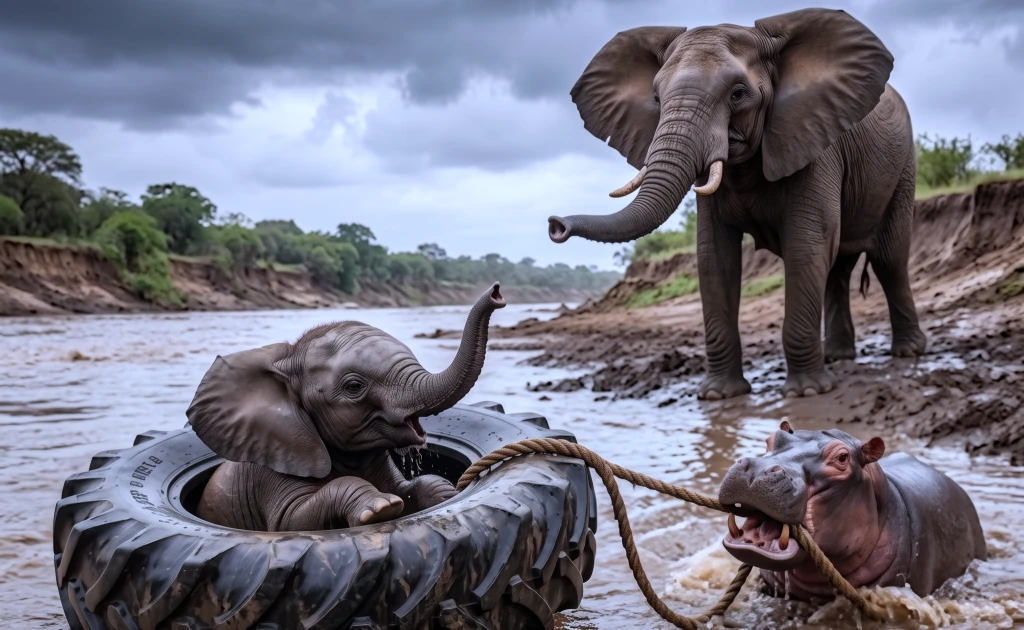
The trunk rose, searching for air, then vanished as the brown water slapped over it. On the bank, the calf’s mother screamed.
Grace dropped the radio from her hand.
Across the mudflat, the rest of the rescue team was still unloading rope, canvas straps, and the portable cutting kit from the ranger truck. No one had expected the river to rise this fast. The storm had been downgraded before dawn, the worst of it supposedly moving east toward the coast, but Cedar Bend Wildlife Preserve sat in a low bowl of Georgia pine, marsh grass, and old farmland. When the rain came hard enough, everything above them emptied into the same river.
“Mara,” Grace whispered.
She did not mean to say the calf’s name aloud. It came out anyway, small and useless under the roar of the water.
The baby elephant was eight months old, still round through the belly, still clumsy when she tried to keep up with her mother. She had been born on the preserve after Grace and the team rescued Nia, her mother, from a roadside wildlife operation that had shut down under a county investigation. Nia had arrived thin, suspicious, and pregnant, with chain scars around one ankle and a silence so complete that Grace had once wondered if the old cow would ever make a sound again.
Mara had changed that. The calf had come into the world before sunrise on a January morning, pink behind the ears and furious at the cold. Nia had touched her with the tip of her trunk and made a sound so low that Grace felt it in her ribs before she heard it.
Now that same mother stood on the bank with her ears spread wide, mud streaking her legs, her trunk stretched toward the river. Every few seconds she tried to step in. Every few seconds, one of the older females pushed against her shoulder or blocked her with a body larger than grief.
“Nia, stay back,” Tom Avery called from the slope. “Grace, don’t let her go in!”
Grace was already moving.
Tom was seventy-one and still moved through floodwater better than most younger men moved through a parking lot. He had been a ranger at Cedar Bend before it became a sanctuary, back when the land was still a failing exotic-animal park with rusty gates and weekend crowds. He knew which ground would hold, which mud would swallow a boot, and which part of the river looked shallow only because it was moving too fast to show its depth.
Grace grabbed the radio from the mud and pressed the button with a shaking thumb. “Mark, we have Mara in the main channel. She’s trapped in a tractor tire. Repeat, Mara is in the river, trapped in a tire.”
Static cracked. Then Mark Harlan’s voice came through clipped and breathless. “How far downstream?”
“Past the east bend. Moving toward the cottonwood run.”
There was a pause just long enough for Grace to imagine him looking at a map in the operations office, his finger moving from the elephant paddock to the river, then to the old maintenance road where the ground dropped sharply toward the water.
“Keep staff out of the channel,” Mark said. “Nobody goes in until we have a full assessment.”
Grace looked at the river.
Mara surfaced again. The tire had slipped around her shoulders and chest, wedging behind her front legs so that her body rode wrong in the water. Each time the current turned her, the rubber rim forced her sideways. She tried to raise her trunk, but the movement spun the tire, and the water closed over her face.
A full assessment would take ten minutes. Maybe fifteen.
Mara did not have fifteen.
“Tom,” Grace shouted. “Can we get the flat-bottom boat in below the bend?”
Tom was already unwinding rope from the truck. “Not from here. Current will shove us right into her. We need to catch her before the rock shelf.”
“How long?”
He did not answer. That was worse than any number.
Near the bank, Maya Reed stumbled down the slope with a camera strap across her chest and a coil of bright orange line over one shoulder. She was twenty-three, a summer volunteer who had shown up at Cedar Bend with a wildlife biology degree half-finished, a permanent sunburn across her nose, and a habit of noticing things older staff had learned not to see.
“What do you need?” Maya asked.
“Keep Nia back,” Grace said.
Maya looked at the elephant cow, then at Grace, as if measuring the difference between courage and stupidity.
“She won’t listen to me.”
“No,” Grace said. “But the aunties might.”
Maya ran toward the secondary fence line where two of the other adult elephants stood shifting in agitation, their trunks lifted to the river air. Grace turned back toward the water in time to see the tire strike a submerged branch. Mara’s whole body jerked. Her trunk shot up again, curled, and disappeared.
Nia screamed so hard that birds lifted from the cypress trees across the river.
Grace’s hands went cold.
She had been a veterinarian long enough to know that panic made people dangerous. Panic made them jump into floodwater, cut the wrong strap, pull too hard, wait too long, move too soon. She had taught interns to slow down in emergencies, to gather facts, to breathe before touching a frightened animal. But there was a particular sound a baby elephant made when it wanted its mother, and Grace had never learned how to hear it like a professional.
The sound came now, thin and broken above the river.
Mara was crying.
“Grace!” Tom shouted from the water’s edge. “I can get a line across if somebody anchors me.”
“You’re not going in alone.”
“I didn’t ask to go in alone.”
Before Grace could answer, Mark Harlan’s utility cart slid to a stop behind the ranger truck. He climbed out in a rain jacket that looked too clean for the morning, his phone already in his hand. Mark was not a cruel man. Grace had reminded herself of that often, especially during board meetings when he spoke about donor confidence, public perception, and operational risk as if every living thing on the preserve could be converted into a sentence in a quarterly report.
He cared about Cedar Bend. He had saved it from bankruptcy twice.
He also had a talent for standing exactly where compassion turned into liability.
“What happened?” he demanded.
Grace pointed to the river. “She must have been swept through the low gate when the service road flooded. The tire trapped her in the channel.”
Mark stared at the black rubber circle turning in the muddy water. His face lost color. “Where did the tire come from?”
Grace did not look away from Mara. “Does that matter right now?”
“It matters if there’s more debris coming down.”
“Then send someone upstream. I need the boat.”
Mark shook his head. “No one gets in that water until county rescue arrives.”
“County rescue is twenty minutes out at best.”
“Then we keep visual contact and prepare from shore.”
Tom turned on him. “Prepare? That calf will be dead by the rock shelf.”
Mark’s jaw tightened. “And if one of my staff drowns trying to reach her, what then?”
Grace knew that sentence was reasonable. That was the worst part. Floodwater killed people every year who thought they had one good reason to step in. No animal, no matter how loved, made physics kinder. But reason could also become a locked gate you stood behind while something helpless died in front of you.
Mara’s head bobbed up again. This time the tire spun her so that her back faced the bank. Her trunk slapped the water, rose, failed to find open air, and folded.
Nia lunged forward.
The other elephants moved before any human could. Ruthie, the oldest female, stepped across Nia’s path and pressed her shoulder into the younger cow with a force that shook mud from both of them. Nia shoved back, trumpeting, but Ruthie held. On the far side, another female blocked the slope. They were not calm. Their ears trembled. Their trunks kept reaching toward the calf. But they understood the bank better than Nia did.
They understood that a mother could die trying to save her baby and still not save her.
Grace swallowed hard and looked toward the bend. “Tom, where’s the nearest place the water slows?”
“Old ferry cut,” he said. “If she reaches it.”
Mark turned sharply. “The ferry cut is inside the hippo lagoon perimeter.”
“I know where it is,” Tom said.
“We are not opening that fence during a flood.”
Grace followed Tom’s gaze downstream. The old ferry cut was a wide, shallow side channel that had once served as a livestock crossing decades before Cedar Bend existed. The sanctuary had later fenced the area into part of the hippo lagoon because the bottom was firm there, a rare shelf of packed sand and clay where the river spread and slowed before narrowing again.
The lagoon belonged to Kito.
Grace had not thought of him in the first frantic seconds after seeing Mara in the tire. Now, as she looked toward the reeds below the bend, a different kind of fear moved through her. Kito was not full-grown, but no one at Cedar Bend mistook him for harmless. At three years old, he was already larger than a small car, all muscle, jaw, and unpredictable teenage strength. He had been hand-raised after his mother died during transport from a shuttered roadside zoo in Alabama, but hand-raised did not mean tame. It meant he tolerated familiar voices until he chose not to.
“Kito’s in the lower water,” Mark said. “That area is closed.”
Tom kept tying knots. “Then he’s already part of the problem.”
“No,” Grace said quietly.
Both men looked at her.
In the river below the reeds, something dark surfaced.
At first it looked like another piece of storm debris. Then two small ears broke the water, followed by a pair of eyes and wide nostrils shining with mud. The head drifted in place, barely visible in the brown current, watching the black tire turn.
Maya stopped halfway down the slope. “Is that—”
“Kito,” Grace said.
The young hippo sank without a splash.
Mark swore under his breath. “Everybody back from the water. Now.”
But Grace did not move. She had seen where Kito had surfaced. Not beside Mara. Not in front of her. Below her.
He had placed himself downstream.
The tire rolled again, and Mara’s trunk shot through the center, shaking, desperate, reaching for air. Nia cried from the bank, and the sound traveled low across the water. In the side channel, the reeds parted once, then went still.
Grace stepped closer to the river’s edge.
“No one taught him that,” Tom said.
Grace felt the truth of it before she could speak.
No one had taught Kito to come when Mara called. No one had taught him to move below a trapped calf in floodwater. No one had taught him to remember the baby elephant who used to stretch her trunk through the fence and offer him stolen bundles of hay when they were both small enough to believe the world was made of safe water and patient hands. The tire turned toward the ferry cut. And beneath the surface, something large began moving against the current…
To read the rest of the story – CLICK the NEXT button 👇👇👇