


The bobcat came to Owen Keller’s porch just after dark with a kitten hanging from her mouth. At first, Owen thought the small shape was a rabbit. Then the porch light caught the limp little paws, the spotted fur pasted down with dirt, the tiny head tucked beneath the mother’s jaw, and he stopped with one hand still on the screen door. The bobcat stood at the bottom step, breathing hard.
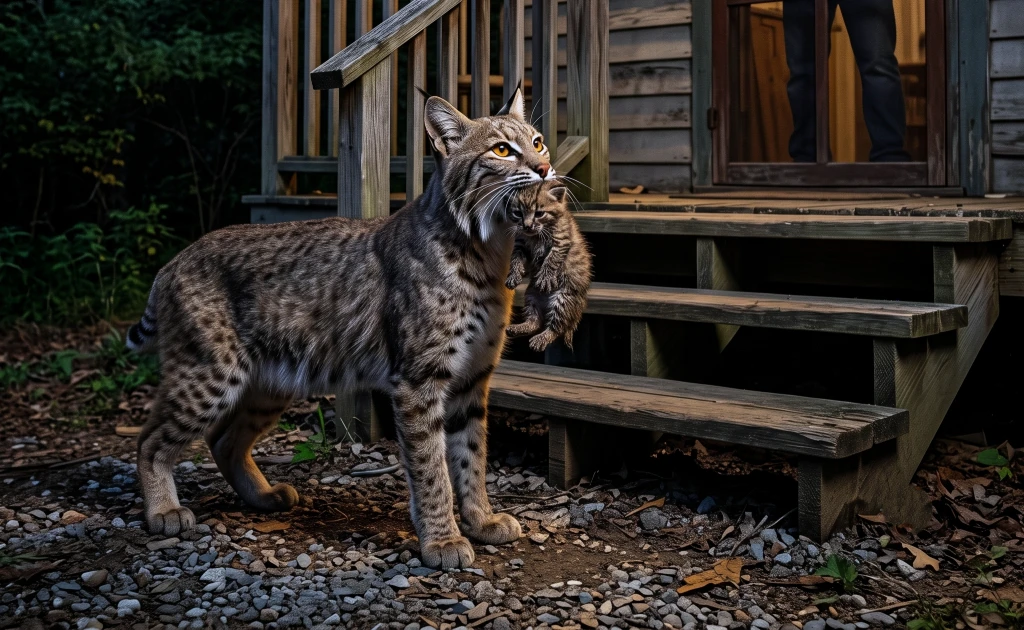
She had been coming around his place for nearly a month, always at the same cautious hour, always keeping the same careful distance. Owen lived alone in a small cedar-sided cabin outside Pine Creek, Arizona, where the roads thinned into gravel and the ponderosas pressed close enough to tap against the gutters during windstorms. He knew better than to make a wild animal comfortable near a house. He knew every rule, every warning, every stern lecture he would have given somebody else.
But the first time he saw her ribs under that tawny coat, after a late spring cold snap had taken down half the small game on the ridge, he had left a shallow pan of water near the woodpile. Then, a few nights later, a small dish of chicken scraps. He told himself it was temporary. He told himself he wasn’t feeding her so much as helping her make it through a bad stretch.
She never came close enough for him to believe she trusted him.
Until that night.
The kitten moved once, barely. A small shudder passed through its body, so faint Owen might have missed it if he had blinked. The mother lowered her head and set the kitten on the second step with a care that made his chest go tight. Then she backed away, not far, just enough to show him the little one and keep herself between the porch and the dark tree line.
Owen did not open the door right away. He stood very still, his pulse beating at the base of his throat, while the bobcat watched him with eyes the color of old honey.
“Oh, girl,” he said softly through the screen. “What happened to you?”
The mother’s ears flicked. Her body remained angled toward the woods, but her eyes never left his face. She looked wild, exhausted, and furious with fear. Burrs clung to the fur along her flank. One front leg trembled whenever she put weight on it. Her whiskers were dusted with pale dirt, the kind that came from dry washes and crumbling foundations.
The kitten made another sound, more breath than cry.
That broke Owen loose.
He eased the door open slowly, keeping his shoulders low and his hands visible. Years earlier, before Rachel got sick, he had worked weekends as a volunteer driver for Rim Country Wildlife Rescue. He had transported orphaned owls in cardboard carriers, wrapped stunned hawks in towels, and once sat in a gas station parking lot at 2:00 a.m. with a dehydrated fox kit under his jacket while Rachel talked him through the whole thing over speakerphone. He had not touched the rescue supplies since the winter she died.
Now, as he stepped onto the porch, his hands remembered before the rest of him did.
The mother bobcat stiffened, but she did not run. Her lips did not curl. She did not growl. She only watched him approach the kitten with a tension so fierce it seemed to pull the air tight between them.
“I’m not going to take her from you,” Owen murmured. “I’m just going to warm her up.”
The kitten lay on its side, no bigger than his palm, its fur marked with soft dark spots and streaks of mud. There were scratches across one shoulder and a faint swelling near the ribs. Not a bite, Owen thought. Not clean punctures. Scrapes. Pressure marks. The kind of injuries something got when the world collapsed around it.
He slipped one hand beneath the tiny body and felt how cold it was.
The mother bobcat made a low, broken sound.
Owen looked up. “I know,” he said, though of course he did not. Not fully. Not in the way she did.
He backed into the cabin, leaving the door open behind him. The mother did not follow, but she came up one step, then another, stopping just outside the threshold while Owen lined a laundry basket with a fleece blanket and tucked a warm water bottle beneath one side. He checked the kitten’s breathing, then laid it gently in the hollow of the blanket where heat could reach without overwhelming it.
The little thing stirred. Its mouth opened. A thin, rasping squeak came out.
The bobcat mother stood at the doorway and listened.
Owen saw something pass through her body then, a loosening so slight most people would have missed it. Not relief. Not yet. But recognition that the sound meant life.
He reached for his phone on the counter and started to call Dr. Mara Ellis at the rescue center, then stopped when the mother’s head snapped toward the woods. Her entire body changed. In one instant, she was not the desperate animal at his porch, but a blade of attention, ears forward, shoulders gathered, nose testing the air.
“What is it?” Owen whispered.
The bobcat turned and vanished.
He stood there with the phone in his hand, listening. The cabin held its breath around him. The heater clicked on. Somewhere inside the laundry basket, the kitten dragged in another frail breath. Outside, the woods had gone too quiet.
Pine Creek nights were never silent. There was always something: a coyote’s wavering call from the lower wash, an owl in the junipers, mice in the dry grass, elk moving down from the ridge. But beyond his porch, every living thing seemed to be holding still.
Then brush cracked.
Owen moved to the doorway just as the mother emerged again.
This time she was empty-mouthed.
She came up the steps with no hesitation, stopped near the threshold, and looked from Owen to the tree line. Then she turned around and took several steps back toward the darkness. At the edge of the porch light, she paused and glanced over her shoulder.
Owen had seen animals do plenty of strange things under stress. He had seen deer run toward roads, dogs refuse to leave burned houses, hawks crash through windows after prey. But this was not confusion. The bobcat was not fleeing, not hiding, not circling in panic.
She was asking him to follow.
Owen looked at the kitten in the basket. Leaving it alone felt wrong, but the little one had warmth now, and the mother’s urgency made the choice for him. He grabbed the heavy flashlight from the hook beside the door, pulled on his boots, and took the old canvas field coat from the chair. The coat still had a folded towel in one pocket from the last transport he and Rachel had made together.
His hand rested on that pocket for half a second too long.
Then the bobcat gave a short, sharp chirr from the yard.
“I’m coming,” he said.
The moment Owen stepped off the porch, the mother moved ahead of him, keeping just inside the reach of the flashlight beam. She did not run. She did not wait either. She paced herself like an animal measuring another creature’s weakness, making sure he could keep up while hating every second of delay.
They passed the water tank, the split-rail fence, and the place where the gravel drive turned toward the county road. The moon had not risen yet, and the forest beyond the cabin was a dark wall of trunks and low branches. Owen followed a narrow path he mostly used to check the back fence after storms, his boots slipping on loose needles.
After fifty yards, he saw the first sign.
A patch of earth had been torn open beside a fallen log, the duff scraped to bare soil. Beside it, a broken sapling leaned at an unnatural angle. Owen crouched and swept the flashlight over the ground. Small pawprints crossed and recrossed in frantic loops. Bigger tracks pressed over them, wide and deep, with claw marks gouged ahead of the pads.
Owen’s mouth went dry.
“Bear,” he said under his breath.
The mother bobcat did not look back. She moved toward the old pump shed that sat beyond the property line, a half-collapsed structure left from a cattle lease long before Owen bought the cabin. He had meant to tear it down for years. The roof sagged at one corner. Rusted tin peeled away from the side. Pack rats had claimed the walls, and storm runoff had carved gullies beneath the foundation.
Tonight, the shed looked as if something had tried to open it from the outside.
Boards were split near the base. One wall had been shoved inward, leaving jagged ribs of wood pointing into the dark. Dry leaves, moss, and shredded strips of bark were scattered across the dirt, not randomly, but in the broken pattern of a nest ripped apart.
Owen took one step closer and saw the fur.
Small tufts. Spotted. Soft.
The mother bobcat stood beside the ruined wall, her sides heaving. She lowered her head to the ground where the nest had been and made a sound so low and raw Owen felt it in his sternum.
This had been her den.
He had been feeding a mother, not a stray. A mother who had hidden her babies in an abandoned shed, close enough to his porch to watch his house, far enough to believe she had kept them safe. Something big had found the den. Something strong enough to rip through the wall and scatter everything she had carried into that place.
Owen turned the flashlight across the wreckage, his mind moving faster than his breath. One kitten was in the cabin. The mother was here, alive, hurt but standing. That meant there might be others.
The bobcat moved around the back of the shed, then stopped beside a gap under the foundation. She crouched and pushed her nose toward the darkness. Her injured leg trembled under her weight.
Owen knelt beside her, careful to stay out of striking distance. “Is one in there?”
For a moment, the only sound was the dry whisper of wind through ponderosa needles. Then, from under the ruined floor, another kitten answered with a thin, splintered cry. The mother pressed her nose to the gap and looked back at Owen. In that look, the whole forest seemed to narrow to one question. Can you reach what I can’t…
To read the rest of the story – CLICK the NEXT button 👇👇👇