


Judge Thomas Avery had already uncapped his pen when the little girl stood up. She was in the second row behind the defense table, wearing a blue cardigan too thin for the courthouse air-conditioning and sneakers with silver stars on the sides. Her feet barely touched the floor when she sat, but when she rose, every head in Courtroom 4 turned as if someone had dropped glass on the tile.
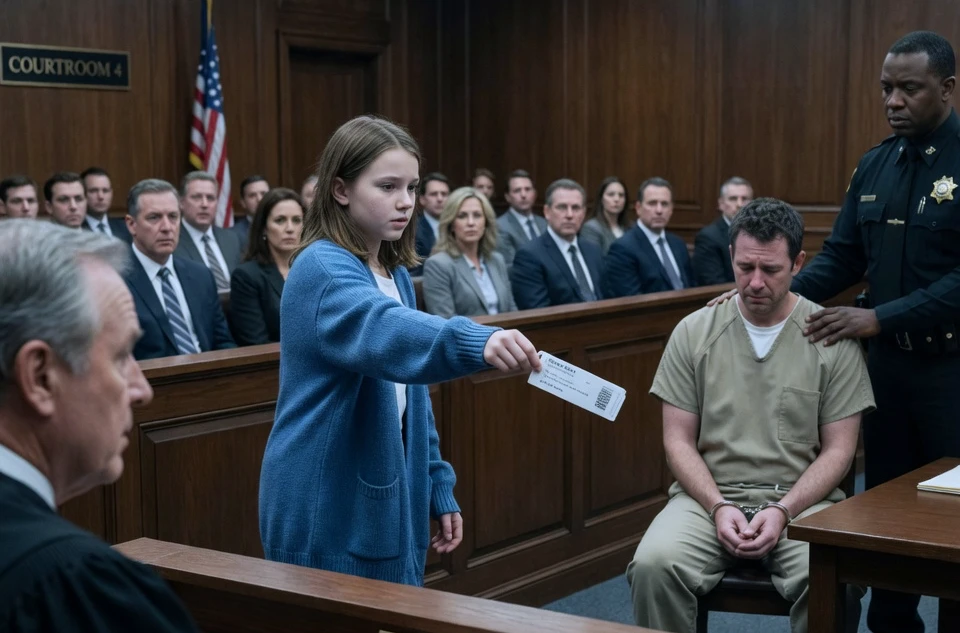
“Please don’t send my dad away,” she said.
Her father, Ryan Mercer, shut his eyes. The deputy beside him shifted his hand toward Ryan’s shoulder, not roughly, but with the practiced warning of a man who had seen grief turn into disorder too many times.
“Maddie,” Ryan whispered. “Honey, sit down.”
But Maddie Mercer did not sit. She looked straight at the judge, at the black robe, at the silver hair, at the wheelchair positioned behind the bench where everyone pretended not to notice it.
“You can stand again,” she said. “I know you can. But first you have to stand for the truth.”
A hard little laugh came from the back of the room. Somebody muttered, “This ought to be good,” and another person shushed him too late. The prosecutor, Assistant District Attorney Evan Pierce, rose with a look of offended patience, the way adults look when a child has interrupted something they have already decided is important.
“Your Honor,” Pierce said, “the state asks that the child be removed. We are here for sentencing. This has already been tried.”
Judge Avery did not answer immediately. He looked down at the papers in front of him, then at Ryan Mercer, who stood in county-issue khaki with his hands cuffed at the waist. Ryan had been convicted three weeks earlier of stealing nearly $400,000 from Crestline Capital, a private investment firm where he had worked as a senior accounts analyst. The state’s case had been clean, technical, and cold: login records, access times, bank transfers, company security reports.
Too clean, his defense attorney had said.
Too late, the jury had answered.
“Maddie,” Ryan said again, softer this time. His voice carried more fear than embarrassment. “Please. You don’t have to do this for me.”
Maddie’s chin trembled, but she kept facing the bench. She was ten years old, though there were moments in the past four months when Ryan thought the case had stolen two years from her face. She had learned the words arraignment, evidence, plea deal, and sentencing before she had learned long division well enough to do it without counting on her fingers.
Judge Avery folded his hands over the file. “Young lady, this is a courtroom. It is not the place for promises about things you don’t understand.”
“I do understand,” Maddie said. “Everybody said my dad did something because a computer said so. But computers don’t tuck you into a hospital bed. Computers don’t sing when you’re scared.”
The defense attorney, Claire Donovan, turned sharply in her chair. It was the first movement she had made in several minutes that did not look defeated.
Pierce let out a controlled breath. “Your Honor, this is exactly why this interruption should not be indulged. The child is frightened, and understandably so. But the verdict—”
“The verdict was wrong,” Maddie said.
A murmur went across the courtroom, not loud enough to stop anything, but loud enough to change the air. Ryan looked as if each word from his daughter cost him something physical.
Judge Avery’s eyes narrowed. He had been on the bench for eighteen years, and for the last six he had presided from that chair. There were stories about the crash that had broken his spine and ended the corruption investigation he had been leading as a county prosecutor. Some people said it made him harder. Some said it made him fairer. Most lawyers simply knew not to waste his time.
“Miss Mercer,” he said, “you have thirty seconds to explain why I should not ask the bailiff to take you back to your seat.”
Maddie swallowed. Then she reached into the pocket of her cardigan and took out a folded hospital bracelet, creased from being handled too often.
“My dad was with me that night.”
Claire was fully on her feet now. “Your Honor—”
“Let her answer,” the judge said.
Maddie gripped the bracelet with both hands. “The night they said he used the computer at work, I was at St. Anne’s Children’s Center. I had a breathing attack. My chest hurt so bad I thought I was going to die. Dad took me to the emergency room after midnight, and they admitted me upstairs.”
Ryan bowed his head.
“He didn’t leave,” Maddie said. “Not once. He slept in the chair with his coat over his knees. Nurse Tess gave him coffee, but he didn’t drink it because he said he needed both hands in case I woke up. He signed papers. There were cameras. There was a wristband. There was a room number.”
Pierce’s expression changed only slightly, but Judge Avery noticed it. A tightening at the jaw. A glance down, not at his notes, but at the second chair behind the state’s table, where Detective Frank Holloway sat with his arms folded.
Claire Donovan stepped toward the bench. “Your Honor, if this is accurate, it goes directly to the state’s timeline. The prosecution argued that Mr. Mercer accessed his workstation at Crestline at 2:14 a.m. and initiated the transfers from inside the company network. They made physical access a core part of their case.”
Pierce shook his head. “The defendant’s credentials were used. Remote access was also discussed.”
“It was dismissed by your own expert,” Claire said. “He testified that the transfer sequence began from Mr. Mercer’s office terminal.”
Judge Avery looked at Pierce. “Did the state investigate this hospital visit?”
Pierce opened his file. The movement was controlled, but slower than before. “Your Honor, I’m not aware of any substantiated alibi. If the defense had one, it should have been presented before trial.”
“We tried,” Ryan said.
Claire turned to him quickly, but Ryan had already lifted his head. His voice was hoarse, not from shouting, but from months of not being believed.
“I told Detective Holloway,” Ryan said. “I told him the morning they brought me in. I told my first lawyer. I told everybody. They said the timestamps mattered more.”
Detective Holloway’s face did not move.
Judge Avery glanced at the bracelet in Maddie’s hand. “What was the room?”
“Four-twelve,” Maddie said. “Pediatric observation. My nurse was Tess Miller. Her real name is Teresa, but she told me I could call her Tess because I was scared.”
The judge looked to the clerk. “Contact St. Anne’s Children’s Center. I want admission records for Madeline Mercer for the night of April 16. Visitor logs, security verification, nursing notes, any consent forms signed by Ryan Mercer, and any statement provided to law enforcement.”
Pierce straightened. “Your Honor, with respect, we are in a sentencing hearing. The court cannot reopen a trial based on a child’s memory and a bracelet.”
Judge Avery’s hand rested on the wheel of his chair. For a moment, the old pain in his lower back made his mouth tighten. It came when weather changed, when hearings ran long, when someone in front of him mistook procedure for justice.
“The court can postpone sentencing,” he said. “The court can also inquire into a potential failure of disclosure before it imposes a prison term on a man who may have been elsewhere when the crime occurred.”
Pierce’s cheeks colored. “There is no evidence of misconduct.”
“Then the records will relieve your concern.”
The bailiff stepped toward Maddie. She flinched at first, but he only bent slightly and said, “Come on, sweetheart. Let’s get you some water.”
“I don’t want to leave him,” she said.
Ryan made a sound under his breath. Claire reached back and squeezed his forearm, a reminder that he could not cross the room with cuffs on.
Judge Avery watched the child’s fingers close tighter around the hospital bracelet. “She may sit with Ms. Donovan at counsel table until the records arrive. No one is removing her from this courtroom unless she becomes disruptive again.”
Pierce sat down. Holloway leaned back in his chair, his mouth flattening into a line.
Maddie walked to the defense table and stood beside her father. Because his hands were cuffed, Ryan could not hug her. He lowered his head until his forehead touched her hair.
“I’m sorry,” he whispered.
“You told me truth leaves tracks,” Maddie whispered back. “I remembered.”
The recess lasted forty-seven minutes. Long enough for people in the gallery to check their phones, for two reporters to hurry into the hallway, for Pierce to make three calls with his back turned, and for Judge Avery to sit alone in chambers staring at the framed photograph on the side table.
In it, he was standing on the courthouse steps twelve years earlier, younger and broader, with a stack of files tucked under one arm. The photograph had been taken two weeks before the crash on County Road 6. Two weeks before the investigation he had been building into public contracts and shell companies disappeared into sealed storage. Two weeks before doctors told him that walking again was possible but unlikely, then later changed that to possible with years of therapy, then finally stopped saying anything unless he asked.
He had stopped asking.
A knock came at the door.
His clerk, Janice Bell, entered with a faxed packet in one hand and a look on her face that told him the day had already stepped outside its proper boundaries.
“St. Anne’s sent the preliminary file,” she said. “The full certified records are coming by courier, but this is enough to start.”
Judge Avery took the pages. The first sheet showed Madeline Mercer admitted through the emergency department at 12:38 a.m. on April 17. The second showed Ryan Mercer’s signature on a treatment consent form at 12:51 a.m. The third was a nursing note documenting that the father remained at bedside through the early morning.
The fourth page made the judge stop.
It was not a hospital record. It was a witness statement. Teresa Miller, RN, had given it to Detective Frank Holloway on April 22. In it, she confirmed Ryan Mercer had been with his daughter all night. At the bottom was Holloway’s signature, the case number, and the date it had been received.
Judge Avery read it twice. Then he looked through the open door toward the courtroom, where Maddie sat beside her father with the old bracelet still in her hand.
The statement had never been turned over to the defense. Across the room, when court resumed and Janice placed the page on the bench, Detective Frank Holloway stopped leaning back in his chair…
To read the rest of the story – CLICK the NEXT button 👇👇👇