


The first black SUV stopped beside Evelyn Porter’s crooked mailbox, the one held upright with baling wire and a stack of flat river stones. By the time the third one rolled in behind it, her neighbor across the road had stopped pretending to water her petunias.
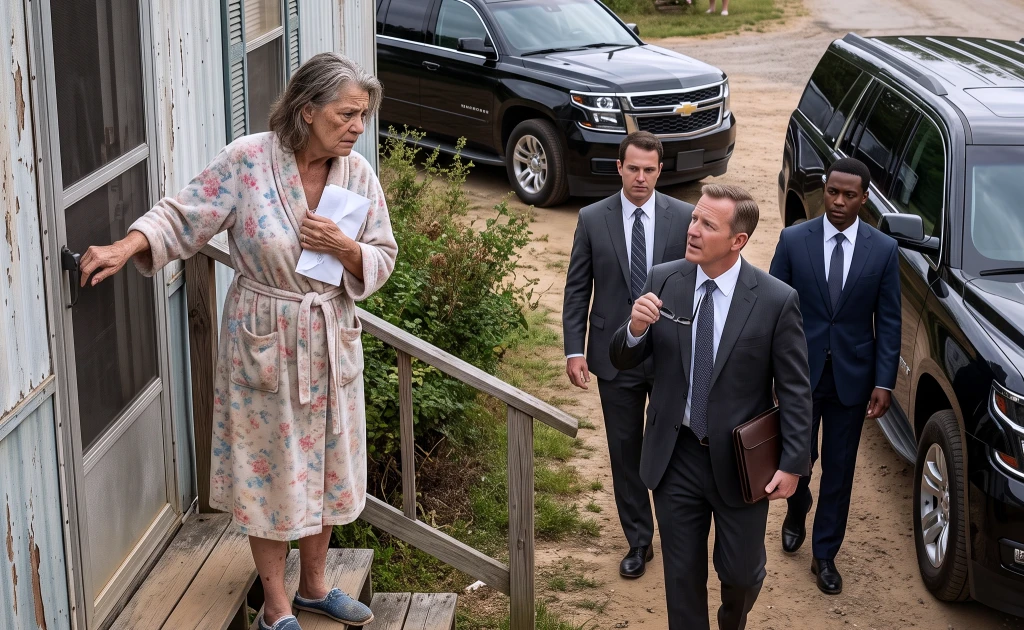
Evelyn stood behind the screen door in her house shoes, one hand on the latch, the other pressed against the envelope tucked in her robe pocket. The county tax notice was folded in there, soft at the creases from being read too many times. She had been waiting for bad news all week, but bad news usually came in one car, maybe a white pickup with a county seal on the door. It did not arrive in three polished SUVs with Tennessee plates and men in dark suits stepping out into the dust.
The youngest man opened the rear door of the lead SUV. A taller man climbed out slowly, not because he was old, but because he seemed to understand that sudden movements frightened people. He carried no clipboard, no badge, no sheriff’s papers. Just a leather folder held carefully against his side.
“Mrs. Porter?” he called.
Evelyn tightened her grip on the latch. “Depends who’s asking.”
“My name is Julian Brooks. I’m an attorney with Brooks, Kellerman & Wade in Nashville.” He stopped at the bottom of her porch steps and removed his sunglasses. “You may have known us years ago under a different office name. We’ve been trying to find you for a long time.”
“Nashville?” Evelyn looked past him at the other men, then toward the road where Mrs. Hanley had given up pretending entirely. “I don’t know anybody in Nashville.”
Mr. Brooks glanced at the folder in his hand. “You once went by Evelyn Shaw.”
The name moved through her like cold water. She had not heard it spoken by a stranger in more than thirty years. Shaw belonged to another woman: a woman who owned a diner on a state road, wore her hair pinned up with two pencils, and still believed work could keep grief from finding her.
Evelyn opened the door only a few inches. “What is this about?”
“A boy you helped in the winter of 1991,” he said. “Seventeen years old. Maybe eighteen. Thin, quiet, carrying a guitar case patched with duct tape.”
For a moment, the porch disappeared. So did the road, the SUVs, the mailbox, the neighbor staring over her flowers. Evelyn smelled old coffee and grill grease. She heard wind knocking against the front windows of a diner that no longer existed. She saw a boy standing just inside the door with blue fingers wrapped around the handle of a guitar case like it was the last thing in the world that still belonged to him.
She let the screen door fall open.
Inside, the trailer looked even smaller than it had that morning. Evelyn had scrubbed the kitchen counters before breakfast, as she always did, and stacked her medicine bottles in a row beside the toaster. Still, the ceiling stain over the sink had spread another inch after last week’s rain, and the old linoleum curled at the corners. Three attorneys made the place feel like a room that had been asked to hold too much.
Mr. Brooks sat at the table only after she pointed to the chair. The other two men stayed near the door, quiet and respectful, as if they had been told not to crowd her. Evelyn poured coffee because she did not know what else to do with her hands, then forgot to offer any.
“You said 1991,” she said.
“Yes, ma’am.” Mr. Brooks opened the folder but did not take anything out yet. “January, we believe. You were running Shaw’s Corner Diner outside Mill Creek, Missouri. You had a storage room behind the kitchen.”
Evelyn stared at him. “That diner burned down fifteen years ago.”
“I know.”
“And I sold it before that.”
“I know that too.”
“Then you know more than most people who live around here.”
A small, careful smile crossed his face. “We had help from records, old utility bills, former employees, a retired mail carrier, and one gentleman who remembered you made the best coconut cream pie in three counties.”
Despite herself, Evelyn almost laughed. “That would’ve been Earl Dobbs. He used to order two slices and say one was for his sister.”
“Was it?”
“Earl didn’t have a sister.”
The smile faded gently. “Mrs. Porter, do you remember the boy?”
She did not answer right away. It felt dangerous to reach for him. Some memories stayed on shelves for a reason; touch one, and everything stacked behind it could come down.
“He never gave me his full name,” she said at last. “I asked once. He looked at me like names were something people used to return you to places you’d escaped.”
Mr. Brooks nodded, as if that answer mattered. “He went by Caleb then.”
Caleb.
The name lit a small lamp in the back of her mind. She saw him at the dish sink with sleeves rolled to his elbows, washing plates faster than she could stack them. She saw him crouched beneath the counter, fixing a pipe that had dripped for two years because she never had the extra money for a plumber. She saw him after closing, sitting in the last booth with a guitar across his lap, playing so quietly that the music seemed embarrassed to be heard.
“I let him stay a while,” Evelyn said. “It was freezing that week. He was hungry. I had a cot in the storage room.”
“For nearly a month,” Mr. Brooks said.
“Was it that long?”
“Twenty-six days, according to something he wrote later.”
Evelyn looked down at her hands. The skin across her knuckles had grown thin, the veins raised and blue. In 1991 those same hands had flipped eggs, counted change, lifted heavy coffee urns, and reached for a stranger before she had time to talk herself out of it.
“What happened to him?” she asked.
Instead of answering, Mr. Brooks took a photograph from the folder and placed it on the table. It showed a man onstage, one hand on a guitar, light falling around him in a silver cone. He was older than the boy in Evelyn’s memory, with lines at the corners of his eyes and a beard trimmed close to his jaw, but the face still held the same watchfulness. Not suspicion exactly. More like a person who had learned early that kindness could vanish if you leaned on it too hard.
Evelyn touched the edge of the photograph but did not pick it up. “That’s him.”
“Yes.”
“He looks…” Her throat tightened. “He looks like he got there.”
“He did more than get there.”
The attorneys by the door shifted, not impatiently, but with the restrained energy of people waiting for a door to open. Mr. Brooks took out his phone, tapped the screen, and set it between them.
“I need you to hear something,” he said. “Please tell me if you recognize it.”
The first guitar chord was simple. Evelyn had heard it before, though she could not have said where, not at first. The melody rose softly, then widened into something that seemed to gather the whole room inside it. When the voice came in, older and steadier than the boy she remembered, Evelyn stopped breathing through her nose and covered her mouth with both hands.
She had heard that song in grocery stores. In a pharmacy waiting area after her second husband died. On the radio in a neighbor’s truck while she stood at her mailbox with a bill she could not pay. Once, years ago, she had heard it at a funeral and thought it was a kind song, the sort of song people played when they did not know what else to do with sorrow.
Then the chorus arrived.
Evelyn pushed back from the table so hard the chair legs scraped the floor. “Turn it off.”
Mr. Brooks paused it immediately. “Mrs. Porter?”
“That’s not possible.”
He waited.
“That’s what I told him.” Her voice sounded strange to her, as if it had come from the far end of a hallway. “Those aren’t the exact words, but that’s what I said. He was stuck on a song about his mother. He kept saying he couldn’t make grief sound true. I told him…” She pressed her hand to her chest, over the place where old pain still knew its way around. “I told him the people we lose don’t leave the room. We make room around them. We carry them into what we do next.”
Mr. Brooks’s eyes softened. “He wrote that down?”
“On a napkin.” Evelyn looked toward the narrow kitchen window, though she was not seeing the yard outside. “He wrote like he was afraid the words would run off before he caught them.”
Mr. Brooks reached into the folder again. This time he removed a photocopy of an old registration document. The paper had been enlarged so she could read it easily, every typed line sharp and official-looking. Near the top was the title of the song she had just heard, the song she had heard for decades without knowing it had once passed through the back booth of her diner.
Then she saw the names.
Caleb Hayes.
Evelyn Shaw.
She stared until the letters blurred. “Why is my name there?”
“Because he put it there,” Mr. Brooks said.
“I didn’t write a song.”
“No, ma’am. But he believed you gave him the heart of it.” The attorney turned the document gently so it faced her squarely. “He registered you as a co-writer in 1993. That has never changed. Not on the original copyright, not on the albums, not on the film licenses, not on the royalty statements.”
The room seemed to shrink around the table. Evelyn heard the refrigerator kick on behind her, the soft rattle it made before settling into its usual hum. Outside, one of the SUVs ticked as its engine cooled in the sun.
Mr. Brooks laid one more page beside the first. This one was not a copy of anything old. It was crisp, new, and filled with numbers Evelyn did not understand at first because there were too many of them. – “For thirty-one years,” he said quietly, “part of that song has legally belonged to you…”
To read the rest of the story – CLICK the NEXT button 👇👇👇