


Caleb Hart saw the baby’s hand before he saw the woman. It was no bigger than a bird’s claw, curled outside a torn quilt, blue at the fingertips and half-buried in the snow. For one breath Caleb thought his mind had finally started playing tricks on him, the way lonely men in the high country sometimes saw lamps in empty cabins or heard voices where there was only wind. Then the bundle moved.
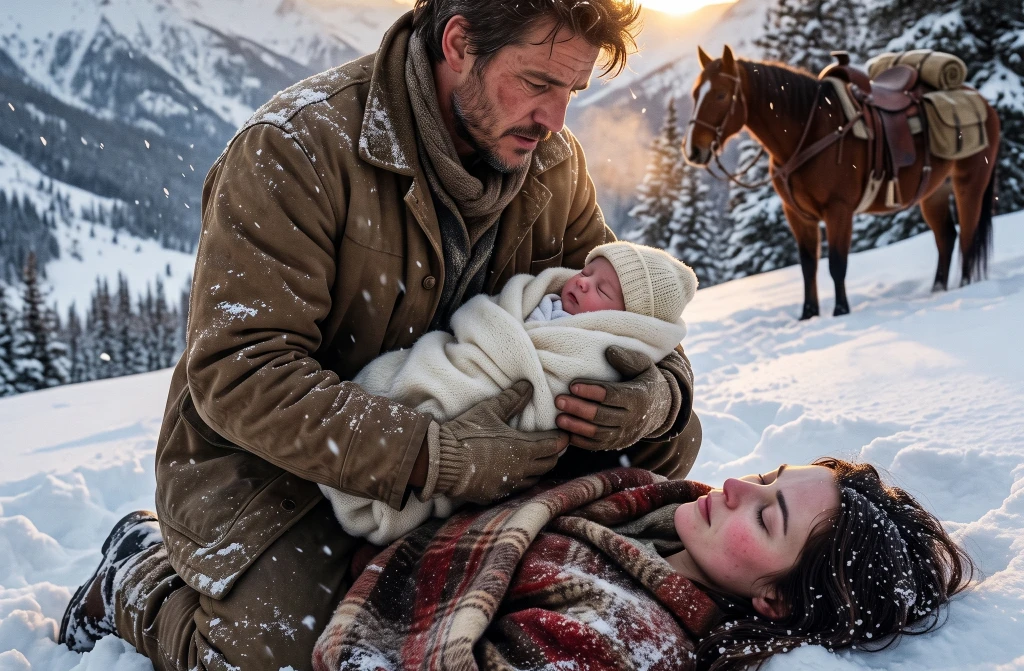
His mare stopped hard beneath him, ears pointed forward, nostrils blowing steam into the white air. Caleb leaned out of the saddle and stared down the narrow pass, where the snow had piled in uneven drifts along the wagon ruts. Something dark lay across the trail twenty yards ahead, too small to be a horse, too still to be a traveler resting.
“Easy, Copper,” he murmured, though the horse had more sense than he did in a storm. “Easy now.”
The mountains had been trying to kill him since dawn. Snow swept sideways across the pass, hiding the cliff edge on his left and the black pines on his right. Caleb had been three days bringing flour, salt, coffee, cartridges, lamp oil, and two sacks of dried beans up from Elk Creek to his cabin, and he had spent most of that time cursing himself for waiting so long to make the trip.
He had been thinking of his stove, his barn, and the quiet little valley below Riley Pass where no one asked questions. He had not been thinking of people. He had worked hard, these past three years, to stop thinking of people.
But there, in the road, was a woman with a child in her arms.
Caleb swung down before Copper had fully stopped. His boots sank nearly to the ankle, and the cold bit straight through the worn leather of his gloves as he dropped to his knees beside her. She lay curled around the baby, her body turned like a shield against the wind. Snow had gathered in the folds of her coat and along the dark hair slipping loose from her scarf.
“Ma’am,” he said, brushing snow from her cheek. “Can you hear me?”
She did not answer.
Caleb slid two fingers beneath the line of her jaw. For a terrible second he felt nothing but ice-cold skin. Then a weak pulse fluttered against his fingertips, faint and stubborn.
“Thank God,” he breathed.
The baby gave a thin, broken sound, not quite a cry. Caleb peeled the quilt back with care, expecting the worst and bracing for it. The child was alive, small and hollow-cheeked, maybe six or seven months old. His lips trembled, but his face still held a little color because the woman had wrapped him in nearly everything she had.
Her own hands were bare.
Caleb stared at them longer than he should have. They were swollen, reddened, stiff with cold, the fingers bent around the baby even in unconsciousness. She had given the child her gloves. She had given him her scarf, too. She had given him every warm thing except the beat of her own heart, and Caleb knew by the look of her that she had nearly given him that as well.
He worked fast after that.
He freed the baby first, tucking him inside Caleb’s coat against his chest. The child whimpered at the movement, and Caleb spoke without thinking, soft and low the way he used to speak to frightened horses and fevered men.
“I’ve got you, little one. You stay with me.”
The woman was harder. She was light, too light, but limp with cold and exhaustion. When Caleb lifted her, her head fell against his shoulder, and for an instant her breath brushed the side of his neck. It was barely there.
Copper stood steady while Caleb fought the wind, the child, the woman, and his own stiff hands. He got the woman across the saddle, wrapped his bedroll around her, and tied her in place as gently as he could. Then he gathered the reins and began leading the mare down the back side of the pass, one slow step at a time.
The cabin was less than two miles away. In clear weather, Caleb could have made it in half an hour. That day, with the trail glassed over and the storm scraping the world down to rock and whiteness, it took nearly two.
Every few minutes he stopped and touched the woman’s throat. Each time, her pulse was weaker. Each time, the baby made a little sound from inside Caleb’s coat, and Caleb tightened one arm around him, feeling the fragile heat of that small body against his ribs.
He had never held a baby before.
Hannah had wanted children. She had talked about them as if they were already waiting somewhere, as if God had placed them just beyond the next season and all they had to do was work hard enough to reach them. A girl with her eyes, she used to say. A boy with Caleb’s stubborn jaw. A house too loud to keep clean.
Then fever came through Blackwater, and Caleb rode for the doctor too late.
He shoved that thought down before it could find its teeth. The storm was enough. The woman and child were enough. A man could not fight weather, memory, and death all at once.
By the time his cabin appeared below the ridge, squat and dark against the snow, Caleb’s beard had frozen stiff and his hands had gone clumsy on the reins. Smoke still leaked from the stone chimney. He had banked the fire before leaving three days ago, and if the embers had held, there might be enough heat left to save them.
“Almost there,” he said, though he did not know whether he meant it for the woman, the child, the horse, or himself.
Inside, the cabin smelled of ashes, pine, leather, and the loneliness Caleb had long ago stopped noticing. One room, one stove, one narrow bed, a table, a chair, a trunk, a shelf of old books, and a rifle above the door. He had built the place with his own hands after Hannah died, choosing the hidden valley because it was far enough from town that no one came unless they had lost their way.
Now a woman and a baby had lost theirs.
He laid her on the bed and set the baby beside her long enough to throw wood into the stove. The fire caught slowly, then greedily, brightening the iron belly until heat began to push back the cold. Caleb moved the bed closer, hung blankets near the stove, warmed water, and stripped off the woman’s frozen boots.
Her stockings were torn through at the toes. The skin beneath was pale in places, red in others, and Caleb’s jaw tightened when he saw the bruises around one ankle. Not fresh, maybe days old. Not from the snow.
“Who did this to you?” he asked under his breath.
The woman did not stir.
The baby started crying then, a sound so small and tired that it frightened Caleb more than a full-throated scream would have. He looked from the child to the woman and back again, helpless in a way he had not felt since standing beside Hannah’s bed with a doctor who would not meet his eyes.
“All right,” he said. “All right, we’ll figure it out.”
He warmed milk in a tin cup, cooled it against his wrist the way he had seen mothers do in town, and tried feeding the child with a spoon. Most of it dribbled down the baby’s chin. Some of it went in. Caleb counted every swallow like a victory.
The baby’s eyes opened once. They were gray, wide and unfocused, with dark lashes clumped from melting snow. He stared at Caleb as if asking a question no man in the world could answer.
“I know,” Caleb said quietly. “I’m not who you were hoping for.”
The child blinked, hiccupped, and finally slept.
All night Caleb kept the fire high. He rubbed the woman’s hands and feet with dry cloths, careful not to put them too close to the stove. He wrapped warm stones in towels and tucked them near her body. He fed the baby a little milk whenever he woke, and each time he did, his grip grew steadier.
Toward morning, the storm eased enough for the cabin to stop shuddering. The woman’s color returned by degrees, first to her lips, then her cheeks. She still trembled, but the terrible blue tint faded from her skin.
Caleb sat in the chair beside the bed and watched the thin rise and fall of her breathing. He had not prayed in a long time. At first he only bowed his head because he was tired. Then the words came, awkward and plain.
Not again.
That was all he had.
When dawn opened pale over the ridge, the woman moved.
Caleb stood so fast the chair scraped the floor. Her eyes fluttered, closed, then opened fully. They were gray like the baby’s, but sharper, clouded by pain and fear. For a moment she looked at the ceiling beams. Then she turned her head and saw Caleb.
She tried to sit up and failed.
“Easy,” he said, stepping closer but keeping his hands where she could see them. “You’re safe.”
Her gaze flew around the room. “My baby.”
“He’s here.” Caleb reached to the cradle he had made from an empty apple crate and folded blankets. “He’s sleeping. He took some milk. Not much, but enough for now.”
The woman’s mouth trembled. She stretched one injured hand toward the child, and Caleb lifted him carefully, placing him beside her. She pulled the baby close with a sound that was not quite a sob and not quite a laugh.
“I thought I’d killed him,” she whispered. “I thought I’d carried him all that way just to—”
“You didn’t,” Caleb said. “You kept him alive.”
She shut her eyes. A tear slipped into her hair. “Where am I?”
“My cabin. About two miles below Riley Pass, west of Elk Creek. Name’s Caleb Hart.” He waited, then added gently, “Can you tell me yours?”
The woman hesitated long enough for Caleb to notice.
“Nora,” she said finally. “Nora Whitaker. This is Eli.”
“Do you have people nearby, Nora?”
Her arms tightened around the child. “No.”
“Were you traveling with anyone?”
“No.”
The answer came too quickly. It had a door behind it, locked and braced shut. Caleb had heard that kind of answer when he wore a badge, from women with bruises under their sleeves and men who had seen too much in a saloon alley.
He nodded once. “You don’t have to tell me anything right now. You need rest, warmth, and food. When the weather clears, I’ll see about getting you to a doctor.”
“The weather won’t clear.” Her voice was hoarse, but certain. “Not enough.”
Caleb glanced toward the window. Snow had already begun falling again, softer now but steady. The pass would be gone by nightfall. The lower road to Elk Creek would be no better. He knew what it meant, and from the look in Nora’s eyes, so did she.
“You and the boy can stay here until it’s safe to travel,” he said.
She looked at him then, really looked, as if trying to decide whether a man who said a kind thing might still be dangerous. Caleb did not blame her. A woman did not end up half-dead on a mountain trail with a baby in her arms because the world had been gentle.
“I can’t pay you,” she said.
“I didn’t ask.”
“I won’t be trouble.”
“You already are,” Caleb said, and when fear flashed across her face, he softened his voice. “But not the kind I’d leave in the snow.”
That nearly undid her. Her eyes filled again, and she looked down at Eli because looking at Caleb seemed to cost too much. The baby slept against her, one small fist resting on the torn edge of her coat.
Caleb turned toward the stove. “I’ll make broth. You try to stay awake long enough to drink some.”
He had taken only two steps when the bed ropes creaked behind him. Nora had pushed herself up on one elbow, her face drained white with effort. Her gaze had fixed on the wall above the door, where Caleb’s rifle hung beside an old leather holster and, tucked half behind it, the dull edge of a tarnished sheriff’s badge.
Her breath changed.
Caleb saw fear take her before she spoke. It moved through her body like cold water, stiffening her shoulders, widening her eyes, making one damaged hand reach blindly for the baby.
“Did Pike send you?” she whispered.
Caleb turned slowly.
The name struck like a match in a dark room. He had not heard Gideon Pike spoken aloud in years, not since he had left Blackwater and put his lawman’s life in a trunk with the rest of his dead things. Nora’s voice broke as she held Eli closer. “Please. If he sent you, tell him I’ll die before I go back…”
To read the rest of the story – CLICK the NEXT button 👇👇👇