


The cry came just after midnight, when the wind dropped so suddenly Ruth Whitaker could hear the nails ticking in the cabin walls. At first she thought it was a man. Not a neighbor—there weren’t any close enough for a voice to carry in that weather—but a lost hunter, maybe, or one of the ranch hands from the valley who had taken the wrong snow road after dark. The sound rose out of Devil’s Notch in a long, torn breath, then disappeared into the timber as if the mountain itself had swallowed it.
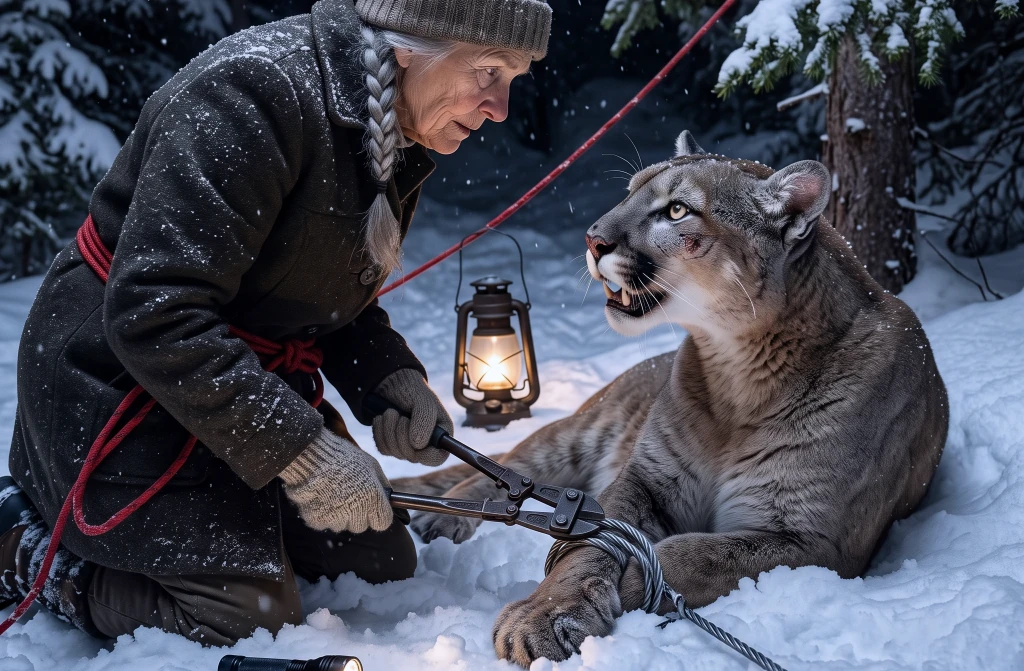
Ruth stood beside the woodstove in her wool socks, one hand wrapped around the handle of the kettle. The water had just started to steam. On the table behind her sat the chipped blue mug her husband had used every morning for thirty-eight years, the one she still set out without thinking before she remembered there was no one left to drink from it.
The cry came again.
Lower this time.
Too raw for a man. Too full of pain for anything ordinary.
Ruth turned toward the dark window. Her own reflection stared back from the glass: seventy-two years old, gray braid over one shoulder, face cut thin by age and winter, eyes too awake for the hour. Outside, the January snow lay high against the porch rails. Beyond the clearing, the pines stood black and crowded under a moonless sky.
“No,” she whispered, though she didn’t know who she was answering.
The sound had come from the notch.
Everybody in Juniper Creek knew that place. Devil’s Notch was a split in the ridge three miles above Ruth’s cabin, a jagged ravine where cold air pooled and old snow turned blue as steel. Kids dared each other to go there in summer. Hunters avoided it in winter. Ruth’s husband, Sam, used to say the mountain had places where it didn’t forgive carelessness, and Devil’s Notch was one of them.
Sam had known every unforgiving place within thirty miles.
That was why people had called him when the weather turned bad, when trucks slid off forest roads, when hunters got turned around in whiteout, when a child wandered too far from a campsite. Sam had been the one who went out with a coil of rope across his shoulder and a thermos in his pack. Ruth had loved that about him until the night she hated it.
The night he went out and didn’t come back.
The cry sounded a third time, shorter now, almost strangled.
Ruth set the kettle down so hard that water sloshed over the rim. For a moment she stayed perfectly still, listening to the stove crackle and the old clock mutter above the sink. Then she crossed the kitchen and took Sam’s red rescue rope from the peg beside the door.
She had not touched it in years.
The rope was stiff with age, but she knew the weight of it. Her hands remembered the braid before her mind did. Sam had kept it cleaned, coiled, and ready, the way some men kept rifles. Ruth had left it hanging there after his funeral because putting it away felt like admitting he was gone for good.
Now the rope came off the peg with a dry whisper.
Ruth pulled on her boots, then her heavy coat, then the knit hat Maggie Doyle from the post office had given her for Christmas. She shoved a flashlight, a folding knife, and a pair of old work gloves into her pockets. At the last second she took the dented storm lantern from the shelf, the one that still smelled faintly of kerosene, because batteries died in cold like that.
She did not call 911.
Out there, in the first minutes after a cry like that, a call could mean help. It could also mean headlights, rifles, men who saw danger before they saw suffering. Ruth had lived long enough in ranch country to know the difference between an animal in trouble and an animal people wanted permission to kill.
At the door, she paused.
Beside the sink, Sam’s mug sat in the lamplight. She could almost hear his voice, quiet and tired, the way it had sounded the last night of his life when he had zipped his coat and checked the radio.
“Ruthie, somebody’s out there.”
She had been angry that night. Afraid, but angry first. She had stood right where she stood now and said, “Somebody is always out there, Sam. When do I get to be the one you choose?”
Those had been the last words she said to him before the storm took him.
The memory moved through her like cold water.
Ruth opened the door.
The wind hit her hard enough to steal her breath. Snow scraped sideways across the porch, fine and sharp as ground glass. She lifted the lantern, stepped down into the drift, and let the cabin door fall shut behind her.
The trail to Devil’s Notch had vanished under fresh snow, but Ruth knew the shape of the land. She had walked it with Sam for half her life, first as a young wife trying to keep up with his long stride, then as a woman with a bad knee and a stubborn heart, and finally as a widow who went out into the trees because staying inside made the silence too large. She followed the shallow dip between the pines, then the rise where the old logging road curved west.
Every few minutes she stopped to listen.
Nothing.
Then, faintly, the cry again.
It came from higher ground, farther than she wanted it to be. Ruth tightened her grip on the lantern and pushed on. Snow came over the tops of her boots. Once, near the creek bed, she broke through a crusted drift and went down to one knee. Pain shot up her leg, bright and mean, and for a moment she stayed there with one mitten pressed into the snow, breathing through her teeth.
“Don’t start,” she muttered to the knee. “We’re not having this fight tonight.”
She got up.
By the time she reached the lower edge of Devil’s Notch, her lungs burned and sweat had dampened the hair at the back of her neck. The storm had eased, leaving a thick, waiting cold behind it. The ravine opened ahead of her like a black wound in the ridge, its sides glazed with ice where meltwater had frozen and refrozen over weeks.
Ruth raised the lantern.
At first she saw nothing but rock, snow, and shadow.
Then two eyes caught the light from below.
They burned pale gold.
Ruth stopped breathing.
The animal lay at the bottom of the ravine, half-buried in drifted snow. Its coat was tawny-gray, almost silver under the lantern glow, and its body was longer than Ruth’s kitchen table. A mountain lion. A big one. One of the old cats people swore they glimpsed at dusk and then argued about at the feed store for two weeks.
It lifted its head and showed its teeth.
The sound that came out of it was not the cry Ruth had heard from the cabin. This was a warning, low and vibrating, something felt more in the ribs than heard in the ears. Its tail lashed once against the ice. One front paw jerked, and the animal’s whole body went rigid with pain.
Ruth saw the problem then.
Its left foreleg was trapped near the base of the ravine, caught in a loop of steel cable that had cinched above the paw and frozen into the ice. The cat had pulled so hard that the snow around it was churned and dirty. Blood darkened the fur near the cable, not much, but enough.
“Oh, Lord,” Ruth said.
The mountain lion stared at her, panting.
She had seen cats before from a distance. Once on a ridge at sunrise, another time crossing the county road like a shadow with muscle under it. Sam had taught her what to do if she ever met one close: don’t run, don’t crouch, don’t turn your back. Make yourself bigger than you feel. Speak steady. Give it a way out.
But this cat had no way out.
Ruth looked around the rim of the notch. The snow was disturbed near a young lodgepole pine, where something had been anchored and covered over. She moved her lantern lower, squinting. There, half-buried beside the trunk, was the other end of the cable.
This was no accident.
The realization settled into her stomach with a weight heavier than fear. A rockslide did not braid steel. A storm did not anchor cable to a tree. Somebody had set a snare in a place where no legal trap line should have been, and the mountain lion had dragged itself into the ravine trying to get free.
The cat hissed again, weaker this time.
Ruth took one careful step back from the edge. She needed bolt cutters. A shovel. Maybe a pry bar. She needed daylight, and help, and a body younger than hers. She needed to call someone who knew what they were doing.
But if she called the wrong person, this animal would not see daylight.
She thought of the men at the feed store, of Wade Coyle holding court near the coffee machine, telling anyone who would listen that lions were getting bold and somebody ought to thin them out. She thought of the ranchers who had lost calves that winter and wanted one clear thing to blame. She thought of the sheriff’s office two towns over, understaffed and tired, and the way public safety could turn mercy into paperwork and paperwork into a bullet.
Ruth looked down at the cat.
“You picked a poor night to trust me,” she said.
The mountain lion blinked once, slow with exhaustion or hatred or both.
Ruth backed away from the ravine and started toward home. She made herself move carefully because one fall could end the matter for both of them. Her breath came hard. The rope bumped against her hip. Twice she stopped and bent over, hands on knees, until the stars stopped swimming in front of her eyes.
At the cabin, she did not take off her coat.
She dragged Sam’s old bolt cutters from the shed, found the short-handled shovel, and took a frozen deer roast from the chest freezer on the back porch. It had been meant to last her another week. She wrapped it in a feed sack and tied it to the end of a length of twine, then filled a thermos with coffee so hot it burned her thumb when she screwed on the cap.
While she worked, she caught herself glancing at the phone.
It sat on the kitchen wall, yellowed with age. One call could bring help. One call could also bring Wade Coyle, or someone like him, grinning behind a rifle and calling it necessary.
Ruth took the phone off the hook anyway.
For one second she listened to the dial tone.
Then she hung it back up.
“Sam,” she said into the empty kitchen, “I’m either doing what you taught me or proving I never learned a thing.”
The old cabin gave no answer.
She went back out.
The second walk to Devil’s Notch felt longer. The wind had picked up again, carrying loose snow through the trees in twisting white sheets. Ruth’s gloves stiffened around the handles of the bolt cutters. Every shadow looked like movement. Every snapped branch sounded like a rifle being cocked.
At the rim of the ravine, she lowered the deer roast first.
The mountain lion recoiled, then froze. Its nose twitched. Hunger moved through the animal before trust did. Ruth kept the twine loose and let the meat drop several feet away from the trapped paw, close enough to smell, far enough that she would not have to put her hands near its mouth.
“There,” she said. “That’s the deal. You eat, I work, and neither one of us does anything stupid.”
The cat watched her.
Then, with a suddenness that made Ruth flinch, it dragged the meat toward itself and tore into it.
Ruth waited until its head was down before she moved along the rim, searching for a safer way into the ravine. There wasn’t one. The sides were too steep, the snow too unstable. If she slid to the bottom, she might never climb out, and the lion would not have to be cruel to kill her. Hunger and pain would do the thinking.
So she worked from above.
She tied Sam’s rope around the lodgepole pine, looped the other end around her waist, and tested the line with both hands. The bark creaked, but the tree held. Then she lay flat on her stomach in the snow and reached down with the shovel, chipping at the ice where the cable disappeared into the frozen crust.
The work was miserable. The shovel bounced. The ice refused. Her shoulders screamed before the first chunk broke loose. Below her, the mountain lion ate and watched, ate and watched, never taking its eyes off her for long.
Ruth lost track of time.
She chipped, rested, drank coffee, chipped again. The moon slid behind clouds. Her fingers went numb, then painful, then numb again. Once the lion lunged without warning when a piece of ice skidded near its injured paw. The rope caught Ruth around the ribs as she jerked back from the edge, and for several seconds she lay gasping in the snow with the taste of panic in her mouth.
“Fine,” she rasped. “I deserved that.”
The cat panted below her, lips pulled back.
It was nearly dawn when Ruth finally exposed enough of the cable to see where the loop tightened. She lowered the bolt cutters as far as she could, arm trembling with the strain. The angle was wrong. She could not get the jaws around the cable. She shifted her weight, and the snow under her left elbow gave way.
For one sickening instant, she slid.
The rope snapped tight around her waist. The lantern tipped and rolled, throwing wild light across the ravine wall. Ruth dug her boots into the snow and stopped with her upper body hanging over the edge, face no more than ten feet above the mountain lion.
The cat rose.
It could have reached her.
Ruth knew it with a clarity that emptied every thought from her mind. One spring, one hooked claw, one bite to the arm, and she would go down into the ravine with it. Nobody would find her until the next thaw, if then.
The animal stared up at her.
Ruth stared back.
Her breath shook in and out. The rope cut into her coat. Snow slid past her cheek in soft little streams. After a long moment, the mountain lion lowered itself back onto the ice, not peacefully, not gratefully, but with the hard calculation of a wild thing that had decided, for reasons Ruth would never understand, not to take the chance.
Ruth swallowed.
“Much obliged,” she whispered.
She dragged herself back from the edge and lay there until her heartbeat slowed enough for her hands to work again. Then she reset the rope, changed the angle, and lowered the bolt cutters once more.
This time, the jaws caught.
Ruth squeezed.
Nothing.
She set her teeth and squeezed again, using both hands, her whole body shaking. The cable groaned but held. She shifted, braced her boots against the frozen root of the pine, and pulled the handles together with everything she had left.
The steel snapped.
The sound cracked through the ravine like a gunshot.
The mountain lion exploded upward, not at Ruth but away from the pain. It slammed into the icy wall, scrambled, slid, then found a narrow shelf with its back paws. Ruth saw the freed leg buckle. She saw the animal almost fall. Then it gathered itself and climbed, claws finding seams in the rock no human eye would have trusted.
At the top, twenty yards from Ruth, the cat stood in the gray dawn.
It was bigger than she had realized. Its head was scarred across one cheek, the old mark pale against the tawny fur. The injured leg trembled under it. A strip of broken cable still hung loose near the paw.
Ruth did not move.
The mountain lion looked at her once.
Then it turned and vanished into the pines.
Ruth sat in the snow until the first weak light reached the ridge. She should have felt relief. Instead she felt the thin, creeping awareness that mercy had not ended anything. It had only opened a door she could not close.
She began gathering her tools with shaking hands.
That was when she saw the boot print.
It was pressed deep into the snow beside the lodgepole pine, half-filled by new powder but still sharp at the heel. A square heel. A heavy tread. Too fresh to be Sam’s old memory, too deliberate to belong to a lost hunter passing through.
Beside it, caught on a broken twig, hung a torn strip of orange survey tape. Ruth lifted the tape with two fingers. On one side, written in black marker, were three letters. COY…
To read the rest of the story – CLICK the NEXT button 👇👇👇