


The first thing Eli Mercer saw when he came to was his own blood dripping into the snow beneath his face. For a few confused seconds, he could not understand why the ground was above him and the gray sky was somewhere near his boots. Then the pain found him. It came from his ribs first, sharp enough to steal the breath out of him, then from his shoulders, his wrists, the back of his head, and the rope cutting into both ankles.
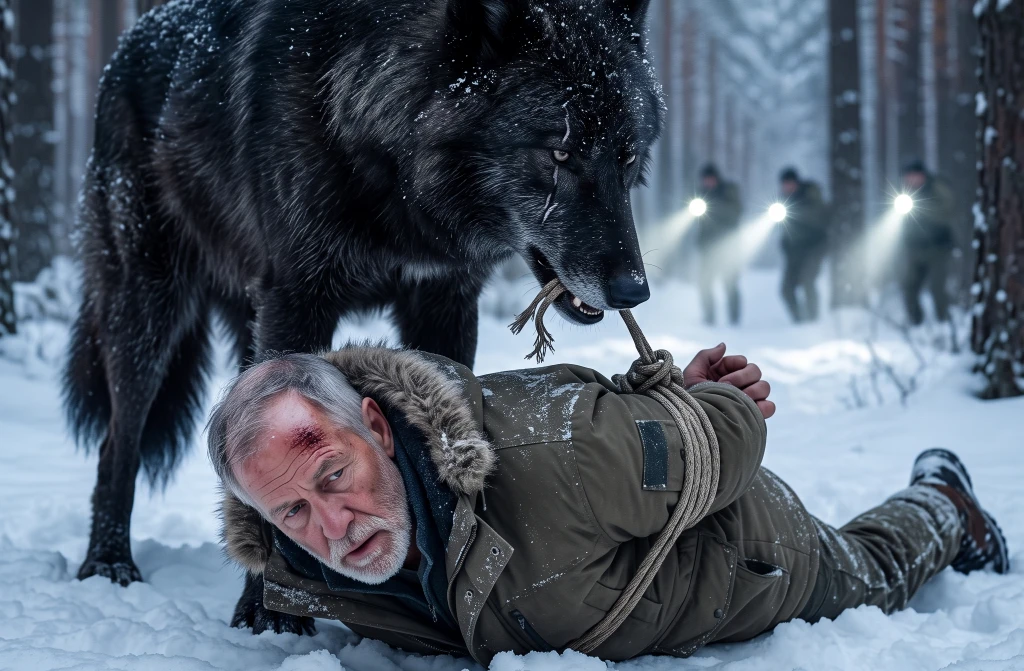
He was hanging upside down from a dead pine in the High Divide Wilderness, twenty miles from the nearest plowed road, with his radio gone, his sidearm gone, his pack gone, and winter closing in around him.
Eli tried to twist. The rope bit deeper, and a hot pressure surged behind his eyes. His hands were tied behind his back with climbing cord, tight enough that his fingers had already gone numb. Whoever had done this had known what they were doing, or at least they knew enough to let the cold and gravity finish what they had started.
The woods around him were too quiet. No chickadees. No squirrel chatter. Not even the groan of branches moving against each other. Just the hush of falling snow and the steady drip of blood from his eyebrow into the white powder below.
He forced himself to breathe through his nose.
In.
Out.
Again.
At sixty-eight, Eli had learned that panic spent a man faster than cold did. He had served thirty-two years with the Forest Service, most of them in country that punished carelessness within minutes. He had pulled lost hikers off ridgelines, found campers half-frozen in creek beds, argued with hunters, written citations, marked avalanche paths, and once carried a teenage boy four miles through sleet because the kid’s father had twisted an ankle and would not leave him.
But he had never woken up hanging from a tree like meat.
That morning, the assignment had looked wrong before he even left the Granite Creek ranger station. A printed route order sat on his desk, slipped under his coffee mug sometime before dawn. It sent him up toward Deadfall Basin, a section of protected wilderness nobody had reason to inspect in January unless something had gone bad.
The map had red lines drawn over old service tracks. Eli had stared at them with one hand resting on the chipped edge of his desk. He knew every drainage, switchback, and washout in that part of the forest, and two of the routes marked as passable had been blocked by rockfall for years.
The signature at the bottom was supposed to be his.
It wasn’t.
A younger man might have walked straight into District Ranger Sarah Keene’s office and raised hell. Eli almost did. He even made it as far as the hallway, the paper folded in his fist, before the old habit took over.
Check first. Report after. Don’t make noise until you know what you’re standing on.
That habit had kept people alive. It had also made him lonely.
Eli had been living alone long enough that silence had become his second language. His wife, Laura, had been gone nine years, taken by a cancer that made a strong woman look smaller each week until her wedding ring slid too loose on her finger. Their son, Daniel, had died two winters after that in an avalanche near Windbreak Pass while volunteering with search and rescue.
People said Daniel died doing what he loved. Eli never corrected them, but he hated the sentence. It made loss sound clean, as if love could be folded into a neat line and put away.
After Daniel’s funeral, Eli stopped going to dinners at the station. He stopped answering invitations. He took the lonely patrols because nobody else wanted them, and because the mountains did not ask him how he was holding up.
So when a forged route order appeared on his desk, Eli did what he had always done. He put on his parka, checked the weather, loaded his old truck, and drove north before sunrise.
By late morning, he had found the first tracks.
Four men, maybe five. Heavy boots. A sled scar dragged over crusted snow. Someone had hauled equipment through a protected drainage and tried to brush the evidence behind them with pine boughs. Farther up, near the split in the basin trail, Eli found orange survey tape tied low behind a cedar where it would be hidden from anyone moving fast.
Rare-earth test markers, he thought. Not logging. Not poaching.
Mining.
There had been rumors for months. A private exploration company had been sniffing around the county line, promising jobs, quietly buying land, and getting angry whenever anyone mentioned the wilderness boundary. Eli had heard the name in town, in the feed store, at the gas station. Titan Ridge Materials. They had clean trucks, clean lawyers, and just enough money to make local officials uncomfortable.
They were not supposed to be anywhere near Deadfall Basin.
Eli had taken three photographs before something moved behind him.
He remembered a branch snapping. He remembered turning too late. He remembered a flash of red beard through the fog, then a blow across the side of his head that dropped him to one knee.
After that, the memory came back in pieces.
Men’s boots around him.
Someone laughing.
A voice saying, “Voss said the old man still walks like he owns the place.”
Another voice, lower and rougher, answering, “Hang him high enough and he won’t own anything by dark.”
Voss.
The name had floated through Eli’s fading mind like a hook under ice. Nolan Voss worked logistics at Granite Creek, a careful man with pressed uniforms, spotless reports, and the kind of smile that never reached his eyes. Eli had never trusted him, but distrust was not evidence.
Now, dangling from the dead pine with blood filling his head, Eli understood too late what that forged signature had meant. Someone inside the station had sent him out here to disappear.
A gust moved through the trees. Snow lifted off the branches and brushed his face like cold ash.
He tried to work his wrists apart, but the cord only tightened. The pain behind his eyes grew heavier. If he blacked out again, he knew he might not wake up. Men had died faster in better positions.
Eli swallowed against the pressure in his throat.
“Come on,” he rasped to himself. “Think.”
But thought was difficult upside down. The forest swayed in long, slow arcs. His heartbeat pounded in his ears. The blood dripping from his brow had made a small red pit in the snow.
Then he heard something.
Not a human step. Not the careless crunch of a man in boots. This was softer, heavier, with pauses between movements as if whatever approached had all the time in the world.
Eli stopped struggling.
The sound came again. A careful press into snow. A breath. Then another step.
Through the gray curtain of trees, a shape moved at the edge of the draw. At first Eli thought it was a black bear, though no bear should have been awake in that weather. Then the shape lowered its head, and two amber eyes caught the weak light.
A wolf stepped out of the timber.
Eli had seen wolves before. He had watched them through binoculars on open ridges, caught them on trail cameras, found their prints stitched along frozen creeks. They were leaner than the stories made them, more cautious than cruel, built for distance and patience.
This one looked like he had walked out of an older story.
He was enormous, deep-chested, black from muzzle to tail except for a faint ash-gray patch under his throat. A long scar cut across the left side of his face, pulling the fur into a pale seam from cheek to jaw. One ear had a torn notch near the tip. He moved with a grave, measuring calm, neither slinking nor rushing, and every line of him said he had survived more than one winter that should have killed him.
Coal, Eli thought, though he had never seen the animal this close.
That was what the younger rangers called the black wolf from the trail camera photos. Coal had been showing up for years at the northern edge of the district, always alone, always at night, his yellow eyes reflecting like lanterns. Some said he was a disperser from a Canadian pack. Some said he was too old to still be alive.
Eli had never cared for campfire legends. Yet hanging helpless in the snow while the black wolf studied him, he understood how legends started.
“Easy,” Eli whispered, though his voice barely moved. “I’m not much of a meal.”
The wolf came closer.
Eli’s body wanted to fight. His muscles jerked against the cord. He had no weapon, no leverage, no good prayer left. If the wolf went for his throat, it would be over quickly. If he tore into him alive, it would not.
But Coal did not lunge.
He circled once beneath the tree, nose working. He sniffed the blood in the snow, then the boot prints around it. His lips lifted slightly when he reached the place where the men had stood. The expression was not hunger. It was recognition of a smell he disliked.
Eli blinked, trying to keep the wolf in focus. “You know them?”
The wolf looked up at him.
For one impossible moment, Eli felt less like prey than a man being judged.
Coal rose onto his hind legs and planted both front paws against the trunk. The tree shuddered. He stretched his neck toward the rope, sniffing first, then closing his teeth around it with a delicacy that made no sense in a mouth built to crush bone.
The rope tightened. Eli gasped as the pressure on his ankles changed.
“No,” he choked. “Wait—”
The wolf pulled.
Fibers creaked. The branch above Eli groaned. Coal released, adjusted his bite, and pulled again, harder this time. The rope began to fray strand by strand.
Eli’s heart hammered so violently he thought he might pass out before he hit the ground. “Careful,” he whispered, as if the wolf had any reason to care what he wanted. “Careful, boy.”
Coal’s ears flicked at the word, but he did not stop.
The rope snapped.
Eli fell hard, shoulder first, into snow and buried stone. Pain burst white through his ribs. For several seconds he could not breathe, could not move, could not do anything except lie on his side with the world ringing around him.
The wolf landed beside him, silent as a shadow.
Eli dragged in air. He expected teeth. He expected the warm wet bite of an animal claiming what it had brought down.
Instead, Coal turned away from him.
His ears angled toward the slope above the draw. His body stiffened, black fur lifting along his spine. Through the trees, a man’s voice carried thinly on the wind.
“He better be frozen by now.”
Another man laughed. “Check the pine first. Voss wants proof.” – Coal stepped over Eli’s bound wrists and placed himself between the old ranger and the voices coming down through the snow. Then the wolf showed his teeth…
To read the rest of the story – CLICK the NEXT button 👇👇👇