


The wolf came out of the snow while Eli Mercer was still tied inside the burning truck. At first, Eli thought the smoke had finally started lying to him. The cab was already gone, swallowed in a roaring orange light that crawled along the dashboard and licked through the broken rear window. Heat rolled into the truck bed in thick waves, turning the metal around him into a griddle. His wrists were bound behind his back with wet rope, and every breath tasted like melted plastic, gasoline, and the black edge of fear.
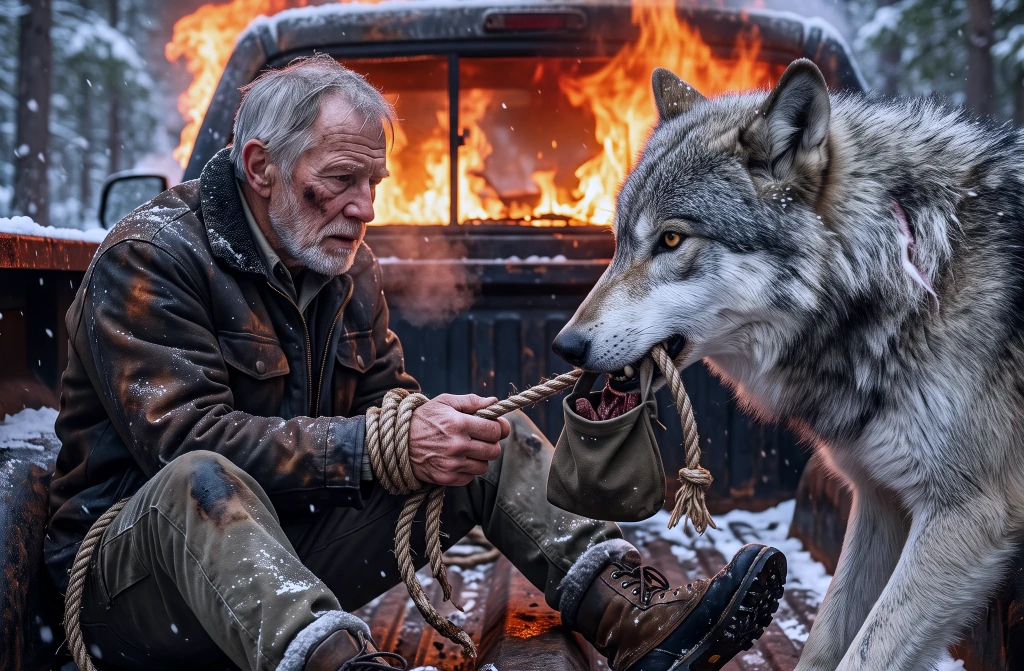
Then the shape moved again beyond the split in the tailgate.
Not a man. Not help.
A wolf.
It stood just beyond the reach of the flames, half-hidden by the blowing snow, its thick gray coat dusted white and its eyes catching the firelight in two steady flashes of amber. It was big even for the north woods, long-legged and narrow through the hips, with an old scar pale against the fur along one side of its neck. It watched the truck with the stillness of something that had learned never to waste movement in winter.
Eli did not call out. A man who had spent fifty years in the backcountry did not ask a wild animal for mercy. Wolves did not come to burning trucks because they cared who was inside. They came because the world had offered them a smell worth risking the heat for.
And Eli knew exactly what the wolf smelled.
On his belt, pinned under his hip, hung a canvas pouch with the last of his venison jerky. He had packed it that morning before leaving his cabin near Frost River, a habit from years of working alone in the Superior National Forest. At seventy, Eli had lost track of how many times a strip of dried meat had carried him through a long day on snowshoes, a stuck truck, a storm that came early. He had not expected it to become the only thing between him and being burned alive.
The wolf lifted its muzzle. Its nostrils worked once, slow and careful.
Eli swallowed smoke and forced himself not to cough. Panic wasted air. Panic made hands stupid. Panic was how men died before the cold or the fire ever reached them.
Grant Hollis had counted on panic.
He had counted on Eli screaming.
Three hours earlier, Grant had stood in the blue headlights of his idling pickup, smiling through the snow like a man posing for a campaign photograph. He was tall, broad, handsome in the hard way that made people in town step aside before they knew why. His timber company bought diners, sponsored hockey teams, paid for the church roof, and shook hands with county officials as if the whole northern half of Minnesota belonged to him already.
But Eli had walked Grant’s cut roads. He had photographed stumps inside protected boundary lines. He had written down license plates, hauling schedules, GPS coordinates, and names whispered by men who thought an old retired Forest Service ranger did not understand what he was seeing.
Eli understood plenty.
The notebook was small, black, and cheap, the kind sold in three-packs at a gas station. It was also enough to ruin Grant Hollis, two county commissioners, a state procurement officer, and every contractor who had been stealing old-growth cedar out of federal land under cover of storm cleanup permits.
Grant’s men had found Eli before Eli could make the drop.
They had taken his phone first. Then the radio. Then the old revolver he carried for bears and the folding knife in his coat. Grant himself had patted down Eli’s pockets with a kind of patient disgust, never once finding the notebook sealed inside a plastic sleeve beneath the false bottom of Eli’s thermos.
“Where is it?” Grant had asked.
Eli had looked at the spruce trees behind him, their branches heavy with snow, and said nothing.
One of Grant’s men had hit him in the ribs. Another had twisted his wrists until one shoulder flashed white with pain. Eli had tasted blood. Still, he had kept his mouth shut, because some things in a man’s life had to weigh more than comfort. More than fear. More than the next breath.
Grant’s smile had thinned.
“Fine,” he had said. “Then you and your little book can disappear together.”
They had dragged Eli to an abandoned timber service truck half-buried off an old logging spur. The truck had belonged to no one for years, just rust, cracked glass, and a faded company logo under frost. They tied him in the bed, shoved him behind a half-collapsed plywood panel, splashed fuel through the cab, and lit it from a distance. The last thing Eli saw before the smoke thickened was Grant’s face in the falling snow, calm as a man leaving a job site.
Now the fire had reached the front seats. A tire burst with a gunshot crack, rocking the truck on its springs. Eli closed his eyes and breathed through his nose as slowly as he could. In, hold, out. The old ranger lessons came back not as thoughts but as orders written into bone.
Do not fight the rope until the rope can lose.
His wrists were slick now. Sweat ran beneath the fibers, mixing with the melted snow that had soaked the rope before Grant’s men tied it. Eli had pressed his bound hands against the heated wall of the truck bed until his skin screamed. He had done it on purpose. The pain was almost more than he could carry, but the rope had softened. Not enough to pull free. Enough, maybe, to shift.
The wolf took one step closer.
Eli turned his head, cheek scraping the hot metal. Through the torn seam where rust had opened the tailgate, he could see the animal’s paws sink silently into the powder. It did not hurry. Hunger made it brave; fire made it careful. A wild animal measured everything.
“So do I,” Eli rasped, though his voice barely existed.
He rolled.
The movement sent a brutal pain through his ribs and shoulder. Sparks drifted down from the cab, settling on his coat. He bit into the inside of his cheek and kept moving, inch by inch, twisting his hips until the canvas pouch on his belt slid toward the split in the tailgate. The metal was jagged there. If he misjudged it, the pouch would catch. If he moved too slowly, the fire would reach the fuel line beneath the bed.
The wolf watched.
Eli pushed again, forcing his bound hands higher, dragging the rope along a raised ridge of rust. His vision narrowed. Somewhere beneath him, the truck gave a low metallic ping, then another. Heat had begun to change the shape of things.
The pouch slipped through the gap and swung outside.
The wolf froze.
Eli held still, every muscle trembling. The pouch hung just beyond the truck, dark canvas against white snow, the smell of venison pouring into the cold. The wolf’s ears tilted forward. Its jaws opened slightly, and Eli saw the teeth.
There was no kindness in that face.
There was something better.
There was hunger, memory, instinct, and a body built to survive a world that did not apologize.
“Come on,” Eli whispered. “Take it.”
The wolf lowered its head. It came close enough that the heat pushed at the fur along its muzzle. For one second, amber eyes met Eli’s through the gap, and the old man felt the strange humiliation of being judged by something that owed him nothing.
Then the wolf struck.
Its teeth snapped shut on the pouch. It jerked backward with the full force of its shoulders, expecting the canvas to tear free. Instead, the pouch held, still caught under Eli’s belt. The pull slammed Eli’s spine into the inside of the tailgate so hard that the air left his lungs. White pain burst behind his eyes.
But the rope moved.
It shifted down over his raw wrists, slid across the rusted edge, and caught on a bent nail that jutted from the truck’s inner frame. The wolf pulled again, harder, growling now because the food resisted. The rope went tight from Eli’s wrists to the nail to the angle of his trapped body.
Eli understood what was happening before it happened.
He planted both boots against the bed floor, pressed his bound hands backward into the nail, and used what strength was left in him to lean away from the wolf. Fire roared in the cab. The wet rope stretched, twisted, and began to shear against the metal.
The wolf snarled and gave one final savage wrench.
The sound of the rope snapping was small.
To Eli, it was louder than the fire.
His hands flew apart. The pouch tore free, disappearing into the wolf’s jaws as the animal leapt back from the truck. Eli collapsed forward, arms useless beneath him, wrists burning, shoulders shaking. For half a second, he could not move at all.
Then the truck shuddered.
Beneath the floor, something hissed long and sharp, like a fuse finally finding its way home.
Eli lifted his head. Through smoke and sparks, he saw the wolf standing in the snow with the torn pouch hanging from its mouth. The animal had its meal. It should have vanished into the timber. Instead, it stood there watching him. The fuel tank began to tick…
To read the rest of the story – CLICK the NEXT button 👇👇👇