


At 12:17 in the morning, something hit Eli Mason’s back door hard enough to rattle the spoon jar off the counter. The old spoon jar had belonged to his wife, Ruth. It was blue ceramic, chipped on the lip from the year she dropped it laughing at something he could no longer remember. It rolled once across the pine floor, spilled three bent teaspoons at Eli’s feet, and stopped against the leg of the stove.
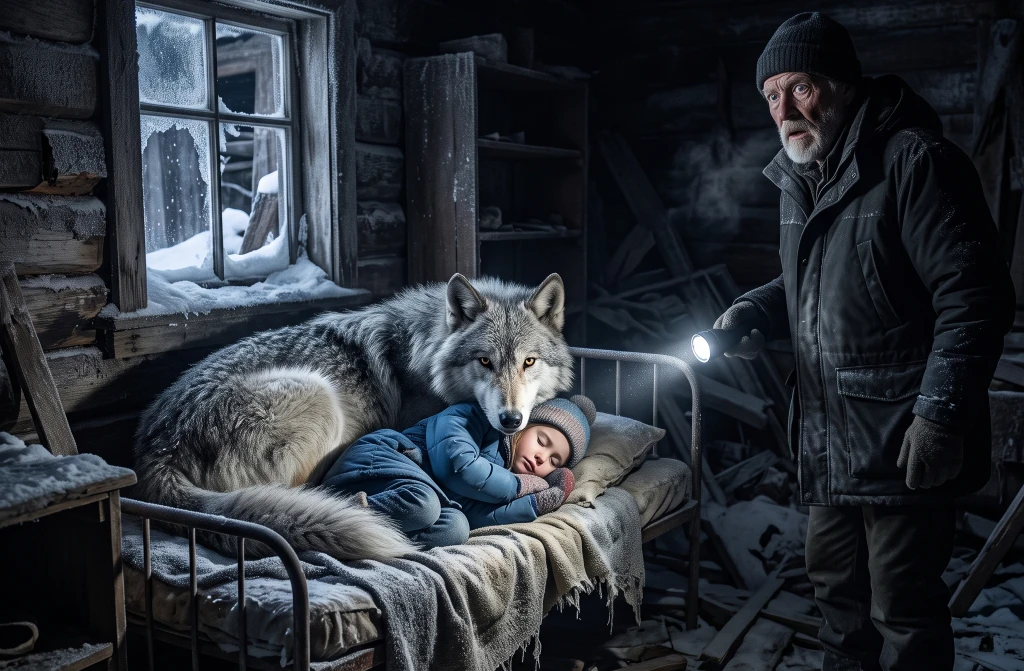
Eli didn’t reach for his shotgun first.
He reached for the meat.
“Easy,” he called, though his voice sounded rough in the empty cabin. “I hear you.”
Outside, the January wind moved through the black spruce like water through teeth. Snow had been falling since dusk, thick and sideways, the kind of Northwoods storm that erased roads, driveways, fence lines, and good judgment. The thermometer nailed beside the window read eleven below, and that was before the wind found your bones.
Another blow landed against the door. Then came claws, dragging hard down the wood.
Eli limped to the kitchen table and picked up the strip of venison he had saved from supper. He had meant it for Ash anyway. The wolf had been coming around for almost two years now, never tame, never truly belonging to anyone, but familiar enough that Eli knew the rhythm of him: two knocks of his heavy body against the door, a low chuff, the patient wait on the stoop.
That was not what this was.
“Hold on,” Eli muttered, pulling on his coat. “You’ll take the door off the hinges.”
He slid the bolt back. The storm shoved into the cabin, carrying needles of snow and the wild, iron smell of the woods. Ash stood on the threshold, enormous and silver-gray, his coat crusted white along the shoulders. His amber eyes did not drop to the meat in Eli’s hand.
They stayed on Eli’s face.
The wolf’s lips lifted, not in threat, but in a tight, desperate sound Eli had never heard from him before. Ash stepped forward, seized the hem of Eli’s coat in his teeth, and pulled.
“Hey.” Eli braced a hand against the doorframe. “You’ll tear that.”
Ash let go, backed into the snow, and barked.
Not a howl. Not a growl. A bark, sharp and broken, as if he had borrowed the sound from a dog and did not know how to use it.
Eli stared at him, the strip of venison hanging uselessly from his fingers. Two winters ago, he had found Ash caught in an illegal trap near Hollow Creek, a half-grown wolf with blood frozen down one leg and enough fight left in him to take Eli’s hand off. Eli had been a county paramedic for thirty-eight years. Fear had never stopped him from kneeling beside the injured.
It had taken most of a night, two towels, half a bottle of antiseptic, and the last clean sheet in the cabin, but Ash had lived. After that, the wolf came and went like weather. Sometimes he left a rabbit on the porch. Sometimes he watched from the tree line while Eli stacked wood. Sometimes, in the deep dark of winter, he came close enough to eat from the old man’s hand.
He had never begged.
“What is it?” Eli asked quietly. “Trap?”
Ash lunged forward, caught his coat again, and pulled so hard Eli stumbled over the threshold. The cold slapped his face and stole his breath. Ash released him, ran three steps toward the woods, then turned back, stamping his front paws in the snow.
Eli looked past him into the storm. Nothing but black trees, flying white, and the narrow beam of yellow from his kitchen.
A sensible man would have closed the door. Eli was seventy-two, with a left knee that clicked every time he climbed the porch steps and a spine that reminded him of every stretcher he had ever lifted. A sensible man would have told himself a wolf could survive weather that would kill an old widower before sunrise.
But Eli had spent his life answering calls that came at inconvenient hours. Babies came early. Hearts stopped during blizzards. Accidents happened on Christmas Eve. Pain never checked the weather.
“All right,” he said.
The old habits came back before his courage did. He grabbed his headlamp, the big flashlight, matches, a pocketknife, and the battered red medical bag that had been sitting in the hall closet since the county shut down the volunteer station. He paused with his hand on the bag’s cracked handle. He had not carried it on a call in five years.
Then Ash barked again.
Eli took the bag.
“If this is about a raccoon,” he said, pulling on his gloves, “we’re going to have words.”
Ash led him straight into the timber.
The wolf did not run the way he usually did. He kept just far enough ahead to guide, then circled back whenever Eli sank too deep or stopped to breathe. The snow was above Eli’s shins in the open places and nearly to his knees where the wind had piled it against fallen trunks. Twice he had to lean against a tree until the sparks cleared from his vision.
The woods changed after twenty minutes. Eli felt it before he placed it. The spruce grew denser, their boughs bent low with snow, and the land dipped toward the old Hollow Creek survey camp. Nobody went that way anymore, not since the logging company pulled out and a hunter was found dead in one of the cabins a decade later. Local boys dared each other to go there in summer, but even they left before dark.
Ash bounded down the slope without hesitation.
Eli stopped at the ridge. “No,” he called after him. “Not there.”
The wolf turned. Snow clung to his whiskers. He came back, pressed his muzzle into Eli’s gloved hand, and made a low sound that was almost a whine.
That frightened Eli more than the dark.
He followed.
The cabin appeared in the flashlight beam one piece at a time: a sagging roof, one crooked wall, a window blanked by frost, the old porch half-swallowed by drifts. It should have looked dead. Everything about it should have belonged to rot, mice, and weather.
But the door had been boarded from the outside.
Two fresh pine planks crossed it in a crude X, yellow and raw against the old gray wood. The nail heads shone silver in Eli’s beam. Snow had not yet crusted over the boards. Sap still glistened along one splintered edge.
Eli stood very still.
“Who boards up an empty cabin from the outside?” he whispered.
Ash leapt onto the porch and clawed at the planks. His nails shrieked against the wood. He caught one board in his teeth and pulled until it groaned, but the nails held.
Eli set the flashlight between his boots, shrugged off the shotgun, and found a length of rusted rebar near the steps. His gloves slipped on the metal. His shoulder burned. The first nail came loose with a scream that cut through the storm.
“Back,” he told Ash.
The wolf backed up but did not take his eyes off the door.
The first plank fell into the snow. The second came easier because Eli was angry by then, angry without yet knowing at whom. The old door sagged inward when the last nail gave, and the smell that came out was worse than mildew. Cold, human waste, damp cloth, and something sour underneath.
Eli lifted the flashlight.
“Hello?” His voice shook. “Is somebody in there?”
For a few seconds there was only the wind moving through cracks in the walls. Then, from the far corner, something shifted beneath a filthy quilt.
Eli stepped inside. The floorboards complained under him. His light found an overturned crate, a line of expensive bottled water, a stack of unopened protein drinks, and a grocery bag from a high-end market two towns over. There were cans of soup with pull tabs, packaged fruit cups, sealed boxes of crackers.
Not forgotten things.
Supplies.
The quilt moved again.
Eli reached the cot in the corner and pulled back the edge.
A child lay curled beneath it.
She was small enough that, for one confused second, his mind refused to accept what he was seeing. A girl, maybe five or six. Pale hair matted against her forehead. Lips split from thirst. A good winter coat hung open around her, far too large for her shoulders, and underneath it she wore thin pajamas printed with little yellow moons.
Her eyes were closed. Her skin, when Eli touched her neck, was so cold that his fingers tried to draw back from it.
“Come on,” he whispered. “Come on, sweetheart.”
He found a pulse.
Thin. Slow. There.
Eli let out a breath that hurt his ribs. He set the medical bag on the cot and worked with the careful speed of a man whose hands remembered what the rest of him thought he had lost. Airway. Breathing. Pulse. Signs of exposure. No obvious bleeding. Too cold, too thin, too quiet.
Ash came in behind him.
“No,” Eli warned, turning fast. “Stay back.”
The wolf ignored him. He stepped to the cot, lowered his huge body beside the child, and laid himself along her spine. His nose touched her cheek. He began licking her face, not roughly, not the way an animal tears at food, but in quick, urgent strokes.
The girl’s eyelids fluttered.
Her mouth opened. No real voice came out, only a scraped little breath.
“Dog.”
Eli’s throat tightened.
Ash tucked his head over her, and the child moved one hand. Her fingers, blue around the nails, sank into the thick fur at his neck. She did not reach for Eli. She did not ask where she was. She clung to the wolf as if he were the only familiar thing left in the world.
That was when Eli understood that Ash had been here before.
Maybe once. Maybe many times. Maybe the wolf had found the cracks in the wall and slept outside them. Maybe he had pressed his body against the boards while the child froze on the other side. Maybe, after days of circling a place no animal should care about, he had gone to the only human he trusted.
Eli looked again at the supplies. Too much food to be an accident. Too neat to be panic. Someone had left a child in a condemned cabin with enough water to keep her alive and enough cold to make her disappear slowly.
His flashlight slid across the floor and caught a flash of gold.
It was a barrette. A tiny butterfly, heavy for its size, lying near the cot as if it had fallen from the child’s hair. Eli picked it up. The underside was engraved in delicate script.
For my Lily-Bug — Dad.
On the clasp was a small stamped emblem: a white pine inside a circle, with a W beneath it.
Eli had seen that mark on campaign signs, charity banners, the side of the new pediatric wing at Kestrel County Medical Center. Whitaker Family Foundation. Grant Whitaker, county executive, state senate candidate, husband, father, the man whose smiling face stood beside the words Strong Families. Safe Children.
Eli looked down at the half-frozen girl in the wolf’s shadow. Then, outside the broken doorway, beneath the roar of the wind, came a sound that did not belong to the storm. A boot settled into fresh snow…
To read the rest of the story – CLICK the NEXT button 👇👇👇