


The white mare at the back of the kill pen did not scream when the gate slammed behind her. That was what made Nathan Hale stop. Every other animal at Mill Creek Stockyard was fighting the morning in some small, ordinary way. Calves bawled from the holding alleys. Goats climbed over one another in the portable panels. Somewhere near the main barn, a mule kicked hard enough to make sheet metal ring, and the auctioneer’s voice ran above it all in a fast, practiced chant that made grief sound like business.
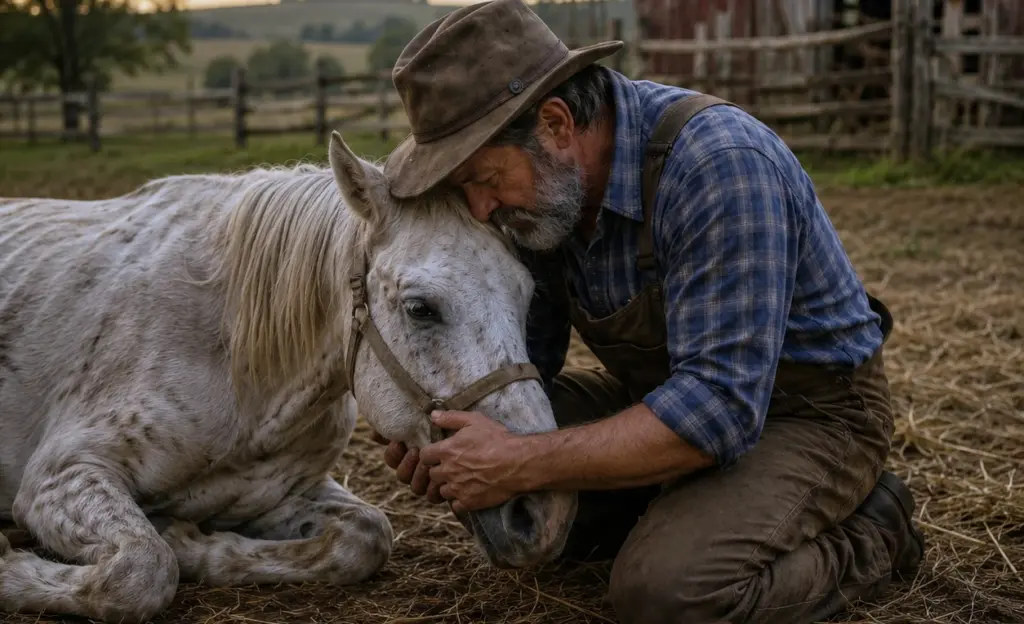
But the mare in the last pen barely moved.
She stood in a square of hard-packed dirt where the gravel thinned into weeds, her white coat so packed with dried mud and sweat that she looked gray in patches. Her head hung low, almost level with the swollen joint of her front leg. That knee was twice the size it should have been, hot-looking even from the other side of the pipe rail, and she held it slightly off the ground as if touching the earth hurt more than floating above it.
Nathan had not come for a horse.
He had come for a used alternator.
The old Massey Ferguson had quit three days earlier in the lower pasture, coughing once and then falling silent in a way that sounded expensive. He had two hundred and sixty dollars folded inside his wallet, tucked behind his driver’s license and a photo of Ellen taken the summer before she got sick. That money was supposed to get the tractor running long enough to cut the back field before the weeds went to seed. It was also the last cash he could pull without shorting the bank note or the property tax payment that had already been waiting too long on the kitchen counter.
At seventy, Nathan had learned to walk through crowds without inviting conversation. He kept his battered cap low, his hands in the pockets of his faded work coat, and his eyes away from men who used to call out to him from truck beds and auction rails. Since Ellen died thirteen months earlier, people had started speaking to him too carefully, as if grief had made him breakable and dangerous to touch.
He preferred the animals. They did not ask how he was holding up.
“Don’t get sentimental over that one.”
The voice came from behind a livestock trailer with peeling red paint. A thin man in a sweat-stained ball cap leaned against the fender, smoking a cigarette burned nearly to the filter. His boots were clean in the way kill buyers’ boots often were: clean enough to suggest he paid other men to do the hard part.
Nathan did not answer.
“She’s done,” the man said, nodding toward the mare. “Came in last night. Somebody already ran her through three hands trying to make her disappear cheap. Leg’s infected, belly’s empty, and she won’t load worth a damn. I’m waiting on a transport truck, assuming she doesn’t drop before they get here.”
The mare flicked one ear. Not toward the man. Toward Nathan.
He stepped closer to the rail. “Who owned her?”
The man laughed under his breath. “Old man, with animals like that, you don’t ask family history. You pay by the pound and hope the paperwork is boring.”
Nathan looked at the mare’s neck. Beneath the mats of hair and mud, he could see old rub marks where a good halter had sat for years. Not rope scars from a backyard pony. Smooth, worn lines from leather. Her hooves, though cracked now, had once been shaped by a farrier who knew what he was doing. Whatever this horse was today, she had not started her life in a cull pen.
The buyer pushed off the trailer and came closer. “You want advice? Go find your tractor part. You look like a man who can’t afford a mistake.”
Nathan almost smiled at that. The stranger had no idea how right he was.
He should have kept walking. Every practical part of him knew it. A dying horse meant feed he did not have, medicine he could not afford, and a hole dug somewhere past the barn if the mare gave up before sunrise. Ellen would have told him the same thing, though she would have said it softer while sliding coffee across the kitchen table with both hands wrapped around the mug.
Then the mare lifted her head.
It took effort. Her neck trembled, and her bad knee shook under the shifting weight. Her eyes were dark and quiet, not wild with panic or sharp with anger. They held a dull, settled emptiness that made Nathan’s chest tighten before he could stop it.
He knew that look.
Ellen had worn it during her last week in the hospital bed the hospice nurse set up beside the living room window. Not fear. Not even pain, though there had been enough of that. It was the look of someone who had fought as long as the body allowed and had finally turned toward the far shore because no hand, no prayer, no bargain could pull her back.
Nathan had sat beside that bed with a damp washcloth and a bottle of pills, useless with all his love.
He reached through the pipe rail.
The mare flinched so hard her whole body rippled. She expected pain. She expected a rope jerk, a slap, a boot against the ribs to make her move faster. Nathan held his hand still, palm open, the way Ellen used to touch frightened barn cats before winter drove them under the porch.
“Easy,” he said.
His voice came out rough. He had not used it much that morning.
The buyer snorted. “She ain’t a petting zoo animal.”
Nathan ignored him. He stayed exactly where he was, arm through the rail, shoulder aching, palm open in the dusty air. The mare watched him for a long time. Then, with a small, awkward hop, she dragged herself one step closer. Her injured leg hovered, quivering. Her muzzle stopped inches from his hand.
When she exhaled against his skin, Nathan felt the warmth of her breath all the way through his bones.
He pulled his wallet from his coat.
The buyer straightened. “Don’t do something dumb.”
Nathan counted nothing. He took every bill he had and folded them once. “I’ll take her.”
The man stared at him, then at the money. “You buying a horse or a funeral?”
“Depends on whether she lets me change her mind.”
The buyer gave a hard little laugh and took the cash before Nathan could become reasonable again. He scribbled a receipt on a carbon pad, wrote “white mare, as-is,” and tore the paper off with a shrug. “No refunds. No crying to me if she dies in your trailer.”
Nathan slipped the receipt into his pocket. “Open the gate.”
Loading her took nearly an hour. The transport truck came and went with other animals while Nathan stood in the choking dust beside his old two-horse trailer, speaking low and steady as the mare placed one trembling hoof and then another on the ramp. Twice she stopped. Once she nearly folded. Nathan did not pull the rope. He stood beside her shoulder and waited until she decided the next inch for herself.
By the time she was finally inside, sweat had soaked through the back of his shirt despite the cool spring morning. The kill buyer leaned on the fence and watched him latch the trailer with an expression halfway between amusement and disbelief.
“You got a name for your miracle?” he called.
Nathan looked through the slats at the mare’s lowered head. “Not yet.”
He drove home at twenty miles an hour with the hazard lights blinking on the two-lane road. Cars stacked up behind him, swung around, and honked as they passed, but he kept both hands on the wheel and watched the trailer in the mirror. Every pothole felt like a betrayal. Every brake tap made him picture her going down on the metal floor and never rising again.
The farm looked smaller when he turned in at the leaning mailbox.
Ellen had loved that place even when it was falling apart. She had planted lavender along the porch and painted the kitchen cabinets pale blue with a brush so cheap it left bristles in the finish. Now the lavender had gone woody and gray, the porch steps sagged in the middle, and the house held its silence like a locked room.
Nathan bypassed the main barn. It was too big and drafty for a horse that had spent the night in a slaughter pen. Instead, he backed the trailer to the old foaling shed under the sycamores, the one Ellen had insisted they keep “just in case some poor thing needs a soft place someday.”
He had not opened that shed since the summer before she died.
Dust lifted in gold sheets when he pushed the door in. He moved without letting himself think too much, hauling out old boards, spreading pine shavings from a half-used bag, and shaking loose flakes of hay from the last square bales stacked against the wall. By the time he lowered the trailer ramp, the little shed smelled of dry cedar, dust, and the sharp green sweetness of hay.
The mare took nineteen minutes to step down.
Nathan counted because he needed something to do besides fear. When her front hooves touched grass, the bad knee buckled. He threw his shoulder into her ribcage, his boots sliding in the mud, and for one long second they leaned against each other like two old buildings in the same storm.
“Stay with me,” he whispered.
The mare’s breath shuddered. Then she caught herself.
Inside the shed, she did not explore. She stood in the deep bedding, head low, eyes dim, as if softness itself had become suspicious. Nathan brought warm water from the house in a bucket. She ignored the hay, but when he lifted the bucket to her muzzle, she drank in long, desperate pulls, emptying half of it before she stopped.
He washed the mud from her injured leg under the yellow light of a bare bulb. He had treated plenty of farm injuries in his life, though never one this far gone. The swelling was hot under his hand. The skin had split in places, crusted with dirt and old drainage. He mixed Epsom salts in warm water, soaked clean cotton, and wrapped the joint as gently as his rough hands knew how.
She did not kick him. She did not try to bite.
She only watched.
Near midnight, Nathan dragged an overturned feed tub into the corner and sat with his back against the wall. The house waited across the yard with Ellen’s chair beside the cold fireplace and her gardening gloves still folded on the laundry-room shelf. He could not bear the thought of going inside. Not while this broken animal stood a few feet away, fighting breath by breath to remain in the world.
Sometime before dawn, he fell asleep sitting up.
He woke to the soft, cautious sound of teeth pulling at hay.
The mare had her head lowered into the manger. She was chewing slowly, as if she had forgotten the shape of hunger and was learning it again. Nathan stayed still, afraid that even gratitude might startle her. After a minute, he reached for the old quilt he had thrown over his knees and found Ellen’s blue work scarf still tucked in the folds, smelling faintly of cedar and dust.
He pressed it once between both hands.
“You’re going to need a name,” he said, his voice barely filling the shed.
The mare paused, ears shifting toward him.
Ellen had loved willow trees. She used to say they looked fragile until the weather came, and then you found out how much bending a living thing could do without breaking.
“All right,” Nathan said. “Willow, then.”
Two days later, Ray Mercer’s dented pickup rolled into the yard.
Ray farmed eighty acres of hay and ran cattle on land that bordered Nathan’s lower pasture. He was the kind of neighbor who would fix a fence in a rainstorm and then deny he had been there. He found Nathan in the shed, unwrapping Willow’s knee while she stood drowsing in the shavings.
Ray leaned over the Dutch door and looked at the mare for a long time. “Feed store says you bought a ghost.”
“Feed store talks too much.”
“Feed store ain’t wrong often enough to ignore.” Ray’s gaze moved from the horse’s hip bones to the wrap in Nathan’s hands. “You call a vet?”
Nathan kept working. “No.”
“You planning to pay one with wishes?”
“I’m planning to keep her comfortable.”
Ray rubbed a hand over his jaw. He did not mention Ellen. Most people did, sooner or later, and Nathan had come to dread the softening of their faces. Ray only looked at the mare, then at the empty feed sacks stacked near the wall.
“I’ve got senior mash in the barn,” he said. “Bag split, so I can’t sell it. I’ll bring it by.”
“I can’t pay.”
“Didn’t ask.” Ray turned toward his truck, then stopped. “And I’m calling Hannah Reed. Don’t start growling at me. That leg needs eyes better than yours.”
Nathan wanted to refuse. Pride rose automatically, old and useless. But Willow shifted her weight, and the bad knee trembled under her. He let the pride go because it did not feed horses or heal infection.
Dr. Hannah Reed arrived the next afternoon in a white veterinary truck with mud on the fenders and a stethoscope hanging from the rearview mirror. She was younger than Nathan expected, maybe mid-thirties, with clear gray eyes and the practical calm of someone who had seen large animals choose panic, pain, and stubbornness in the same ten seconds.
“I hear you made an expensive decision for two hundred and sixty dollars,” she said, offering her hand.
“Two hundred and sixty used to be expensive.”
“It still is, depending on who’s holding it.” Hannah stepped into the shed and let Willow smell the back of her hand before reaching for the mare’s neck. “Hello, girl.”
Nathan watched her work. She listened to Willow’s heart, checked her gums, ran careful fingers over the swollen knee, and said very little. That silence frightened him more than bad news would have.
Finally, Hannah straightened. “You probably saved her leg from going septic. She’s not rideable. She may never be sound, not really. But if we get the infection down and the weight on slowly, she can be comfortable.”
Comfortable.
Nathan felt the word settle somewhere tender. He did not need miracles. He had already learned what they cost when they failed to arrive.
“I can do comfortable,” he said.
Hannah nodded and reached into her kit. “I’ll draw blood for a Coggins while I’m here. And I need to scan for a chip. Auction horses with no papers are always a mess.”
Nathan frowned. “You think somebody’s looking for her?”
“Maybe. Maybe not.” Hannah clicked on a yellow scanner wand and moved it along Willow’s neck. “Sometimes a chip just gives us old medical history. Sometimes it gives us a headache.”
The scanner passed over the left side. Nothing.
Hannah moved to the right side beneath the mane, slow and methodical.
A bright electronic beep cut through the shed.
Willow flinched. Nathan’s hand went automatically to her shoulder. Hannah looked down at the screen, then scanned the same spot again.
The wand beeped a second time. For a moment Hannah did not move. Her thumb hovered near the button, and the fifteen-digit number glowed in the dirty yellow light of the shed. When she finally turned toward Nathan, her face had lost every trace of casual country-vet friendliness. “Where exactly did you say you bought this mare?” she asked. “The cull pen at Mill Creek.” Hannah closed her fingers around the scanner as if the number itself needed hiding. “Lock this stall tonight,” she said. “And don’t tell another soul she’s here…”
To read the rest of the story – CLICK the NEXT button 👇👇👇