


The calf made no sound when the bottle touched his mouth. That was what frightened Dr. Nathan Mercer most. A healthy elephant calf would have shoved, squealed, kicked, searched, demanded. Even a scared one would have fought the nipple with enough strength to prove some part of him still expected the world to answer. But the little bull curled in the far corner of Cedar Ridge Wildlife Refuge’s quarantine room only tightened his trunk beneath his chin and waited for the human smell to go away.
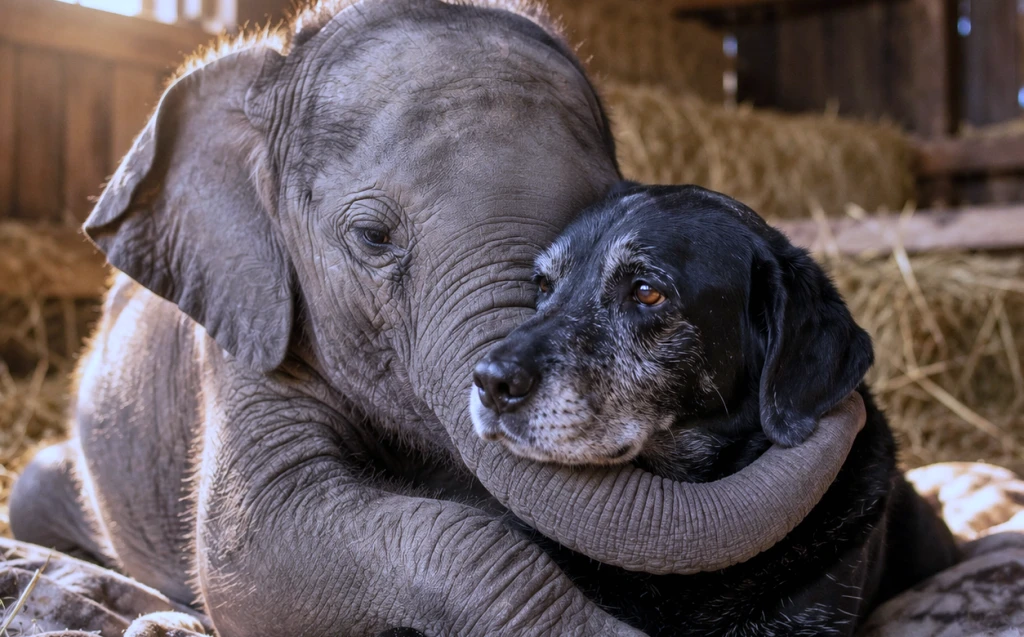
“Easy, Otis,” Caleb Warren whispered from his knees.
Caleb had been handling large animals for sixteen years. He could read fear in a twitching ear, anger in a shifting shoulder, and pain in the soft collapse of a mouth. He had taken in circus horses, seized tigers, half-starved llamas, and one arthritic camel with a hatred of every man alive. But his hand shook as he held the oversized bottle three inches from the calf’s sealed, clouded eyes.
Behind the reinforced glass, Nathan stood with his arms folded tight across his chest. The room smelled of warmed milk replacer, antiseptic, damp hay, and the sharp chemical tang of fear. A portable monitor beeped beside the gate, its numbers telling him what his eyes already knew. Heart rate too thin. Breathing too fast. Body temperature holding, barely.
Beside him, Lena Brooks pressed two fingers to the bridge of her nose. She had changed shirts twice that day and still wore chalky streaks of formula across her forearms.
“He knows it’s there,” she said quietly.
Nathan nodded once. “He knows.”
Caleb did not move the bottle closer. The last time they had tried, Otis had thrown his head sideways and slammed his shoulder into the padded wall. He was only three weeks old, but even a dying elephant carried enough strength to hurt himself badly. Now Caleb waited, the way Nathan had trained all of them to wait when panic was stronger than hunger.
The calf’s trunk uncurled by less than an inch.
Everyone in the hall stopped breathing.
The little gray tip lifted, trembled, and drifted toward the smell of milk. Then Caleb’s knee creaked on the rubber mat. It was a tiny sound, nothing more than fabric shifting against skin, but Otis recoiled as if a door had slammed. His rump hit the corner seam. His ears pinned flat, and his thin sides began pumping with shallow breaths.
Caleb closed his eyes for one second. When he opened them, he did not try again. He screwed the cap back onto the bottle, rose slowly, and backed toward the door without turning away from the calf.
Nathan waited until the heavy latch clicked shut before he let his shoulders drop.
Lena stared through the glass. “We can’t tube him again.”
“No,” Nathan said.
The feeding tube had kept Otis alive twice, if the word alive could still be used for what they were watching. Both times, four people had been needed to restrain him. Both times, his panic had surged so violently that the monitor alarm screamed until the room filled with staff. The calf’s body needed calories. His nervous system could not survive the way they had to give them.
“He lost more weight this morning,” Lena said. She kept her voice professional, but the words came out scraped thin. “He’s not even crying anymore.”
Nathan looked past her into the room. Otis lay folded against the wall, blind eyes swollen shut from the infection that had already stolen his sight before he ever reached them. His hide should have been round and soft with baby fat. Instead it hung over him in loose gray folds, every rib a faint ridge beneath the skin.
Federal wildlife agents had brought him to Cedar Ridge six days earlier after a raid on a collapsing roadside animal park near the Gulf Coast. His mother had gone down during the seizure, too weak to rise from the concrete pen where she had been kept for years. By the time the transport trailer reached the North Carolina foothills, Otis was motherless, half-blind, septic, and terrified of every human voice.
The antibiotics were working. His blood infection had begun to retreat.
The rest of him was leaving anyway.
Grace Kline called the emergency meeting at four that afternoon.
The conference room was too cold, the air conditioner rattling in the window while summer heat pressed wet palms against the glass. A paper plate of untouched sandwiches sat in the center of the table. Nobody had taken one. Caleb sat with his cap in both hands. Lena stood by the wall because sitting down, she said, would make her fall asleep. Nathan remained near the door, still in boots damp from the quarantine wash station.
Grace had run Cedar Ridge for nine years, which meant she was the person who signed every grant application, every repair bill, every rescue intake, and every form nobody wanted to read after an animal died. She was not unkind. That made what she had to say worse.
“His kidney numbers are moving in the wrong direction,” she said, tapping the lab report with one finger. “Fluids are buying time, but they’re not reversing the problem. If he doesn’t take nutrition voluntarily, we are going to watch his organs fail.”
“No one here wants that,” Nathan said.
Grace looked at him over the top of her reading glasses. “I know that.”
“Then give me time.”
“I already have.”
“Not enough.”
Lena turned from the window. “Nathan.”
He heard the warning in her voice. He knew what it meant. Do not ask for what we cannot give. Do not make Grace be the villain because she is willing to say the word the rest of us keep swallowing.
Grace folded the report and set it down. “There’s a point where hope becomes a way for us to avoid doing the merciful thing.”
Nathan hated how calmly she said it. He hated more that she was right often enough to be dangerous.
“He still responds to vibration,” he said. “This morning when the backup generator kicked on, his left ear tracked the hum before the monitor picked up the stress response. He’s not gone. He’s not neurologically shut down.”
“He won’t eat.”
“Because everything offering food smells like restraint, transport, needles, and us.” Nathan pushed away from the door and came to the table. “He was born into a concrete pen. His mother died in front of him. Then strangers loaded him into a trailer, treated his eyes, put lines in his veins, and forced a tube down his throat. We are the only world he knows, and every part of us means pain.”
Caleb rubbed a hand over his jaw. “So what are you suggesting?”
Nathan had no answer ready. Only the stubborn certainty that death was too clean a solution for a calf whose body still listened.
“Forty-eight hours,” he said.
Grace stared at him. “That’s not a plan.”
“It’s the space to find one.”
“And if you don’t?”
He looked through the conference room window toward the low concrete building where Otis lay in quarantine. The roof vents shimmered in the heat. “Then I’ll be the one to make the call.”
Lena looked down at her boots.
Grace took off her glasses and rubbed her eyes with the heel of one hand. For a long moment, the only sound was the air conditioner clicking hard against the frame. At last she said, “Forty-eight hours. But if his numbers crash, we don’t wait for the clock.”
Nathan nodded, because gratitude would have been too heavy to lift.
He should have gone home after that. He should have eaten something, showered, and tried to sleep before the night check. Instead, as the sun dropped behind the ridge and the whole refuge turned gold and green, he walked past his truck and through the side gate to the county animal shelter next door.
Cedar Ridge shared a fence line with the shelter, along with supplies, storage, and whichever veterinarian happened to be on call when the county brought in something with teeth. Nathan often stopped there when his head got too loud. Dogs, at least, usually wanted clear things. Food. Pain relief. A dry blanket. A hand that did not hit.
That evening, the kennels were strangely quiet.
“Back here,” Marcie Voss called.
Marcie had run the shelter since before Nathan moved to North Carolina. She was in her sixties, square-shouldered, silver-haired, and permanently unimpressed by dramatic people. He found her in the quarantine wing, rinsing bowls in a utility sink. A faded sweatshirt was tied around her waist despite the heat.
“You look awful,” she said.
“Good to see you too.”
“Elephant calf?”
Nathan leaned one shoulder against the cinderblock wall. “He’s dying by inches.”
Marcie’s face softened, but only briefly. She dried her hands on her jeans. “Then you need to meet someone.”
“I don’t have room in my life for someone.”
“No one ever does.”
She led him down the back corridor, away from the barking runs, to a kennel with a blanket folded in the corner and an untouched bowl of food by the door. At first Nathan saw only a dark shape on a raised cot. Then the shape lifted its head.
The dog was a big black Lab mix, broad through the chest, gray already touching the muzzle though he was not old. A healing line of stitches crossed one shoulder where the fur had been shaved down to dark skin. He did not bark. He did not wag. He watched Nathan with a stillness that felt less like obedience than exhaustion.
“His name is Boone,” Marcie said. “Came in through a family surrender. Sort of.”
Nathan crouched outside the kennel. Boone’s eyes followed him, steady and flat.
“Sort of?”
“He belonged to a backcountry guide out in Montana. Man named Ben Hollis. Took pack trips, search assists, hunting camps, all of it. Boone went everywhere with him.” Marcie picked up the full food bowl and frowned at it. “Three weeks ago, Ben went looking for a loose mule after a storm. A bear had been on a carcass nearby. Rangers found Ben the next morning.”
Nathan’s gaze moved to the dog’s shoulder.
“Boone was lying across him,” Marcie said. “Torn up, dehydrated, wouldn’t let anyone close. They had to sedate him before they could move the body. Ben’s sister brought him east because she couldn’t leave him out there, but she lives in a second-floor apartment and works double shifts at the hospital. He wouldn’t eat. Wouldn’t come inside. Wouldn’t sleep unless his back was against the door.”
Boone lowered his head to his paws. His tail moved once against the cot, a slow, polite thump.
“He’s not aggressive,” Marcie added. “Just… done.”
Nathan understood before he wanted to.
He had seen animals grieve. Not the sweet, simplified version people liked to film, but the hollow kind that rearranged the body. Horses that stood in a corner after a pasture mate died. Dogs that stopped responding to names. Primates that carried what was gone until someone made them let go. Otis was trapped in terror. Boone was trapped in absence. Different doors, same dark room.
Nathan’s phone buzzed in his pocket.
He pulled it out, expecting a text from Lena. Instead, the quarantine monitor app opened with a soft alarm tone. The sound feed from Otis’s room had triggered on movement. Through the speaker came a low, broken rumble from the calf, barely audible beneath the fan.
Boone lifted his head.
Nathan stilled.
The dog’s ears angled forward. His nose worked once, though there was no scent to catch. The sound came again, that small cracked vibration of a calf with no mother and no herd, and Boone rose from the cot for the first time since Nathan had arrived.
Marcie whispered, “Well, I’ll be.”
Boone stepped to the kennel door. He did not paw at it. He did not whine. He pressed his chest lightly against the chain link and listened to the phone in Nathan’s hand with the full attention of a working dog hearing something that needed locating.
Nathan’s pulse began to move in a way that had nothing to do with hope yet.
Not hope.
A possibility.
Marcie looked from the dog to Nathan. “Whatever you’re thinking, I can already tell Grace is going to hate it.”
Nathan slid the phone closer to the fence. Boone lowered his head until his nose almost touched the speaker. When Otis rumbled again, the dog answered with a low vibration of his own, not a growl, not a bark, just a deep sound from the chest. It traveled through the chain link and into Nathan’s bones.
He stood slowly.
“Unlock the kennel,” he said.
Marcie’s eyebrows went up. “For what?”
Nathan looked back toward the refuge, where the quarantine lights glowed white against the deepening blue of the foothills. “Tomorrow morning, I’m taking him to meet an elephant.”
By 7:10 the next day, every person in the isolation wing looked like they wished they had said no more forcefully.
Grace stood behind the observation glass with her arms folded. Lena had a hand on the doorframe, pale around the mouth. Caleb waited beside the padded room with a catchpole he clearly hoped not to use. Nathan had a capped sedative syringe in his chest pocket and Boone’s leash looped twice around his right hand.
Inside, Otis lay on the hay, folded into the same corner he had chosen six days earlier. Caleb slid the bolt free. The door opened two inches. Boone took one quiet breath at Nathan’s knee. On the other side of the wall, the blind calf lifted his head toward the sound…
To read the rest of the story – CLICK the NEXT button 👇👇👇