


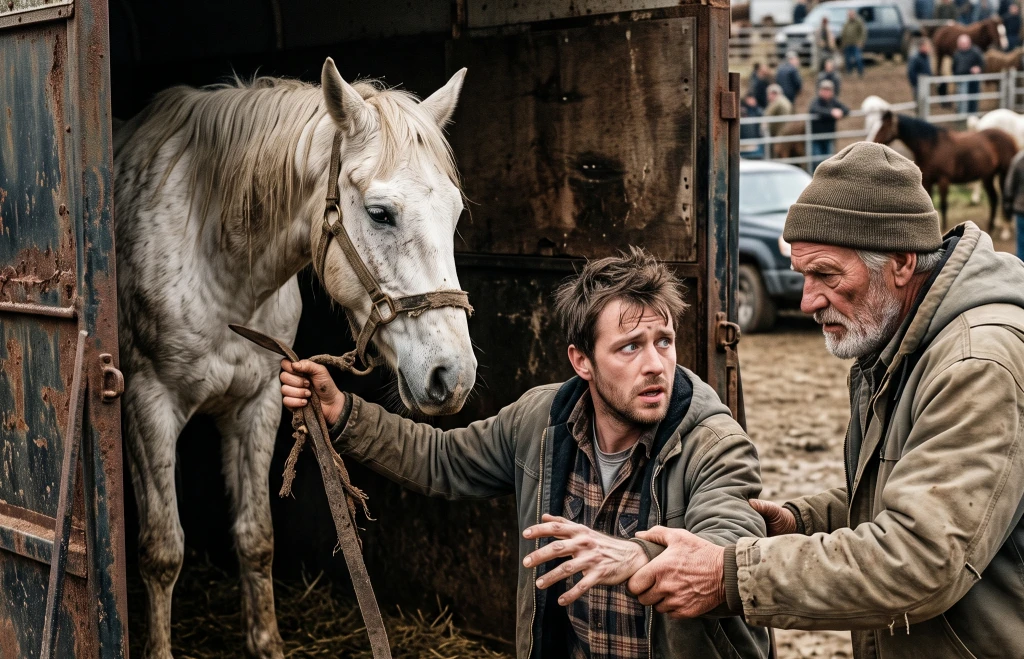
The white mare was standing in the wrong pen. Nolan Whitaker knew that before he saw the number on the rusted gate, before he smelled the sour mix of fear, manure, and sun-baked metal that clung to the back corner of Briar County Livestock Exchange. Healthy horses didn’t stand that still. They didn’t keep their heads low enough for their noses to brush the dirt. They didn’t hold one front leg in the air while every muscle in their body shook from the effort of not falling.
Around the main barn, the auctioneer’s voice rolled through the loudspeakers in a quick, practiced chant, selling feeder calves and goats to men with folded arms and muddy boots. Pickup trucks backed toward loading ramps. Kids ran past with funnel cakes. Somewhere near the equipment swap, somebody started a diesel engine that coughed black smoke into the warm September air.
Nolan had come for an alternator, not a horse.
His tractor had died in the lower pasture four days earlier, and the bank did not care that the hay still needed cutting. The county did not care that property taxes were due in less than three weeks. The farm account held just enough to keep the lights on, maybe, and the two hundred and sixty dollars in Nolan’s wallet had already been assigned a job before he left home.
Then he saw her.
She might have been beautiful once. Beneath the caked mud and yellowed sweat, her coat was almost white, but neglect had made a ruin of it. Her mane hung in ropes. Her ribs made hard shadows under her hide, and her left knee was swollen grotesquely, stretched tight and angry beneath the skin. She stood in the cull pen with three old ewes and a blind pony, all of them waiting for men who bought animals by the pound.
Nolan stopped at the rail fence and forgot about the alternator.
“Don’t get attached,” a voice said.
A thin man in a stained ball cap leaned against a stock trailer with a cigarette between his fingers. Nolan recognized the type. Not a farmer, not really. A trader. One of the men who bought the desperate mistakes and turned them into cash before anyone asked too many questions.
“She’s already spoken for,” the man added. “Transport’s coming through after lunch.”
Nolan looked at the mare’s knee. “Transport where?”
The trader gave a dry little laugh. “Where do you think? She ain’t going to a riding camp.”
The mare did not react to their voices. That bothered Nolan more than if she had panicked. A horse in pain should pin her ears, swing her head, fight the rope, try to live in whatever clumsy way a frightened animal could manage. This mare simply stood in the dust as if she had already traveled past fear and found nothing on the other side.
Nolan’s hand went to the top rail. The metal was hot from the sun.
“She got a name?” he asked.
“Grade mare,” the trader said. “No papers.”
“That wasn’t my question.”
The man flicked ash into the dirt. “Old man, she’s lucky if she’s got a day left. You want a name, call her whatever you want while you’re digging the hole.”
Nolan had not hit a man in thirty-two years, not since he was young enough to think anger could fix anything. Still, something inside his chest tightened in an old, dangerous way. He kept his eyes on the horse instead, because the horse had done nothing to deserve another hard human sound.
Fourteen months earlier, Nolan had sat beside his wife’s hospice bed while the late-afternoon light fell across the quilt she had sewn the winter they lost their first crop. Maggie had been small by then, all sharp wrists and careful breaths, but she still managed to look at him with the kind of patience that made him feel both loved and ashamed.
“Don’t disappear after me,” she had whispered.
He had promised her he wouldn’t.
Then he had done exactly that.
Since the funeral, Nolan had kept the farm running in the narrowest possible sense. He fed the chickens, patched fences, paid what bills he could, and let the rest of the world go quiet. Neighbors stopped dropping by after he let coffee grow cold too many times on the table. The church ladies quit leaving casseroles on the porch. Even the house seemed to understand that it was no longer a home but a place where one old man waited out the evenings.
The mare lifted her head.
It was not much. A few inches, maybe. Enough for Nolan to see her eyes beneath the dirt-stiff forelock. They were dark and dull, but not empty in the way the trader seemed to think. There was still something there, pressed down under exhaustion. A question, maybe. Or the last weak thread of one.
Nolan slowly slipped his hand between the rails.
The mare flinched so hard her bad leg trembled. Her whole body pulled inward, expecting the blow before it came. Nolan kept his palm still, fingers open, the way his father had taught him when he was a boy gentling colts in the round pen.
“No hurry,” he murmured.
The trader snorted. “She can’t even walk to you.”
Nolan ignored him.
For a long moment, the mare only stared. A fly crawled along the ridge of her neck. Her breathing came shallow and uneven, the skin along her ribs quivering each time she shifted weight off that ruined knee. Then, with a stiffness that made Nolan’s own joints ache in sympathy, she made a small, dragging hop toward the fence.
The trader looked away first.
The mare lowered her muzzle until it hovered over Nolan’s palm. She did not sniff him like a curious horse. She simply stood there, close enough for her breath to warm his skin, as if touching kindness might hurt more than pain if it turned out not to be real.
Nolan felt Maggie’s absence move through him, not like a memory this time, but like a hand pressed to his back.
He withdrew his arm and reached into his jacket pocket. His wallet was soft at the corners, the leather darkened by years of sweat and rain. Inside were the bills meant for the tractor, folded beside an old photo of Maggie in the garden, squinting at him because he had taken the picture before she was ready.
He pulled out the money.
The trader straightened. “You serious?”
“How much?”
“For her?” The man stared as if Nolan had asked to buy a dead tree stump. “Two hundred. Cash. And I don’t haul, I don’t guarantee, and I don’t want to hear about it when she goes down in your trailer.”
Nolan held out the bills. “Write me a receipt.”
The trader moved quickly then, like speed might keep common sense from catching up. He snatched the money, counted it with his thumb, and dug a bent receipt book from his back pocket. While he scribbled, Nolan unlatched the gate and stepped into the pen.
The mare’s ears flicked. She watched him, but she didn’t move away.
“Easy,” Nolan said, more breath than word.
Up close, she was worse. The smell of infection rose from the swollen joint, hot and metallic beneath the heavier odor of old mud. Her halter was cheap nylon layered over an older leather throatlatch someone had cut and left hanging beneath it. The leather was stiff with dirt, but it had once been expensive. Nolan could tell by the stitching.
The trader tore the receipt free. “There. One white grade mare, as is. Congratulations. You bought a problem.”
Nolan folded the paper and put it in his wallet. “I’ll need help loading her.”
“Not my job.”
“You took my money.”
The trader’s jaw tightened, but a few men near the fence had begun watching. He muttered something under his breath and grabbed a lead rope. The moment he stepped toward the mare, she lurched backward, eyes rolling white. Her bad knee buckled, and for one terrible second Nolan thought she was going down right there in the dust.
He put himself between them without thinking.
“Give me the rope,” he said.
The trader hesitated.
Nolan did not raise his voice. “Give it to me.”
Something in his tone made the man toss him the rope instead of arguing. Nolan clipped it to the mare’s halter and stood beside her shoulder until the shaking eased. He didn’t pull. He let her find the first step, then the second, and then the awful, slow third.
It took nearly thirty minutes to move her from the cull pen to Nolan’s battered stock trailer. People stared as he guided her across the yard. A teenage girl near the goat pens covered her mouth. An older rancher took off his cap and looked down. Most people turned away, because pity was easier when it did not ask anything of you.
At the ramp, the mare stopped.
Nolan could feel the whole day holding its breath around them. The trader shifted impatiently behind him, but Nolan kept his hand on the mare’s neck and waited. He talked to her about nothing in particular, about the field behind his barn, about the shade under the sycamores, about how the old foaling shed was still standing even though no one had used it in years.
At last, she placed one front hoof on the ramp.
The sound was small, a dull scrape of metal under a dying animal’s weight. Nolan’s throat tightened. She took another step. Then another. When she finally stood inside the trailer, trembling and slick with sweat, Nolan slid the divider gently into place and secured the latch.
The trader reached past him to close the back door, and that was when the strip of old leather beneath the halter swung loose.
Something brass flashed under the mud.
The trader saw it at the same time Nolan did. His face changed so quickly that Nolan almost missed it—not greed, not irritation, but alarm. He lunged for the leather strap.
Nolan caught his wrist.
For the first time all afternoon, the trader looked afraid.
“Leave it,” Nolan said.
The man yanked his hand free and stepped back, forcing a laugh that came out too sharp. “Suit yourself. Keep the junk if you want.”
Nolan waited until he was gone before he touched the brass plate. Most of the front had been scraped raw, as if someone had tried to file away whatever name had once been engraved there. But on the back, hidden against the leather, three clean letters remained. H.R.F. Nolan closed the trailer door slowly, the little brass tag warm against his palm…
To read the rest of the story – CLICK the NEXT button 👇👇👇