


The baby elephant had pressed himself so tightly into the back corner of the recovery stall that his spine followed the seam where the rubber floor met the wall. His trunk was folded under his chin like he was trying to hide it from the world, and every breath came out thin, wet, and too fast. Dr. Owen Mercer stood outside the rail with a bottle warming under his arm and felt, for the first time in years, the sickening weight of having no good choice left.
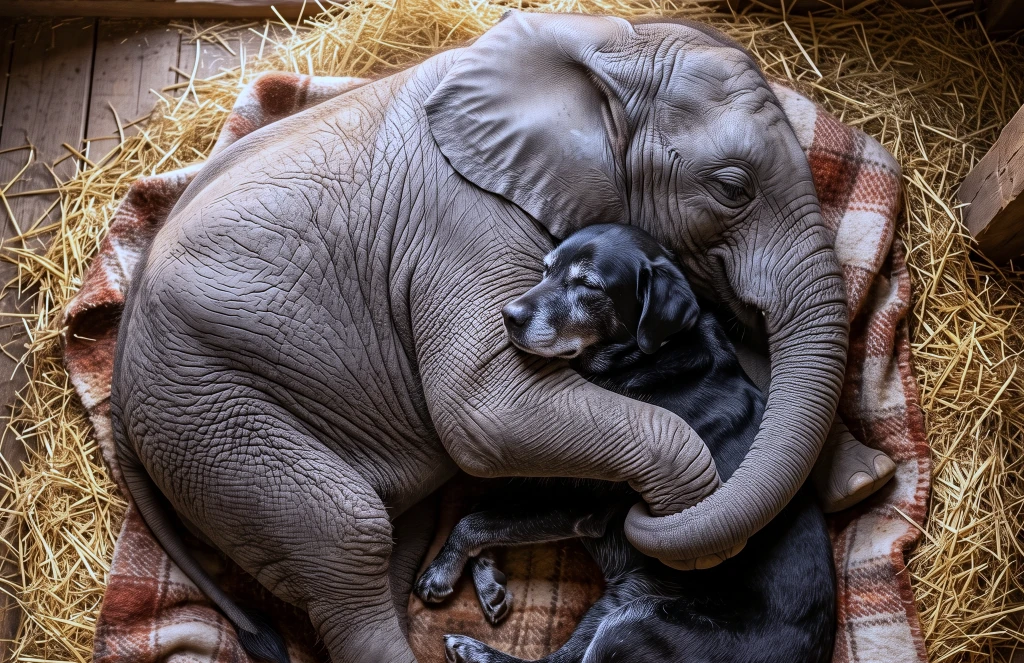
It was late afternoon in the Blue Ridge foothills, the kind of August heat that made even the shadows feel damp. Beyond the clinic building, the older elephants at Hollow Creek Wildlife Rescue moved through their pasture with slow, dusty patience, their low rumbles traveling through the ground more than the air. Inside the isolation wing, though, there was only the hum of a wall fan, the sharp smell of disinfectant, and the sound of a calf slowly giving up.
“His breathing’s worse,” Lena Brooks said beside him.
Owen didn’t answer right away. Lena was the senior elephant keeper at Hollow Creek, and she had the kind of calm that usually steadied everyone else. That afternoon, her khaki shirt was streaked with milk replacer and mud, and her hair had come loose from its braid. She looked as if she had spent the last five nights sleeping in chairs, which she had.
“I know,” Owen said.
The calf’s name was Finn. He was barely a month old, though it was hard to believe when you looked at him. A healthy elephant calf should have been round and nosy and loud, all ears and curiosity, bumping into buckets and leaning into the legs of anyone patient enough to stand still. Finn was folded into himself, his gray skin loose over his ribs, his eyes clouded and sealed half-shut from an infection that had gone untreated far too long.
The medication had saved his life, if you could call this living. It had cleared the worst of the fever and pulled his blood pressure back from a dangerous edge, but nothing could restore his sight. The infection had destroyed too much. Owen had delivered that news to the staff two days earlier, and nobody had said much afterward. In rescue work, silence was often how people kept doing their jobs.
Finn had arrived six days before in a federal transport trailer, wrapped in blankets, dehydrated, and crying in a hoarse little call that made every keeper on the property stop moving. Wildlife officers and state investigators had seized him from a failing roadside animal park near the Gulf Coast, the kind of place that sold snow cones beside rusted cages and called neglect “education.”
His mother had been too weak to rise when the officers came. The report said advanced arthritis, untreated sores, starvation, and exhaustion. She died before the trailer carrying Finn crossed the state line.
Since then, Finn had refused almost everything that might keep him alive.
He turned away from the warmed formula. He ignored softened hay and peeled bananas. He flinched when boots crossed the concrete outside his stall, and when Hollow Creek’s oldest female, Marigold, came to the fence and rumbled to him for nearly an hour, Finn trembled until the staff led her away. Even Rosie, a young rescue calf who could usually coax any frightened animal into curiosity, had only made him press harder into the wall.
“He can’t handle another tube,” Lena said.
Owen looked down at the oversized bottle in his hands. They had tube-fed Finn twice, and both times had nearly broken him. It took five people, soft restraints, and the kind of urgency that left no one feeling merciful. The calf’s heart rate had spiked so violently during the second feeding that Owen had stood over him afterward with a stethoscope pressed to that frail chest, silently bargaining with a body that had already been asked to survive too much.
“No,” Owen said. “He can’t.”
Gabe Turner, their most experienced handler, waited by the stall door. He had worked with horses, cattle, and elephants for almost thirty years, and his movements were so measured that Owen sometimes thought animals trusted him before people did. Gabe held a fresh bottle filled with warm formula and waited for Owen’s nod.
“Go slow,” Owen said, though he knew Gabe didn’t need the reminder.
The latch clicked.
Finn’s ears tightened against his head. His trunk curled hard under his chin, and the small muscles along his shoulders began to shake. Gabe stepped inside with his body turned slightly away, avoiding the direct approach that could feel threatening to a blind animal. He lowered himself to one knee several feet from the calf and set the bottle on the rubber mat between them.
No one spoke.
The formula gave off a sweet, warm smell, coconut oil and milk replacer and the faint chalky scent of supplements. Finn’s trunk twitched once. For half a second, something in him seemed to remember hunger. The tip of his trunk loosened, lifted, and drifted toward the scent.
Then Gabe shifted his weight.
It was barely a sound, just the quiet creak of a boot sole against rubber, but Finn jerked as if he had been struck. He scrambled backward, his body hitting the padded corner with a dull thud. His breath turned ragged, and the thin, frightened squeak that came out of him made Lena turn her face away.
Gabe stayed still for almost twenty minutes. He murmured low, easy words that didn’t matter except for their rhythm. He never reached for the calf. He never pushed the bottle closer. At last he stood, capped the bottle, and came out of the stall with his jaw set.
Owen didn’t have to ask.
Thirty minutes later, the small conference room in the administration building felt colder than it had any right to feel. The air conditioner rattled in the window, failing to keep up with the heat pressed against the glass. Caroline Price, Hollow Creek’s director of operations, sat at the head of the table with Finn’s medical file open in front of her.
Caroline was not unkind. That was what made the conversation worse. Unkind people made easy enemies, and easy enemies were a luxury. Caroline cared deeply about every animal at Hollow Creek, but she also signed the checks, talked to donors, answered to the board, and made sure grief did not bankrupt the sanctuary.
“His kidney values are moving the wrong way,” she said. Her voice was flat from exhaustion, not indifference. “Fluids are buying us hours, maybe days. They aren’t feeding him.”
Lena stared at the table. “He lost more weight.”
“I know.” Caroline closed the folder with care. “Owen, we need to talk about suffering.”
The word she avoided sat in the room anyway.
Owen rubbed both hands over his face. At fifty-two, he had spent half his life working with large animals hurt by people who should have known better. He knew when mercy was a needle. He had administered it more times than he wanted to remember, and he had never once thought of it as failure when it was the right thing. But Finn was not beyond reach. Owen could feel it with an animal doctor’s stubborn, irrational certainty.
“He’s still responding,” Owen said. “This morning, when the backup generator kicked on, his left ear turned toward it. When Marigold rumbled from the other side of the wall, his breathing slowed for almost ten seconds. He’s not gone. He’s trapped.”
“In blindness,” Caroline said.
“In fear,” Owen answered. “He lost his mother, his herd, his sight, and every familiar sound he had. The only hands he knows are hands that restrained him, loaded him, poked him, washed his eyes, held him down. To him, we’re all one long emergency.”
Gabe leaned back in his chair. “Then what does he need?”
Owen looked toward the clinic window, where the isolation wing sat beyond the dusty service drive. “Something that doesn’t smell like us.”
Caroline’s expression tightened. “That is not a plan.”
“No,” Owen admitted. “Not yet.”
She gave him until Friday.
Not two weeks, not some generous stretch of hope everyone could pretend was practical. Friday. Three days. If Finn continued to refuse food and his organs began to fail, Owen would be the one to end it. Caroline said it gently, but she said it clearly, and Owen respected her too much to argue past reason.
When the meeting broke, Lena stayed behind. “You really think there’s something else?”
Owen didn’t answer quickly, because she deserved better than comfort. “I think if we keep trying to make him trust people, we’re going to lose him.”
He left Hollow Creek near dusk but did not drive home. Instead, he turned down the gravel lane toward Ridgeview County Animal Shelter, a low cinder-block building that sat just beyond the sanctuary’s lower pasture. Hollow Creek often helped the shelter with difficult medical cases, and Owen sometimes stopped there after hard days because a stitched-up hound or a limping barn cat felt like a problem small enough to solve.
That evening, the shelter smelled of bleach, wet concrete, and kibble. Tess Dunlap, the shelter coordinator, was rinsing the quarantine corridor when she saw him.
“You look awful,” she said, turning off the hose.
“Always good to be seen.”
“Finn?”
Owen nodded and leaned against the chain-link gate. “Tell me you’ve got somebody back here who just needs ear drops.”
Tess’s face changed. “No. But I’ve got someone you should meet.”
She led him past the barking runs to the last kennel in the quiet wing. A large black dog lay on a raised canvas cot with his front paws crossed and his head lifted. He was broad through the chest, heavy-boned, maybe part Lab and part something tougher. A jagged healing scar ran across his left shoulder, the shaved fur around it just beginning to grow back.
The dog did not bark. He did not rush the gate. He simply watched Owen with a tired, level gaze. After a moment, his tail tapped the cot once.
“Boone,” Tess said softly. “He came in four days ago.”
Owen crouched. The dog’s eyes followed him, calm but distant. “What happened to him?”
“He belonged to a backcountry guide named Caleb Ross out in Montana. Caleb took hunters and hikers into the mountains. From what the family told me, he and Boone went out after a pack animal that broke loose during bad weather. There was a bear involved.”
Owen looked at the scar again.
“Boone tried to draw it off,” Tess said. “He survived. Caleb didn’t.”
The kennel seemed quieter after that.
“Caleb’s sister lives outside Asheville,” Tess continued. “She drove out west and brought Boone back because she couldn’t stand the thought of him being left behind. But she works double shifts and lives in a second-floor apartment. He wouldn’t eat. Wouldn’t settle. Wouldn’t respond to her. She surrendered him crying so hard she could barely sign the form.”
Boone lowered his head to his paws. His tail did not move this time.
Owen had seen grief in animals before. He had seen it in horses that called for dead pasture mates, in dogs who slept by hospital beds that were no longer occupied, in elephants who touched the bones of their dead with impossible tenderness. Boone did not look frantic. He looked as if the only person who made the world legible had vanished, and no one had told him what to do with the rest of his life.
“He’s not aggressive?” Owen asked.
“Not once. He lets me clean the wound. Takes food if I sit with him. But he’s shut down. That dog had a job, Owen. He had a person. Now he has neither.”
Owen stayed crouched outside the kennel for a long time.
Behind his eyes, the isolation stall returned to him: Finn curled in the corner, blind and trembling, flinching away from every human sound. Then he looked at Boone, a working dog built around loyalty, lying in a kennel with nowhere to put it.
The idea was unreasonable at first. Then it was dangerous. Then it became the only thought in his head.
Tess saw his expression and straightened. “No.”
“I didn’t say anything.”
“You didn’t have to.”
“He’s steady,” Owen said.
“He’s a dog.”
“He’s a grieving, low-drive, human-bonded working dog with excellent restraint and no kennel reactivity.”
“He is still a dog,” Tess said. “And whatever you’re thinking, I can hear the liability waiver screaming from here.”
Owen stood slowly. Boone lifted his head again, and for the first time, the dog’s eyes sharpened with something almost like attention.
“I have a blind elephant calf dying because every living thing near him feels dangerous,” Owen said. “This dog is dying because the living thing he trusted is gone. I don’t know if they can help each other. But I know what happens to Finn if we don’t try.”
By nine the next morning, everyone at Hollow Creek had told him it was a terrible idea.
Caroline told him first. Lena told him twice. Gabe said very little, which was worse, because Gabe’s silence usually meant he was imagining all the ways an animal could get hurt. Owen did not argue that it was safe. It wasn’t. A frightened calf could crush a dog by accident. A dog’s bark could send Finn into a panic. One bad movement inside a contained room could turn hope into injury.
But Friday was coming.
So Caroline allowed one controlled session in the padded recovery room. No visitors. No noise. Gabe by the door. Lena at the observation window. A sedative ready if Boone panicked. Owen inside the room, close enough to intervene, far enough not to make himself the center of it.
At 10:15 a.m., Gabe carried Finn in and laid him on a deep bed of hay against the far wall. The calf immediately dragged himself backward until his rump touched the padding. His blind eyes leaked clear fluid, and his trunk coiled tight under his chin.
Owen brought Boone in on a thick nylon lead. The dog walked beside him without pulling, his head low, scarred shoulder rolling stiffly under his black coat. At the threshold, Boone stopped. His nostrils moved as he took in the room: hay, disinfectant, fear, milk, old rubber, and the strange, living scent of a baby elephant.
Behind the glass, Lena pressed both hands to her mouth. Owen unclipped the lead. Boone stepped into the room, saw the trembling calf in the corner, and did not move toward him. Instead, the dog turned his head away…
To read the rest of the story – CLICK the NEXT button 👇👇👇