


The first thing I saw was a little boy’s red sneaker lying by the lemonade cart. It sat in the middle of the zoo promenade with its Velcro strap peeled open, small enough to fit in my palm, and for one thin second my mind tried to make it ordinary. A kid had kicked it off. A parent had scooped him up. Someone would come back for it once the panic passed. Then Samson stepped around it.
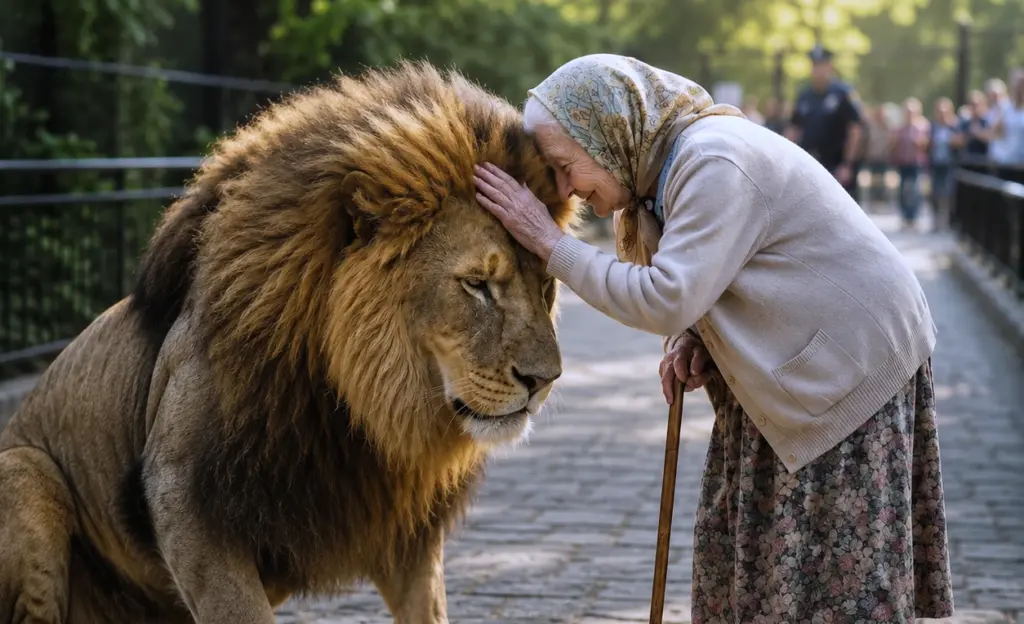
Our twelve-year-old male lion moved down the sun-bright pavement with his head low and his mane dragging in the damp July heat. He wasn’t running. He wasn’t roaring. He walked as if the crowd, the dropped phones, the overturned stroller, and the locked glass doors of the snack shop belonged to another world entirely.
I had worked big cats for fifteen years. I knew the difference between a lion that was hunting, a lion that was frightened, and a lion that was thinking through a problem with all the quiet patience evolution had given him. Samson was doing the third one, and that was what scared me most.
“Everybody inside,” I called, keeping my voice low but hard enough to cut through the noise. “No running. Get behind a door. Now.”
Nobody listened to the “no running” part. A mother dragged two girls into the gift shop and shoved the door closed with her hip. A teenage boy froze beside the trash cans, filming with both hands until his father slapped the phone down and pulled him backward. Near the flamingo rail, an older man had gone pale and still, one hand gripping his wife’s sleeve as if he had forgotten how legs worked.
Samson ignored them all.
I took my radio off my belt, but my thumb slipped once before I found the button. Sweat had already slicked my hands.
“Code Red on the East Promenade,” I said. “Samson is out of containment. Repeat, Samson is out of containment. I need carnivore response, vet team with darts, security lockdown, and city police to the perimeter.”
A burst of voices answered me, too many at once. Control room. Dispatch. The assistant curator. Someone swore softly before remembering the channel was open.
I did not wait for them to organize. I moved sideways, never directly toward Samson, matching his pace from about sixty feet away. If I startled him, if some panicked visitor screamed too close, if a child broke from cover and ran, the entire afternoon could turn in less than a breath.
The strange part was his focus. Samson wasn’t scanning the crowd or testing doors. Every few steps, he lowered his broad nose to the pavement and drew in the air. Then he adjusted his path by inches, following something invisible through the zoo.
That was when I remembered the alarm.
Twelve minutes earlier, a smoke sensor had tripped in the maintenance annex. We had been told it was probably dust from a contractor cutting concrete. Our emergency system had done exactly what it was designed to do for human safety: it reduced power to several magnetic locks in the affected grid so staff could evacuate if the fire doors jammed. Samson’s night shift gate must have lost enough hold for him to lean his whole body against it.
Four hundred and eighty pounds of muscle had done the rest.
He passed the carousel, turned away from the main exit, and headed for the service lane behind the education building. My stomach tightened so sharply I almost lost my footing.
It was produce delivery day.
The back gate by the loading dock would be open for the refrigerated trucks.
“Control,” I said into the radio, already running. “Shut the service gate. Shut it now.”
“We’re trying,” someone answered. “Truck’s in the lane. Driver left the cab.”
Samson disappeared around the corner of the brick education building. I heard the sound a second later, not a roar, not a crash—just the metallic rattle of a gate being brushed by something too large for the space it was entering.
I hit the service lane hard, keys banging against my thigh, and saw the empty opening at the far end of the loading yard.
Beyond it was Briar Street.
Beyond that were houses, sidewalks, a preschool, a bus stop, a neighborhood full of people who had no reason to imagine a lion could step into their Tuesday afternoon.
A white bakery van braked so violently that the back doors flew open and plastic crates slid into the street. A man on a bicycle tipped sideways into a hedge. Across the road, a woman pushing a double stroller saw Samson and made one sound, short and broken, before she turned and ran the other way, the stroller wheels juddering over the curb.
“Police units need to block Briar and Seventh,” I said into my phone now, because the radio traffic had become useless. “Keep sirens back if you can. Do not crowd him. He’s tracking a scent. He is not actively pursuing people.”
The dispatcher asked me to repeat that last part, and I did, though I could hear in her silence that it sounded absurd.
Samson padded along the sidewalk with his tail low and his ears forward. He passed the bakery van without looking inside. He moved by a frozen cluster of landscapers, their leaf blowers hanging from shoulder straps like abandoned instruments. He paused at the corner, lifted his head, and tested the air.
Then he turned toward Finch Park.
Finch Park was barely more than a block of grass, two picnic tables, a playground, and a few old sycamores. On slow mornings, retirees cut through it on their way to the pharmacy. By midafternoon, it belonged to toddlers, dog walkers, and people on lunch breaks who wanted shade.
There were still three children on the playground when Samson entered.
Their babysitter reacted fast. She swept the smallest child off the bottom of the slide and shoved all three of them into the fenced splash pad building, where the restroom door slammed shut and locked. A man with a terrier stumbled backward, dragging the barking dog until the leash tangled around his knees.
Samson did not turn toward any of them.
He crossed the grass toward the largest sycamore, where a woman sat alone on a bench with a paper bag in her lap. She was elderly, but not frail in the soft way people use that word when they do not want to say old. Her back was straight. Her gray hair was pinned with two practical clips. She wore a pale blue cardigan despite the heat and was scattering crumbs for sparrows with the careful patience of someone who had nowhere urgent to be.
I was close enough to see her lift her head.
She looked at Samson.
I stopped breathing.
Every rule in my body wanted me to shout, to tell her not to move, not to stand, not to run, not to hold out a hand. But a sudden sound from me could snap Samson’s focus. A scream from her could do worse.
The lion slowed. His shoulders lowered. His paws sank noiselessly into the grass.
Ten feet.
Eight.
The woman’s paper bag crinkled once under her fingers. She did not drop it. She did not recoil against the bench. She looked straight into Samson’s amber eyes, and something in her face changed so quietly that I almost missed it.
Recognition.
Her mouth opened, but no scream came out.
Instead, she whispered a name I had never heard any keeper use.
“Sammy?”
The lion froze.
The woman leaned forward a few inches, her hand trembling now, not from fear alone. “Oh, sweetheart,” she said, so softly the words barely carried. “Did you find me?” – Samson took one more step toward her. Then his front legs began to bend…
To read the rest of the story – CLICK the NEXT button 👇👇👇