


The first thing Dr. Sam Whitaker noticed was not the rain hitting the roof, or the bears calling for breakfast, or the smell of wet pine drifting through the open clinic door. It was the bottle sitting untouched on the concrete. The formula inside had gone from warm to lukewarm, then to a thin skin of cold milk clinging to the rubber nipple. Beside it, under the red glow of a heat lamp, a black bear cub lay curled so tightly he looked less like an animal than a fist. He had been at Laurel Ridge Wildlife Center for six days, and in those six days, Sam had watched him survive almost everything except the part that mattered most.
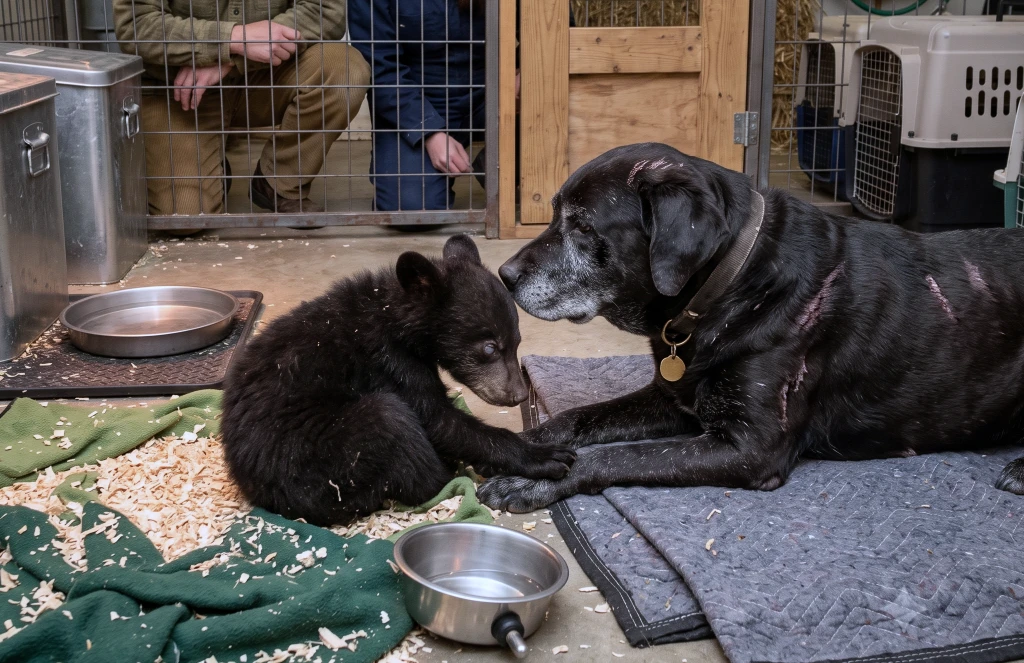
The cub would not eat.
They had named him Cedar because one of the state wildlife officers had found him beneath a fallen cedar in a ravine north of Boone, North Carolina. It was the kind of name the staff gave themselves permission to use only after an animal made it through the first night. Cedar had made it through that. He had made it through fever, dehydration, and the infection that had sealed both of his eyes beneath a pale, cloudy film before anyone got to him.
But now he lay with his blind face pressed under his paws, refusing the world one careful breath at a time.
Sam stood on the safe side of the quarantine mesh, one hand wrapped around a paper coffee cup he had forgotten to drink from. He was fifty-one, with a bad knee from a horse kick and a beard that had gone gray faster than he liked to admit. After twenty-three years in wildlife medicine, he knew how to work inside the hard limits of a body. He had set broken wings, cleaned buckshot from the shoulders of coyotes, stitched raccoons torn open by dogs, and stabilized bears hit on mountain roads by drivers who never stopped.
Cedar was different. His injuries had not ended when the bleeding stopped. Whatever had happened in that ravine had left something inside him still hiding.
June Mercer, the center’s senior caretaker, came into the observation corridor with her sleeves pushed to her elbows and damp hair escaping from her braid. She had bottle-fed orphaned foxes from an eyedropper and slept on a cot beside injured fawns more times than anyone could count. This morning, though, she looked like someone who had run out of tricks.
“His temperature dipped again,” she said quietly. “Not a lot, but enough. And he’s down another few ounces.”
Sam nodded without looking away from the cub. Cedar’s ribs showed through his dull black fur. A healthy cub his age should have been a demanding little engine of hunger, pushing and squealing and clawing for milk. Cedar barely moved unless someone touched him, and when he did move, it was only to get smaller.
“Did he react to the sow recording?” Sam asked.
June shook her head. “Nothing. I tried the low rumble track, the nursing sounds, even the one from the sanctuary in Tennessee. He turned his face to the wall.”
“What about Molly?”
Molly was an older female black bear in permanent sanctuary care, calm enough that she sometimes tolerated orphaned cubs in an adjoining enclosure. June had hoped the scent of another bear might reach some buried instinct in Cedar. Instead, the cub had gone rigid, then pressed himself into the concrete corner until his breathing turned shallow and fast.
“He was terrified of her,” June said. “Not just nervous. Terrified.”
A latch clicked inside the quarantine room. Noah Price, the lead keeper, stepped in with fresh formula tucked against his chest to keep it warm. He moved slowly, his boots silent on the rubber strip by the door. He had taken off his gloves so Cedar would smell bare human skin instead of latex and disinfectant. Every person in the building had been trying to become predictable for the cub, an ordinary sound, an ordinary scent, nothing that would make him brace for the next bad thing.
Noah lowered himself to the floor. He sat with one leg folded under him, the bottle resting against his thigh, and waited long enough for Cedar to hear his breathing.
“Hey, little man,” he murmured. “No rush.”
Cedar did not lift his head.
Noah reached out with two fingers and touched the cub’s shoulder. The reaction was tiny, but Sam saw it. Cedar’s whole body tightened as if he expected the touch to become pain. Noah held still, letting the cub feel that nothing else was coming, then brought the nipple slowly toward his nose.
For a moment, there was a chance.
Cedar’s nostrils fluttered. He smelled the milk. His ears shifted by the smallest degree, and his head came up a fraction from his paws. Everyone behind the mesh stopped breathing with him, waiting for the body to remember what it was supposed to want.
Then Cedar turned away.
He tucked his nose hard beneath his forelegs, shut down again, and left Noah kneeling there with the bottle in his hand.
Noah stayed on the cold floor for almost half an hour. He whispered, waited, warmed the bottle between his palms, tried once more, and then once more after that. Cedar refused each time with the same exhausted motion, not fighting, not crying, simply removing himself from the offer of life.
When Noah finally stood, his face had gone flat in the way people’s faces did when they were trying not to bring grief into a room already full of it. He set the bottle on the counter by the door and looked at Sam through the mesh.
“Nothing,” he said.
By ten that morning, Sam had called a clinical review in the staff trailer. Rain tapped against the thin roof while the center’s tiny heater rattled under the window. On the folding table between them lay Cedar’s chart: glucose falling, hydration barely maintained, kidneys beginning to show strain, weight loss too sharp to ignore.
Marcy Bell, the operations director, had the unpleasant job of saying out loud what everyone already knew. She was not cold, and that made it worse. She had fought for animals that donors never saw and stretched the center’s budget until it squeaked, but she also knew when mercy was no longer avoidance.
“Sam,” she said, turning Cedar’s lab sheet toward him, “we can keep pushing fluids. We can keep warming him. But if he won’t swallow, we’re holding his body here while the rest of him leaves.”
No one spoke for several seconds.
Sam rubbed both hands over his face. He knew the protocols. A blind bear could live safely in permanent sanctuary care if it recovered and could navigate a protected enclosure. A cub refusing food under extreme trauma was something else entirely. They could tube-feed, but restraint might kill him before the calories reached his stomach. They could sedate, but his condition made anesthesia dangerous. Every option had a cost, and Cedar had almost nothing left to pay with.
“How long?” Marcy asked softly.
Sam lowered his hands. “Give me forty-eight hours.”
June looked up sharply. “Forty-eight?”
“I know what the numbers say,” he said. “But his heart is still strong when he’s not panicking. He turns toward footsteps sometimes. He knows we’re there.”
“That doesn’t mean he wants to stay,” Marcy said.
“No,” Sam admitted. “It means I’m not ready to decide for him until I’ve tried one more thing.”
He did not tell them what that thing was, because at that moment it was not a plan. It was a memory from earlier that morning, something a county shelter coordinator had said over the phone while asking whether Laurel Ridge could spare antibiotics for an injured dog. An old Lab mix, she had mentioned. Lost his owner. Won’t eat unless I hand him every bite.
At the time, Sam had been too focused on Cedar to think about it. Now the sentence would not leave him alone.
That evening, instead of driving home, Sam took the road down the mountain toward the county animal shelter. The rain had thinned into a cold mist, turning the pavement black and slick under his headlights. He passed the last gas station before town, the high school football field, the closed diner with its neon sign buzzing in the window, and then the long chain-link fence of Watauga County Animal Services.
Paige Rollins met him at the side entrance wearing rubber boots and a sweatshirt with paw prints faded across the chest. She had the tired, watchful eyes of someone who had spent all day saying no to people and yes to animals who had no idea how close they were to being out of chances.
“You look awful,” she said.
“Good to see you too.”
She unlocked the door. “He’s in isolation. Not because he’s aggressive. He just can’t handle the kennel noise.”
The main runs were loud enough to vibrate in Sam’s teeth, a wall of barking, whining, metal bowls, and claws against concrete. Paige led him through a second door into a quieter block at the back. The smell changed there: bleach, wet blankets, old kibble, and something heavier that Sam recognized immediately.
Grief had a smell in animals. Not in any mystical way, not the way people liked to write about it. It was the smell of a body that had stopped grooming properly, stopped exploring, stopped caring whether the world knew it was alive.
In the last kennel, on a folded blue moving blanket, lay a large black dog with white beginning to frost his muzzle. He had the broad head of a Labrador and the heavier shoulders of something built for farm work. Stitches curved along one side of his neck and disappeared beneath shaved patches near his shoulder. When Paige opened the gate, the dog did not rise. His tail moved once against the blanket, polite and hollow, then stopped.
“This is Boone,” Paige said.
Sam crouched outside the kennel door. “Hey, buddy.”
Boone’s eyes shifted toward him. They were dark, steady, and empty in a way Sam wished he did not understand.
“He belonged to a man named Earl Maddox,” Paige said. “Lived alone up near Elk Creek. Retired surveyor. Boone went everywhere with him. Porch, truck, woods, grocery store if nobody made a fuss.”
“What happened?”
Paige’s mouth tightened. “A young bear got into Earl’s trash shed during the night. Earl went out with a flashlight, probably trying to scare it off. Neighbors heard the dog going crazy, but by the time deputies got up there, Earl was gone. Boone was lying across him, torn up and still growling at anybody who came close.”
Sam looked at the scars along the dog’s neck. “A bear did that?”
“Most likely. Wildlife officers found tracks and blood around the shed. Boone lived, barely. We stitched him up. Physically, he’s healing.” Paige folded her arms. “But he’s waiting for a dead man to come back.”
Inside the kennel, Boone closed his eyes as if the conversation had nothing to do with him.
Sam stayed crouched. Ten miles up the mountain, Cedar lay blind and starving beneath a heat lamp because he had lost his mother to human cruelty. Here, an old dog lay on a shelter blanket because he had lost his person to the very kind of animal Sam was trying to save. The connection was so wrong, so risky, that his mind rejected it before it fully formed.
Then Boone took a slow breath, and the sound that left him was not a growl or a whine. It was a long, low, tired rumble from deep in his chest, the kind of sound an animal makes when it is trying to soothe itself because no one else knows how.
Sam looked at Paige. “Does he react to other animals?”
“Not much. Cats, dogs, nothing. He just looks through them.”
“And wild scent?”
Paige frowned. “Sam.”
He stood slowly, his knees stiff from crouching. Every rational part of him knew what she was about to say. Boone had been mauled protecting his owner from a bear. Cedar was a blind, terrified cub whose heart might give out at the scent of a predator. Bringing them into the same room would violate every clean line between domestic and wild, patient and danger, medicine and desperation.
But the cub was dying inside those clean lines.
Sam looked back at the old dog on the blanket, at the scars healing through his black fur, at the tail that had tried to greet him even though the rest of the body had forgotten why. For the first time in his career, he wondered whether two broken animals might recognize something in each other that no person in a white coat could reach. The thought frightened him enough that he almost left without saying it. Instead, he heard himself ask, “Paige, do you still have the blanket he was found on…”
To read the rest of the story – CLICK the NEXT button 👇👇👇