


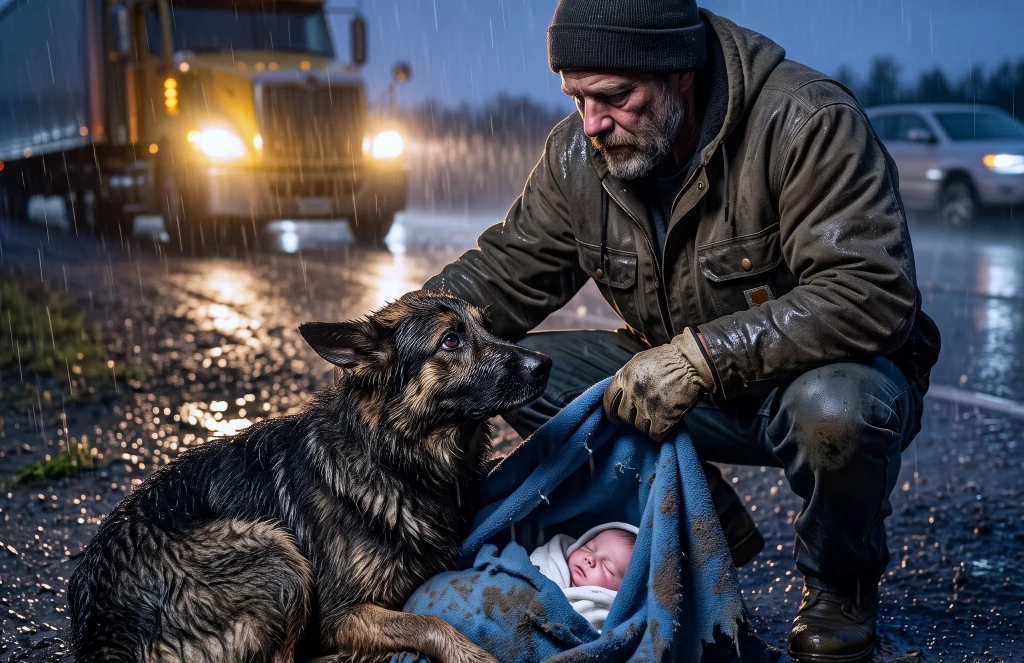
The dog should have run when the semi came around the bend. Cal Mercer saw him in the wash of the headlights, a dark shape low against the gravel shoulder, fur plastered flat by freezing rain. The dog didn’t bolt. He didn’t even lift his head. He just stared straight at Cal’s rig like he had been waiting for that exact engine, that exact pair of lights, that exact tired man to come through the storm. Cal’s first instinct was to keep driving.
He had spent twenty-six years hauling freight across the Midwest, and the road had taught him to make hard choices quickly. You could not stop for every broken-down car, every dead deer, every porch light glowing on some lonely farmhouse past midnight. You would never get home. You would never get anywhere.
But the dog’s eyes stayed with him after the rig passed.
Cal checked his side mirror. The shoulder vanished and reappeared through sheets of rain. The dog was still there, curled near the ditch, watching the highway instead of the woods behind him. Something about that made Cal’s hand tighten on the wheel.
It was almost midnight in northern Indiana, late November, cold enough that the rain had teeth. Cal was forty miles from Laurel Bend, forty miles from the small house he had avoided as much as lived in since Maggie died. The cab heater pushed dry air against his boots. His thermos sat empty in the cup holder. His back ached, his eyes burned, and all he wanted was a shower hot enough to sting.
The dog whined.
Cal heard it through the glass, through the engine, through the slap of the wipers. It was thin and ragged and strangely deliberate, not a howl, not a bark, but a sound that seemed aimed at him.
“Don’t do this,” Cal muttered to himself.
He drove another fifty yards before his foot came off the accelerator. Then he cursed under his breath, hit the hazards, and eased the rig onto the shoulder. The air brakes released with a long, angry hiss that rolled into the storm.
Rain hit him sideways the second he opened the cab door. It needled his face, slid cold down his collar, and soaked through the denim at his knees as soon as he stepped onto the gravel. He grabbed the canvas coat from behind the seat and pulled it around himself, then walked back along the shoulder with one hand raised against the glare of his own flashing lights.
The dog watched him come.
Up close, he was bigger than Cal had thought, a shepherd mix maybe, though hunger had sharpened him down to angles. Mud clung to the fur along his belly. His ribs moved too fast under his skin. When Cal crouched a few feet away, the dog’s tail gave one weak scrape in the wet gravel, but he didn’t stand.
“Easy,” Cal said. “I’m not here to hurt you.”
The dog’s ears twitched. He tried to lift his head and failed. Then he shifted his body just enough that Cal saw the dark stain in the grass beneath him and the shape tucked tight against his side.
At first Cal thought it was trash, maybe a sweatshirt blown out of a pickup bed. A strip of faded blue fleece showed under the dog’s matted flank, soaked almost black by the rain. The dog made that same pleading sound and pushed his nose toward it.
Cal’s breath slowed.
He reached with one hand, carefully, expecting the dog to snap. The animal only trembled harder. Cal pulled back the corner of the fleece.
For one second, the whole highway seemed to empty around him.
A baby lay beneath the dog’s body.
A boy, not more than six or seven months old, was wrapped in a blanket too thin for the weather. His eyes were closed. His cheeks were waxy and pale. His mouth had gone faintly blue, and his little hands were tucked stiffly against his chest inside a cotton sleeper that might have been enough for a warm bedroom, not a storm ditch in November.
Cal forgot the rain. He forgot the truck, the load, the road, the ache in his knees. He pressed two fingers under the baby’s jaw the way he had seen paramedics do after wrecks.
There was a pulse.
It was slow, but it was there.
“Oh, God,” Cal whispered.
The dog had curled himself around the child so tightly that his own body made a wall against the wind. He had taken the rain on his back and the cold in his bones, giving whatever warmth he had left to a baby who could not ask for it. The dog looked up at Cal, eyes glassy and fixed, as though making sure the man understood.
“I’ve got him,” Cal said, though he didn’t know whether he was talking to the dog or to himself. “I’ve got him.”
He slid both hands beneath the baby and lifted him against his chest. The child was frighteningly light. Cal opened his coat and tucked the baby inside against his shirt, trying to share the heat trapped under the canvas. The dog cried out when the child left his side, a broken sound that cut harder than the wind.
“You too,” Cal said, turning back. “You’re coming too.”
The dog tried. His front legs shook, and his back paws skidded in the mud. Cal shifted the baby high against his chest with one arm and wedged the other under the dog’s rib cage. The animal weighed too much and too little at once, all soaked fur and jutting bone. Cal half carried, half dragged him toward the rig, slipping twice on the shoulder before reaching the cab.
Getting them both inside was ugly and desperate. Cal shoved the dog up onto the passenger floorboard first, then climbed in with the baby still under his coat. Mud smeared across the seat. Rainwater pooled near the pedals. The dog collapsed against the passenger door, panting with his nose pointed at Cal’s chest.
Cal cranked the heater until the vents rattled. He pulled onto the road and drove faster than he should have toward Holloway Regional Medical Center, one hand on the wheel and the other cupped over the baby beneath his coat. Every few seconds, he pressed lightly, waiting for that tiny rise and fall.
“Stay with me,” he said. “Come on, little man. Stay with me.”
The dog stared at the coat. Even when the truck hit potholes and the trailer swayed in the rain, the animal didn’t look away. He seemed to understand that the thing he had guarded was still in danger.
The hospital sat on the edge of Holloway, a low brick building glowing white and harsh under the emergency entrance lights. Cal drove the rig straight into the ambulance bay and set the brake before the trailer had stopped rocking. Somewhere nearby, a horn blared. He ignored it.
He jumped down from the cab with the baby in his arms and shouldered through the sliding doors.
“Help!” he shouted. “I need help right now!”
The nurse behind the triage desk looked up. Her face changed before Cal finished the sentence. She came out fast, one hand already reaching for the child while the other hit a call button on the wall.
“Where did you get him?”
“Highway shoulder,” Cal said. “County Road Eighteen, north of Laurel Bend. He’s cold. He was under a dog.”
The nurse didn’t pause long enough to question that. She took the baby, felt his skin, and called down the hall in a voice that snapped the whole emergency department awake. Two more nurses appeared, then a doctor, then a rolling warmer. The child disappeared behind double doors beneath a cluster of blue gloves and urgent voices.
Cal stood in the waiting area with rain dripping off his coat onto the polished floor.
His hands kept the shape of the baby after the baby was gone. He looked down at them, rough and scarred from years of chains, straps, diesel caps, and weather. They shook so badly he had to close them into fists.
“Sir?”
A security guard approached, not unkindly, but with the expression of a man who had already been yelled at three times that night.
“You can’t leave a tractor-trailer in the ambulance bay,” the guard said. “And there’s a dog trying to come inside.”
Cal turned.
The shepherd mix stood just beyond the sliding doors, soaked and shivering on the rubber mat of the vestibule. Somehow he had climbed down from the cab and followed. His eyes were fixed on the hallway where the baby had been taken.
“He saved that child,” Cal said quietly.
“I believe you,” the guard said, though his face suggested he didn’t know what to believe. “But he still can’t be in the ER.”
Cal walked over and crouched in front of the dog. The animal’s legs quivered under him, but he would not lie down. Cal snapped his fingers softly.
“Come on, partner. We’ll wait where they’ll let us.”
The dog looked at the hallway again. Then he leaned into Cal’s knee, exhausted enough to accept the only comfort being offered. Cal guided him back into the storm, moved the rig to the far end of the visitor lot, and let the engine idle with the heat blasting.
For the rest of the night, Cal watched the emergency doors through the rain-streaked windshield.
The dog slept in scraps, jerking awake every few minutes to check Cal’s coat, then the hospital entrance, then the coat again. Cal found an old moving blanket behind the seat and wrapped it around the animal. He didn’t have dog food, so he broke a stale gas station biscuit into pieces and watched the dog eat with careful, painful hunger.
“Ranger,” Cal said sometime after three in the morning.
The dog lifted his head.
“I don’t know what your name was,” Cal told him. “But you stood watch out there. Ranger seems about right.”
The dog blinked at him and settled again, his muzzle near Cal’s thigh.
By dawn, the rain had slowed to a cold mist. Cal had not slept. His clothes were damp, his knees ached from kneeling in roadside mud, and his thoughts kept circling back to the same terrible question. Someone had put that baby there. Someone had walked away.
At a little after seven, a sheriff’s cruiser pulled in near the rig. Behind it came a county sedan with a state emblem on the door. A deputy stepped out first, followed by a woman in a dark wool coat who carried a clipboard close to her chest.
Cal rolled down the window before they reached him.
“Mr. Mercer?” the woman asked.
“That’s me.” His voice sounded scraped raw.
“I’m Denise Hart with county child services. Deputy Lawson filled me in on what happened.” She glanced toward the passenger seat, where Ranger lifted his head but did not growl. “The hospital gave us your name.”
Cal’s first question came out before she could say anything else.
“How is he?”
Denise’s expression softened. “He’s alive. Severe hypothermia, dehydration, some exposure injuries, but the doctors believe he’ll recover. Another hour out there and they don’t think he would have made it.”
Cal lowered his head. For a moment, he saw nothing but his own hands on the steering wheel. The relief did not feel clean. It came with anger under it, and fear, and a strange ache that had nothing to do with the cold.
Deputy Lawson cleared his throat. “We found no wreck nearby. No abandoned car. No missing infant report matching him yet. We’re checking cameras from gas stations and intersections, but that stretch is pretty empty.”
“He have a name?” Cal asked.
“Not one we know,” Denise said. “For now, the hospital has him listed as Baby Boy Doe.”
Ranger made a low sound from the passenger seat. It wasn’t a bark. It was almost the same thin whine from the highway, quieter now, but still pointed at the building.
“What happens to him after the hospital?” Cal asked.
Denise looked at him carefully, as if she had heard the shape of something in his voice. “Once he’s medically stable, he’ll go into emergency protective custody. We’ll place him with a licensed foster family if one is available. If not, he’ll stay in a county-approved temporary placement until we can sort out who he is and whether any relatives can be found.”
“A temporary placement,” Cal repeated.
“Yes.”
Cal looked past her to the hospital doors. Behind all that glass and brick, a baby with no name was lying under heated blankets because a starving dog had refused to let him freeze. Cal thought of his own house in Laurel Bend, the four bedrooms he never entered anymore, Maggie’s sewing room still untouched, the kitchen table where he ate standing up because sitting alone made the silence louder.
He thought of all the years he had used the highway as a place to disappear.
Then he looked at Ranger, curled in the passenger seat, still watching the hospital.
“What would it take,” Cal asked, “for me to bring him home?” Denise didn’t answer right away. The deputy shifted his weight. The mist silvered the windshield. Ranger pressed his nose to the glass and stared at Cal as though the question had been his all along…
To read the rest of the story – CLICK the NEXT button 👇👇👇