


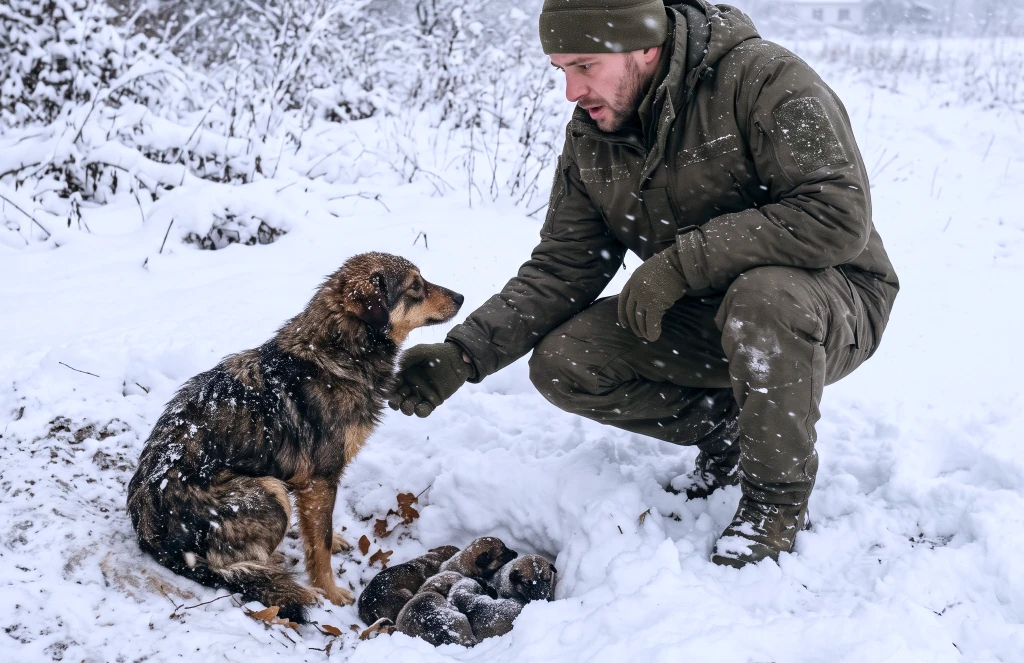
The dog was standing over a hole in the snow as if her body could become a roof. Caleb Mercer saw her from the county road just after noon, a brown-and-white shape braced against the wind beside an abandoned farmhouse three miles outside Cedar Falls, Minnesota. At first, his mind tried to make her into something harmless: a torn feed sack, a collapsed tarp, an old blanket blown loose from the porch. Then the shape lifted its head, and the illusion broke.
She was alive.
Barely.
Caleb eased his old black pickup onto the shoulder and killed the wipers, letting the snow blur the windshield until the world in front of him looked half-erased. The farmhouse sat back from the road behind a sagging wire fence, its gray siding peeled raw by years of weather. No tire tracks led to the drive. No smoke rose from the crooked chimney. Every window was dark, but the yard had the wrong kind of emptiness, the kind that made the hair along his arms rise under his coat.
The dog did not run when he stopped. She did not bark. She kept her legs locked beneath her, ribs showing through a matted winter coat, her spine arched over the shallow pit she had scraped into the drift.
Under her belly, four puppies lay pressed against the frozen ground.
For one brutal second, Caleb thought they were already gone. They were no bigger than rolled socks, their paws folded inward, their bodies so still the snow had begun to collect on them. The mother dog trembled over them with a kind of stubborn, failing discipline, as if she had made a promise to keep standing and intended to honor it until her legs broke beneath her.
Caleb sat there with both hands on the wheel.
He was forty-two years old, old enough to know what a decision looked like before a person admitted he was making one. He had spent most of his adult life in the Army as a combat medic, carrying men out of dust and smoke and ruined streets, learning how quickly warmth could leave a body and how little a person’s training mattered once someone stopped breathing in his hands. Three years earlier, he had come home to the woods with a duffel bag, a scar across his shoulder, and a private vow to stop being the person anyone needed in an emergency.
His cabin waited twelve minutes down the road. The stove would still be warm. There would be coffee in the pot, silence in the rooms, and no living creature asking anything of him.
The mother dog turned her head and looked straight through the glass.
Her eyes were dark, exhausted, and strangely clear. There was no challenge in them. No trust, either. Only a steady, almost unbearable awareness, as though she had heard his truck from a long way off and had spent the last of herself deciding whether he was the kind of man worth waiting for.
Caleb opened the door.
The cold took his breath immediately. It came in clean and sharp, sliding past his collar and biting the damp places at his hairline. His boots sank through the powder as he crossed the ditch and stepped over a broken section of fence, keeping his hands visible and his body turned slightly sideways. Animals under stress read posture better than language. He knew that much. He also knew that fear made teeth fast.
“Easy,” he said, low enough that the word barely rose above the wind. “I’m not here to hurt you.”
The dog’s ears flattened. Her legs shook harder, and her cracked nose lifted toward his glove as he knelt several feet away. Up close, she looked worse than she had from the truck. Ice clung to the edges of her ears. A strip of fur along her neck had been rubbed almost bald, leaving a dark, raw groove in the skin. Her belly hung loose from nursing, but there was no fullness in her teats, no sign her body had anything left to give.
The puppies were breathing. Not much, not well, but breathing.
Caleb felt the old part of himself wake with a quiet snap.
He shrugged out of his parka and laid it across the snow as a shield against the wind. Then he pulled off one glove with his teeth, tucked it under his arm, and touched the first puppy with two fingers. The little body was frighteningly cold, the skin beneath the sparse fur almost waxy. Its mouth opened once without sound.
The mother dog stiffened.
Caleb froze. His bare hand hovered above the puppy while snow collected across his wrist. He did not reach farther, and he did not pull away. He waited the way he had waited in rooms where one wrong move could turn a bad minute into a final one.
The dog stared at him. Her chest moved in shallow, ragged pulls. Then, with an effort that seemed to cost her more than he could stand to watch, she lowered her head a fraction.
Permission.
Caleb moved quickly after that, but not carelessly. One puppy went inside his flannel shirt, against his skin. Then the second. Then the third and fourth, each so light he barely felt their weight, each so cold it was like pressing small stones to his chest. He wrapped the parka around himself and the puppies, trapping what heat he could, then carried them to the truck and laid them in a wool blanket on the passenger seat.
When he turned back, the mother dog had tried to follow.
She made it three steps before her hind legs folded. She went down sideways into the drift with a sound that was not a whimper so much as an apology.
Caleb crossed the yard in long strides and dropped beside her. “No,” he said, more sharply than he meant to. He slid one arm under her chest and the other beneath her hips. She weighed almost nothing. A dog her size should have been solid against him, but she felt hollow, all bone and wet fur and spent will.
She did not fight him. Her head rolled against his collarbone, her nose cold at the hollow of his throat. For a moment he stood there in the falling snow, holding her like something already halfway gone, and a memory came for him hard enough to tilt the world.
A stretcher. A younger man’s hand gripping his sleeve. Blood on tan dust. Caleb saying stay with me, stay with me, stay with me, until the words became useless.
He closed his eyes once and opened them on the dog.
“Not today,” he said.
He carried her to the truck and settled her on the floorboard, angled so she could see the blanket on the seat. Her eyes found the puppies immediately. She let out one long, broken breath, then kept staring at them as if the sight alone was the thread keeping her awake.
Caleb pulled his phone from the cup holder and called the county dispatcher first, then animal control. He gave his name, location, the condition of the dogs, and the weather. He used the steady voice people trusted in emergencies because it did not ask to be comforted.
The dispatcher put him on hold, came back, and told him roads were getting worse. Animal control could not get a truck there safely for at least a few hours, maybe not until morning if the storm line dropped faster than expected.
“You have a safe heated place?” she asked.
“Yes.”
“Then keep them warm. I’m logging this as an emergency protective hold pending officer follow-up. A deputy may contact you.”
“Understood.”
He almost hung up, then looked down at the dog’s neck again. The groove under her fur had not come from a normal collar. It was too deep, too narrow, and too even.
“There may be neglect,” he said. “Possibly abuse.”
The dispatcher’s voice changed. Not dramatically, but enough. “Document what you can without putting yourself in danger. I’m adding that to the call.”
Caleb ended the call and set the phone down. The smallest puppy gave a weak jerk inside the blanket, then went still again. He started the truck, turned the heat as high as it would go, and eased back onto the road.
The dog watched every movement. Even when her eyes sagged and her head slipped sideways against the mat, she forced them open again to check the seat. Caleb drove with one hand on the wheel and one hand near the blanket, feeling for any sign of life every few seconds.
“Stay,” he said under his breath.
The puppy moved once.
“Good,” Caleb whispered. “Again.”
The road to his cabin narrowed after the old quarry, dipping through pines that stood black and heavy under the snow. His place was small, square, and plain, built by someone who had valued survival over charm. It sat at the end of a gravel drive where no one came unless invited or lost. Caleb had chosen it because of that.
By the time he reached the porch, the truck cab smelled of wet dog, cold wool, and fear.
He carried the puppies in first. He set them near the woodstove on layered towels and an old quilt he found in the cedar chest, close enough for warmth but not close enough to burn their fragile skin. He brought the mother in next and laid her where she could see them. She dragged herself toward the quilt with her front legs until her nose touched the smallest puppy’s back.
Caleb built the fire with clean, economical movements. Kindling. Birch bark. Split oak. Air under the flame. The stove caught, clicked, and began to breathe warmth into the room.
He found a dropper in a kitchen drawer, a heating pad in the linen closet, and a digital thermometer in the bathroom cabinet. He called the nearest veterinary clinic, reached the after-hours line, and listened while a tired woman named Dr. Hannah Reeves asked short, useful questions.
“How old?”
“Maybe ten days. Maybe two weeks.”
“Are they responsive?”
“Barely.”
“Do not feed them yet if they’re still cold,” she said. “Warm slowly. Too fast can kill them. I’m coming.”
He gave her the address. She did not ask why a man who lived alone in the woods suddenly had a starving mother dog and four frozen puppies on his living room floor. She only said, “Keep them dry. Keep them breathing. I’ll be there as soon as the road lets me.”
Caleb hung up and knelt beside the quilt.
The mother dog’s eyes followed him. Her head lay flat, but her body still curved around the puppies as much as it could. He had seen people stay awake like that in field hospitals, guarding someone they loved from dangers that had already passed because their bodies had not yet learned the battle was over.
He reached toward her neck to check the raw place more closely. She flinched, then held still.
“It’s all right,” he murmured.
His fingertips parted the matted fur with care. Beneath the groove, something small and blue was tangled tight against the skin. At first he thought it was a piece of plastic from a feed bag, but when he trimmed away the knot with trauma shears and eased it free, he saw it was a narrow strip of blue zip tie, broken at one end and stained dark near the other.
Black marker had been written across it.
M-17.
Caleb stared at the numbers in his palm. A collar tag would have had a name. A phone number. Maybe an address, if anyone had ever loved her enough to want her returned. This wasn’t a name. It was inventory…
To read the rest of the story – CLICK the NEXT button 👇👇👇