


At 8:17 on a gray Tuesday morning, the smallest witness in Hawthorne County walked into Courtroom 3C holding a stuffed rabbit by one ear. Lily Hart was three years old. Her yellow cardigan had been buttoned wrong, the bottom button trapped in the wrong hole, and one of her sneakers blinked pink with every careful step. She did not look at the rows of people, the reporters pressed along the back wall, or the man in the navy suit sitting at the defense table with both hands locked together.
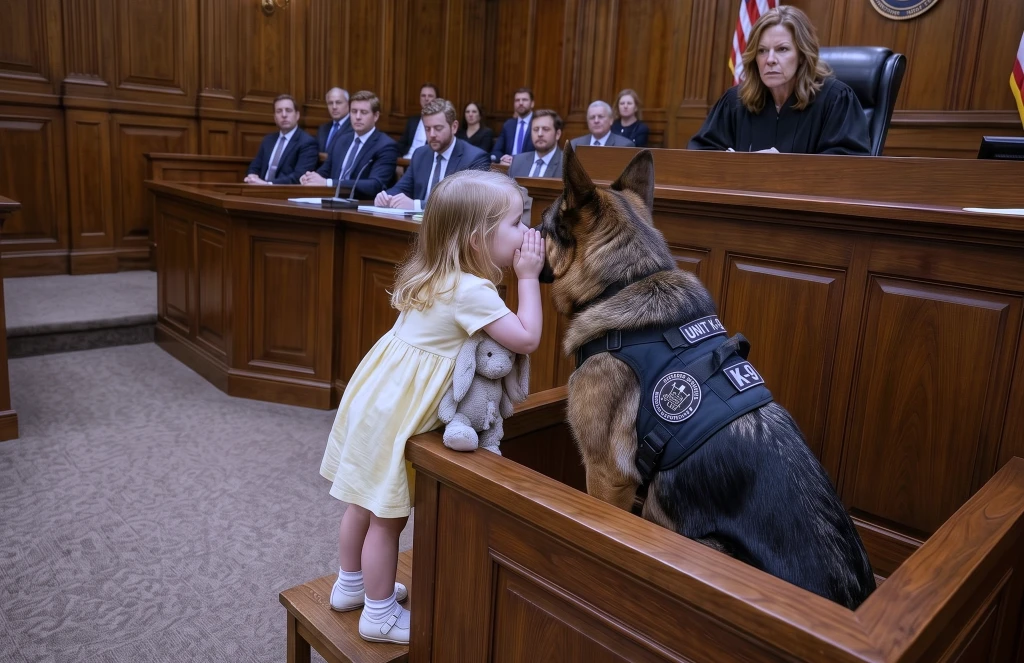
She looked for the dog.
“Right there, sweetheart,” Tasha Reynolds whispered, bending beside her. Tasha had been Lily’s foster mother for six weeks, long enough to know that a direct instruction could make Lily freeze, but a quiet invitation sometimes helped her move.
Near the witness stand, a golden retriever lay on a blue mat with his chin on his paws. His name was Scout. He wore a dark vest with a small courthouse patch near one shoulder, and though his handler stood near the wall, Scout’s eyes followed Lily as if he already understood she was the reason he had been brought there.
Lily stopped at the gate.
The courtroom had gone still before, during hard testimony and guilty verdicts and family members trying not to cry. This stillness was different. It had the strained quality of adults trying to make themselves harmless.
Judge Miriam Caldwell watched from the bench with one hand resting beside her closed notebook. Assistant District Attorney Maeve Porter stood at the prosecution table, a folder open in front of her, though every question she had prepared suddenly felt too large for the child in the aisle.
The case had filled local news for nearly a month. Jenna Hart, a twenty-six-year-old bookkeeper and single mother, had been found unconscious on the kitchen floor of her apartment after neighbors called 911. Her boyfriend, Tyler Shaw, had been arrested two days later. He had a prior disorderly conduct charge, a public argument with Jenna outside a diner, and no clean alibi for the hour when Jenna nearly died.
But the only person known to have been inside the apartment that night, besides Jenna and whoever hurt her, was Lily.
She had been found under a blanket beside the hallway closet, awake and silent, clutching the rabbit now dragging against her shoe. Since then, she had spoken only in pieces. A word at breakfast. A whisper during nightmares. Once, at a therapy session, she had pressed her face against Scout’s fur and said, “Don’t make loud.”
No one had been sure whether she could testify. No one was fully sure she should. Judge Caldwell had heard arguments, read specialist reports, and ordered every accommodation the court could justify. Still, as Lily stood at the gate and stared at the dog, the judge looked less like a person in control of a courtroom than a woman hoping the room would not harm a child already carrying too much.
Scout lifted his head.
Lily let go of Tasha’s hand.
She did not run to him. She walked slowly, one blinking sneaker at a time, until she reached the mat. Scout remained still, tail giving a single low sweep against the floor. Lily bent, studied his face, and then leaned forward until her forehead rested between his ears.
The court reporter’s hands hovered above her machine. A sketch artist lowered her pencil. Tyler Shaw looked up from the defense table, and his attorney, Graham Voss, placed one hand on his sleeve as if warning him not to move.
Maeve waited. She had been told by Dr. Rafael Sloane, Lily’s trauma specialist, that waiting would be the hardest thing. Adults asked too much, too fast. They tried to pull memory out by its roots. Children like Lily needed a door left open and no one blocking it.
After almost a minute, Lily whispered into Scout’s fur.
Maeve could not hear the words, but she saw Lily’s mouth move. She saw the child’s fingers close around the edge of Scout’s vest. Then Lily turned her head slightly and looked across the courtroom.
Not at Judge Caldwell.
Not at Maeve.
At the defense table.
“He made Mommy fall,” Lily said.
The words were soft, uneven, and terrible in their simplicity.
Graham Voss stood immediately. “Objection.”
Judge Caldwell’s gavel touched wood once, not hard, but enough. “The jury will disregard any statement not made in response to a question.”
The instruction was proper. Everyone in the room knew that. Everyone also knew jurors did not become deaf because a judge told them to.
Lily climbed into the witness chair only after Scout rose and settled close enough that she could keep one hand on his back. She sat sideways, knees tucked beneath her, with the stuffed rabbit pressed under her arm.
Maeve approached as if crossing a frozen pond.
“Hi, Lily,” she said, stopping several feet away and lowering herself to one knee. “I’m Maeve. We met in the little room with the blocks. You don’t have to look at me unless you want to.”
Lily rubbed two fingers along Scout’s collar.
“Is it okay if I ask you a few questions?”
No answer.
Maeve nodded as if silence were a kind of answer too. “You can tell Scout if that’s easier.”
Lily bent close to the dog’s ear. Scout blinked slowly, accepting the weight of her small hand against his head.
Maeve waited long enough that the reporters stopped shifting.
Finally Lily said, “There was banging.”
“In your apartment?” Maeve asked.
Lily nodded.
“Can you tell Scout what the banging sounded like?”
The child’s mouth pressed into Scout’s fur. “The chair went over. Mommy said, ‘Go, bug.’”
Maeve felt the words settle somewhere behind her ribs. Jenna called Lily “bug.” That detail had appeared in a note from Jenna’s sister, not in any police report shared publicly. Maeve had not intended to use it in court. Lily had brought it there herself.
“What did you do when Mommy said that?”
Lily’s fingers worked deeper into Scout’s coat. “I went little.”
Maeve kept her voice level. “What does that mean?”
The child slid down slightly in the witness chair, making her body smaller. She pulled her knees closer and tucked her chin. The movement was clearer than any explanation.
“You hid,” Maeve said gently.
Lily nodded.
“Where did you hide?”
“With coats.”
“The hallway closet?”
Another nod.
A juror in the second row put one hand over her mouth. Judge Caldwell glanced toward her, and the juror lowered it quickly.
Graham Voss rose again. “Your Honor, I’m going to object to leading questions. The State is supplying location details to a child who has every reason to please the adults around her.”
Maeve stood. “The closet is documented in the first responder report, and the witness has already described coats.”
“The witness is three.”
“That is why I’m proceeding carefully.”
Judge Caldwell looked down at Lily, who had turned her face into Scout’s neck again. “Sustained in part. Ms. Porter, avoid supplying labels when possible.”
“Yes, Your Honor.”
Maeve took a breath and returned to her earlier distance. “Lily, can you show Scout where you were?”
Tasha had packed crayons in Lily’s small backpack because crayons had become a bridge. Maeve set a blank sheet of paper on the low table placed near the witness chair and opened the box without pushing it closer.
Lily watched the colors. Then she reached for blue.
The first shape she drew was tiny and curled beneath a brown rectangle. She pressed so hard the crayon squeaked. Then came a yellow oval on the floor, with long lines for hair. She colored red around the yellow shape’s arm and then stopped, breathing through her nose in short little pulls.
Scout shifted his weight until his shoulder touched the side of the chair.
Lily picked up black.
She drew a tall figure beside the table. The body was too wide, the arms too long, the head too dark with scribbled hair. Near one hand she made angry marks, round and round until the paper nearly tore.
“What is that?” Maeve asked.
“Mad,” Lily said.
“What is mad?”
“Him.”
Maeve did not ask the next question immediately. She glanced toward Judge Caldwell, then at Dr. Sloane seated behind the prosecution table. He gave the smallest nod.
“Do you know his name?” Maeve asked.
Lily’s mouth trembled once. “Loud man.”
Tyler Shaw lowered his head. He was broad-shouldered, with a shaved jaw and a face that looked older than twenty-eight after weeks in county lockup. He had not spoken all morning except to whisper to his attorney.
Graham Voss stood again, slower this time. He was a composed man in his early forties, precise in dress, with swept-back dark hair and a silver watch that flashed when he adjusted his cuff. “Your Honor, we are now displaying a child’s drawing as if it were forensic evidence. This is prejudicial beyond repair.”
Maeve said, “No one is asking the jury to treat it as a photograph. The drawing reflects spontaneous communication from a traumatized child and includes details consistent with the scene.”
“Details she could have absorbed from any adult.”
“Then cross-examine the adults.”
Judge Caldwell called both lawyers to the bench. The white noise machine came on, but Lily flinched at the sudden hiss until Scout pressed his head into her lap. Maeve saw it and felt a thin line of anger under her professionalism—not at the judge, not at procedure, but at the fact that even justice had sounds that could frighten a child.
When the lawyers returned, the drawing was admitted for a limited purpose. Judge Caldwell instructed the jury carefully, using language plain enough that even the reporters wrote it down. The drawing was not proof by itself. It was one piece to weigh with all the rest.
Graham Voss looked satisfied in a way Maeve did not trust.
His cross-examination began gently.
“Lily,” he said, taking only two steps toward the witness area before Judge Caldwell’s look stopped him. “Do you know what pretending is?”
Lily stared at Scout.
“Like when your rabbit talks,” Graham continued. “Or when you draw pictures.”
Maeve stood. “Objection. Argumentative and inappropriate.”
“I’m exploring the child’s ability to distinguish imagination from fact.”
Judge Caldwell’s voice cooled. “Rephrase, Mr. Voss. And keep your distance.”
He gave a polished nod. “Of course, Your Honor.” Then he turned back to Lily. “Sometimes children make up stories because they are scared. That doesn’t mean they’re lying. It just means they’re little. Do you understand?”
Lily’s lower lip pushed forward. Her hand tightened on Scout’s fur, but she did not cry.
Graham smiled toward the jury, a small sympathetic smile. “Scout wasn’t in your kitchen that night, was he?”
“No.”
“So Scout didn’t see anything.”
Lily looked down at the dog, then back toward the man asking questions. “I did.”
A few people in the gallery forgot not to react. The sound was small, a breath more than a murmur, but Judge Caldwell’s gavel came down once.
Graham’s smile thinned. “And now you tell Scout?”
Lily nodded.
“Because Scout knows?”
“He listens right,” Lily said.
Maeve saw one of the jurors lower his pen.
Graham tried three more times to shake her. He asked whether Tasha had told her Tyler was bad. He asked whether Dr. Sloane had shown her pictures. He asked whether she had heard grown-ups talking. Each question made Lily retreat into Scout, but she did not disappear.
When Judge Caldwell finally called the morning recess, Lily slid down from the chair and wrapped both arms around Scout’s neck.
In the hallway, Maeve leaned against a marble pillar and closed her eyes for one second. Only one. Then she opened them because there was too much still moving around her.
Dr. Sloane stood nearby, watching Tasha offer Lily a pouch of applesauce. “She did more than I thought she would,” Maeve said.
“She did what she could,” he answered. “That isn’t the same thing.”
Maeve accepted the correction. Through the glass in the courtroom door, she could see Graham Voss speaking quietly to Tyler Shaw. Tyler looked shaken. Graham looked controlled. Too controlled, Maeve thought, then disliked herself for the instinct. Defense attorneys were supposed to stay controlled.
Lily walked toward her with Scout beside her and the stuffed rabbit tucked under her chin.
Maeve crouched before the child. “You did a hard thing.”
Lily did not answer. She pulled the crayon drawing from Tasha’s folder and stared at it. Then she reached for the black crayon still clutched in her fist.
“Do you want to add something?” Maeve asked.
Lily nodded.
She knelt on the hallway floor, put the paper on the tile, and drew a small circle on the tall figure’s wrist. Then she colored it gray. Around it she made tiny lines, careful and bright.
“What is that, honey?” Tasha asked.
Lily tapped the gray circle. “His hand clock.”
Maeve’s skin went cold in a way she could not show.
“A watch?” she asked.
Lily nodded without looking up. “It clicked when he got mad.”
Across the hall, the courtroom door opened. Graham Voss stepped out, smoothing one cuff over the silver watch at his wrist. Lily saw him and pressed herself against Scout’s side. Then, so quietly Maeve almost missed it, she whispered, “That one has it…”
To read the rest of the story – CLICK the NEXT button 👇👇👇