


The hearing was supposed to take ten minutes. Then the little girl in the oversized yellow sweater slipped out of her neighbor’s hand and walked straight toward the judge’s bench. Every adult in Courtroom 3 seemed to understand the danger before she did. The bailiff shifted his weight. The prosecutor stopped stacking his papers. Noah Bennett, sitting at the defense table in a borrowed jacket, rose halfway from his chair with panic already open on his face.
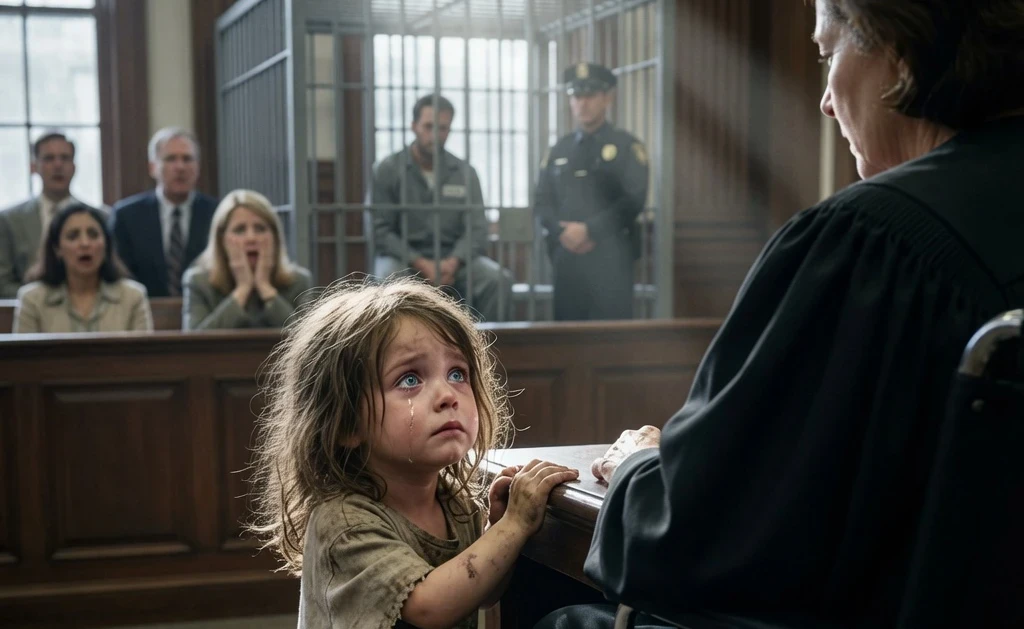
“Maddie,” he whispered. “Sweetheart, come back here.”
But Madeline Bennett did not turn around. She was five years old, small for her age, with tangled brown curls and sneakers that squeaked softly on the polished floor. The sweater hanging off her shoulders had once belonged to a cousin twice her size, and the mask tucked under her chin still smelled faintly of the hospital.
Judge Evelyn Hart watched the child approach from behind the high wooden bench. She had spent twenty-two years learning how to keep emotion from changing the shape of her face. She had ruled on robberies, custody fights, addiction, fraud, and the quiet disasters families brought into court when they had nowhere else to put them. She had also spent the last three years in a wheelchair, which meant people were always deciding whether to look at her legs or pretend not to see them.
Maddie looked directly at them.
Then she set both hands on the edge of the bench and lifted her chin. “Judge lady,” she said, her voice small but clear enough to reach the back row, “if you let my daddy come home with me, I’ll help your legs wake up.”
Someone laughed once, sharply, then swallowed it. A woman in the gallery covered her mouth. Noah shut his eyes as if the sentence itself had struck him. Evelyn Hart did not laugh. She felt, instead, a strange tightening beneath her ribs, not belief exactly, but the old ache that came whenever a person touched the locked room inside her without asking.
Nineteen days earlier, no one in Riverton, Ohio, would have called Noah Bennett dangerous. Tired, yes. Too thin from skipping meals, yes. A widower who smelled faintly of drywall dust and laundry soap, yes. But not dangerous.
He worked for a small construction company that repaired porches, patched roofs, and finished basements when the weather allowed. In winter, the jobs thinned out. So did the paychecks. Noah learned to stretch a pound of ground beef over three dinners, to pay the electric bill late enough to buy groceries but not late enough to lose heat, and to smile in front of his daughter when another envelope arrived stamped FINAL NOTICE.
Maddie had severe asthma. Most days she was a bright, stubborn child who drew suns in the corner of every picture and gave names to birds, clouds, and cracks in the sidewalk. Bad days were different. Bad days turned her chest into a locked door. Her breathing would whistle in the dark, and Noah would sit beside her bed counting seconds between each strained inhale while trying not to let her see his fear.
Her mother, Grace, had died when Maddie was two. Noah still kept Grace’s favorite mug on the second shelf, handle turned outward as if she might reach for it in the morning. He had sold almost everything else that carried memory—her bracelet, his guitar, the wedding band he used to twist when he was nervous—because memories did not keep a child breathing at 2:00 a.m.
On the Tuesday everything broke, Maddie woke before dawn with a fever and a cough that sounded too deep for her little body. The rescue inhaler was nearly empty. The nebulizer medicine was gone. Noah had been waiting on a new insurance approval after his hours were cut, and the pharmacy had called the night before to say the prescription was ready.
Ready did not mean affordable.
He tried anyway. First he called the pharmacy and asked if he could pay half. Then he called the clinic and left a message with the nurse line. He called his boss, who sounded exhausted and ashamed when he said the company could not do payroll advances anymore. Noah thanked him because he did not know what else to do.
By late afternoon, Maddie was lying on the couch under a blanket, cheeks flushed, lips too pale. Noah knelt beside her and held the inhaler to the light. One weak puff remained.
“Daddy,” she whispered, “my chest feels skinny.”
He knew what she meant. He had heard it before, right before the panic set in and her whole body began working for air. He kissed her forehead, told her he was going to fix it, and called Mrs. Helen Parker from downstairs. No answer. She was at her church volunteer night, though Noah did not know that then.
He should have called 911. He would tell himself that later in every possible tone—angry, ashamed, pleading. But in that moment, with unpaid hospital bills already sitting on the kitchen counter and Maddie finally drifting into a shallow sleep, he convinced himself he could run to the pharmacy and back in fifteen minutes.
He left a note on the coffee table. Daddy is getting your medicine. Don’t be scared. I love you.
The Maple Avenue Pharmacy was bright enough to hurt. Flu season had filled the aisles with coughing parents and elderly customers waiting for prescriptions in folding chairs. Noah stood near the counter with his wallet open, staring at the total on the little screen as if the numbers might rearrange themselves out of pity.
“Three hundred twelve dollars and forty cents,” the technician repeated, softer the second time.
“I have thirty-eight,” Noah said. “I get paid Friday. Please, she’s five. She needs the albuterol and the steroid. I’m not asking you to give it to me. I’m asking you to let me come back and pay the rest.”
The pharmacist came over, a woman with tired eyes and a corporate badge clipped to her coat. She listened. She looked sorry. Then she gave him the answer people give when the answer belongs to a policy instead of a person.
“I can’t release a prescription without payment,” she said. “I can give you information about discount programs, but they won’t process tonight.”
Tonight. The word landed like a door locking.
Noah stepped aside while another customer paid for vitamins and cough syrup. The white paper bag with Maddie’s name printed on the label sat in a bin behind the counter, close enough that he could read BENNETT, MADELINE in black type. He did not plan what happened next. Planning would have required a kind of calm he no longer possessed.
When the technician turned toward the drive-thru window and the pharmacist bent to answer the phone, Noah reached over the low side counter, took the prescription bag, and put it inside his jacket.
He made it six steps.
“Sir,” someone said behind him. “Stop right there.”
The security guard was older, with gray in his beard and kindness in his face that made the whole thing worse. Noah stopped. He did not run. He did not argue. He handed over the bag, then covered his face with both hands.
“My daughter can’t breathe,” he said. “Please. Call whoever you have to call, but somebody has to get that medicine to my kid.”
The police came. Mrs. Parker, finally reached by phone, found Maddie crying on the couch and called an ambulance. The hospital treated the fever, stabilized her breathing, and kept her overnight. Noah spent that night in a holding cell with the stale smell of concrete in his nose and the sound of his daughter’s wheeze replaying in his head.
By morning, the charge was theft. Then a child welfare petition was added because Maddie had been left alone while medically fragile. By the end of the week, Noah was out on temporary bond, but Maddie was staying with Mrs. Parker under a safety plan while the court decided whether he could be trusted to care for her.
That was how the Bennetts ended up in Courtroom 3 before Judge Evelyn Hart.
The gallery was fuller than it should have been for a theft hearing. Riverton loved a hard-luck story almost as much as it loved punishing one. Some people came because they knew Noah from job sites, church basements, or the apartment building where he shoveled snow for elderly neighbors without being asked. Others came because they had read about the pharmacy arrest online and wanted proof that a man could not just steal medicine and call it love.
Noah sat beside his public defender, Tessa Reed, with his hands folded so tightly his knuckles looked bruised. Across the aisle, Assistant County Prosecutor Miles Grant kept his expression professional, though he had not looked directly at Maddie since she entered with Mrs. Parker.
The hearing began as expected. Miles explained that theft was still theft, even when the reason was sympathetic. Tessa explained that Noah had no record, no weapon, no intent to profit, and a child who could have died while bureaucracy decided whether compassion fit inside a form. Evelyn listened to both of them with her hands resting on the wheels of her chair.
She had read the file twice the night before. She knew the law. She also knew the familiar temptation to let pity soften rules until they stopped being rules. Since the accident that had killed her husband and taken the use of her legs, Evelyn had built her life around things that did not bend. Statutes. Procedures. Schedules. The clean, merciless grammar of the court.
Then Mrs. Parker brought Maddie in because the child had cried all morning for her father, and no one in the hallway had the heart to make her wait outside.
Maddie saw Noah and ran. The bailiff stepped forward, but Evelyn lifted one hand.
“Let her go,” she said.
Noah caught his daughter against his chest and held her so hard Tessa had to touch his elbow to remind him she needed air. He whispered apologies into her hair. Maddie patted his rough cheek with both hands.
“You came back,” she said.
“I tried, baby.” His voice broke on the second word. “I tried so hard.”
Evelyn looked down at the file again because looking at them felt like trespassing. The law was easier on paper. On paper, no one had a child’s face pressed into a borrowed jacket.
She had just begun to explain that the court could not ignore the choices Noah made when Maddie slipped from his arms. The girl walked toward the bench with the solemn focus of someone approaching a bedside, not a judge. That was when she made the promise that froze the room.
If you let my daddy come home with me, I’ll help your legs wake up.
Miles was the first to recover. “Your Honor, I object to—whatever this is.”
Noah stood so quickly his chair scraped the floor. “Maddie, no. I’m sorry, Your Honor. She doesn’t understand.”
But Maddie kept looking at Evelyn. Not at the robe. Not at the bench. Not at the wheelchair as an object of pity. At Evelyn.
“I do understand,” the child said. “Her legs are asleep because she got hurt, and because she got sad after. But they still listen.”
Evelyn’s fingers tightened on the armrest. Her voice, when it came, sounded almost normal. “Madeline, people say things when they’re scared. You don’t have to make promises for your father.”
“I’m not scared of you,” Maddie said. “You’re the one who’s scared.”
A few people gasped. Noah whispered her name again, this time in warning. Evelyn should have called the bailiff. She should have ended the hearing, cleared the room, done any of the dozen sensible things her mind listed for her.
Instead she leaned forward. “What makes you say that?”
Maddie reached up and touched the edge of the bench with her fingertips. Her small brow wrinkled, not dramatically, but in the careful way children concentrate when sounding out a hard word.
“Because your left foot hurts when it rains,” she said. “And you tell everybody it doesn’t.”
The courtroom went quiet in a different way.
Evelyn Hart had not mentioned the rain pain to a living soul in more than two years. Her doctors had called it phantom sensation. One nurse, not unkindly, had suggested grief sometimes made the body invent messages. After that, Evelyn stopped reporting it. She stopped reporting many things. Outside, against the tall courthouse windows, the first thin drops of spring rain began to fall…
To read the rest of the story – CLICK the NEXT button 👇👇👇