


The first person to move was the bailiff. He did not reach for his radio or step between the child and the bench, not yet. He only shifted one polished shoe against the courtroom floor, the way a person moves when he senses a cup sliding toward the edge of a table and knows one wrong motion will make it fall faster.
“Ellie,” Caleb Price whispered from the defense table. “Honey, come back.”
His daughter did not seem to hear him. She had already slipped out of Mrs. Delaney’s grip and was walking up the center aisle of Briar County Courtroom Two in a sweater so big the cuffs swallowed her hands. The sweater was sunflower yellow, the kind of color her mother would have chosen before the hospital rooms, before the funeral, before Caleb learned how quietly a home could fall apart while a child slept in the next room.
Judge Miriam Hale watched the little girl approach.
Miriam had been on the bench long enough to recognize desperation in all its forms. It came in expensive suits and work boots. It came with attorneys, with shaking hands, with loud anger, with silence so tight it made the air feel thin. But this child did not look desperate. She looked certain.
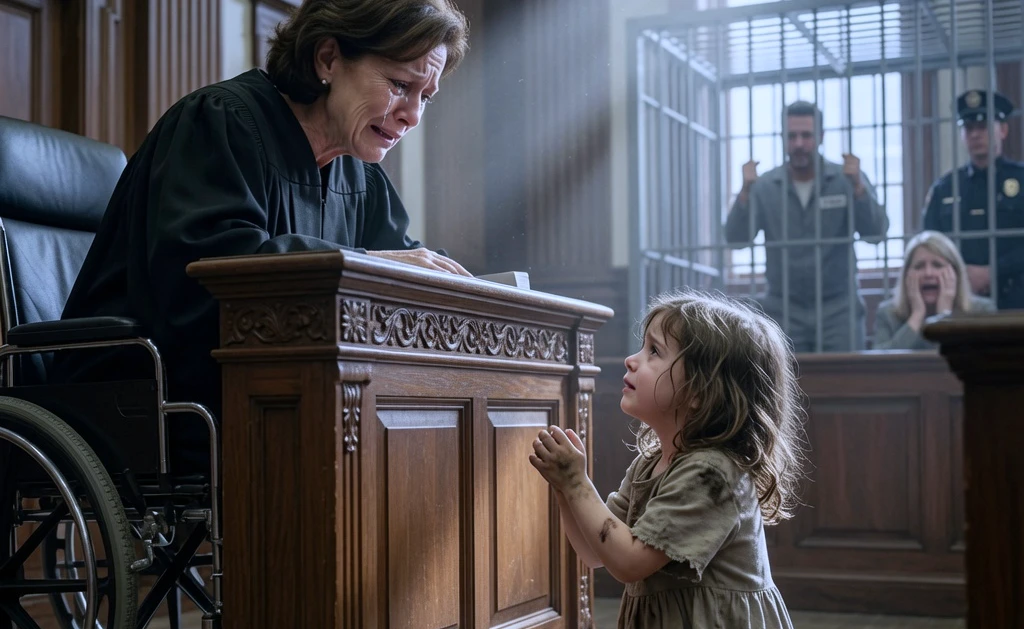
Ellie stopped below the bench and tipped her face up.
“Judge,” she said, clear enough that even the people in the last row heard her, “please don’t send my daddy away. If he comes home with me, I can help your left foot find you again.”
No one laughed. A cough died somewhere in the gallery. Caleb pushed his chair back so abruptly that his public defender caught his sleeve.
“Your Honor, I’m sorry,” Caleb said. “She doesn’t understand what she’s saying.”
Miriam’s hand had tightened around the wheel of her chair before she realized it. Beneath the black robe, beneath the folded blanket across her knees, her left foot sat inside a sensible shoe she had not felt properly in nearly four years.
At least, that was what her medical chart said.
Nineteen days before Ellie Price walked toward the judge, Caleb had been known in Briarwood as the kind of man people trusted with spare keys. He fixed loose porch railings without padding the bill. He shoveled snow from the walk outside Mrs. Delaney’s duplex before daylight. He left church basement dinners early because Ellie got tired under fluorescent lights, but he always stacked chairs first.
Nobody would have called him reckless. Broke, yes. Worn thin, yes. A widower doing the work of two parents on the paycheck of half a job, certainly. But not reckless.
Winter had held on too long that year in western Pennsylvania. Construction slowed. The remodeling company Caleb worked for stopped taking full crews to smaller jobs, and his hours dropped from steady to unpredictable. He learned to stretch a pot of chicken soup across four nights, to let the gas bill sit unopened until payday, and to keep smiling when Ellie asked whether money was sick too.
Ellie was five, almost six by her own fierce accounting. She loved sidewalk chalk, peanut butter sandwiches cut into triangles, and naming things that did not need names. A pigeon outside the grocery store became Professor Waddles. The crack in the apartment ceiling was Mr. Lightning. The nebulizer mask, which she hated, was Captain Puff because Caleb had once told her superheroes sometimes wore masks too.
Her asthma had teeth. Most days, medicine held it back. On bad days, her chest tightened with a whistle that made Caleb stand very still, counting each breath as if his attention alone could keep it from disappearing.
Her mother, Hannah, had been gone three years. Caleb had sold his truck first, then his tools with the duplicates, then the watch Hannah had given him on their first anniversary. He kept her red scarf in a box under his bed and her chipped blue mixing bowl on the top shelf, though he never used it. Some things, he had learned, could be lost only once.
The Tuesday that brought him to court began before sunrise. Ellie woke coughing, one hand pressed flat to her chest, her cheeks hot and her eyes wet from the effort of breathing. Caleb used the last of the rescue inhaler. He shook it afterward, praying for weight that was not there.
“Daddy,” Ellie whispered, “my lungs are closing their door.”
“I know, peanut.” He kept his voice calm because she borrowed fear from his face whenever he let it show. “I’m going to open it.”
He called the clinic and got the nurse line. He called the pharmacy and asked whether the prescription assistance card had gone through. He called his boss, who answered from a job site and sounded genuinely sorry when he said payroll advances were no longer allowed. Caleb thanked him anyway, because anger took energy he needed for panic.
By four in the afternoon, Ellie was asleep on the couch in short, shallow bursts. Her fever had not broken. Mrs. Delaney from the downstairs unit was not home, and Caleb’s phone had two percent battery. The pharmacy had called at lunch to say the medications were ready.
Ready was not the same as reachable.
He should have called 911. Later, he would say that to himself so many times the sentence became a bruise. He should have let the ambulance come, should have handed the problem to people with oxygen and radios and insurance forms he could fight later. But the last ER bill was still on the kitchen counter under a magnet shaped like a strawberry, and Ellie had finally stopped crying.
The pharmacy was twelve minutes away on foot if he cut behind the laundromat.
He wrote a note in block letters and left it on the coffee table beside her cup of water.
Daddy went to get your medicine. Stay on the couch. I love you more than pancakes.
Pine Street Pharmacy was warm, bright, and crowded with people waiting out the tail end of flu season. Caleb stood at the counter in a jacket with drywall dust in the seams and watched the technician ring up Ellie’s prescriptions. The number on the screen looked too large to belong to two small boxes and a bottle.
“Two hundred eighty-six dollars and seventy cents,” the technician said.
Caleb opened his wallet. There were two twenties, three ones, and a grocery receipt folded around a coupon he had forgotten to use. “I have forty-three dollars,” he said. “I can pay the rest Friday. I’m not asking you to forgive it. I’m asking you to let me owe you.”
The pharmacist came over. Her name tag read NICOLE LANE, PHARMACIST. She was not cold. That made it worse. Cold people were easier to hate.
“I’m sorry,” she said. “I can’t release prescription medication without payment. There are programs, but they take time to process.”
“She doesn’t have time.”
Nicole looked past him at the line forming behind his shoulder, then back at the white paper bag in the pickup bin. “If she’s in distress, you need to call 911.”
Caleb almost laughed, because that was the answer everyone gave when the building was already on fire. Call somebody. Wait somewhere. Fill something out. Let the system turn its slow machinery while your child’s breath thinned on a couch.
He stepped aside. Another customer came forward with tissues and cough drops. The bag with Ellie’s name sat behind the counter, close enough for him to see PRICE, ELEANOR printed in black on the label.
He did not remember deciding.
He remembered the phone ringing behind the counter. He remembered Nicole turning away for half a second. He remembered his own hand moving over the low side gate, fast and clumsy, pulling the bag against his chest and tucking it beneath his jacket.
He made it to the automatic doors before a voice behind him said, “Sir. Stop.”
The security guard was older, with a silver mustache and tired kindness around his eyes. Caleb stopped because some remaining part of him still knew how to obey a decent man.
“I’m sorry,” Caleb said, and then the words started coming too fast. “My daughter can’t breathe. She’s five. She’s alone for a minute, I swear it was only supposed to be a minute. Please, call somebody, call the police, call the hospital, just get that bag to her.”
The guard took the bag from him. Caleb let him. His knees weakened so badly he had to grip a display of vitamin gummies to stay upright.
The police came. Mrs. Delaney came home, found Ellie curled on the couch beside the note, and called an ambulance before she called Caleb. By the time Caleb reached the hospital, he was in the back of a patrol car. By the time Ellie was stabilized, he was in a holding cell with a paper blanket over his shoulders and the sound of her wheezing trapped inside his skull.
The charge was misdemeanor theft at first. Then the child welfare concern arrived, because Ellie had been left alone while medically fragile. Caleb did not argue with that part. He could not. Love had not kept him from making a choice that terrified his daughter.
So he came to court in a borrowed navy jacket with sleeves a little too short, sat beside Lena Brooks from the public defender’s office, and listened while Assistant County Prosecutor Adam Kline explained that sympathy could not erase a crime.
Lena explained Caleb had no record, no violence, no resale intent, and a child whose medication cost more than his weekly pay after rent. Adam replied that desperation did not make theft legal and leaving a sick child alone raised a safety issue the court could not ignore.
Miriam listened from the bench with her usual stillness.
Stillness had taken years to perfect. After the crash that killed her husband, Paul, and damaged her spine, people watched her differently. They watched her chair. They watched the ramp beside the bench. They watched her hands on the wheels and pretended they were not imagining her before.
Miriam solved that by becoming harder to read than any document in the room. The law had clean edges. She liked clean edges. Grief had none.
She had read Caleb Price’s file twice the night before. The law did not allow her to pretend he had done nothing. It also did not require her to confuse punishment with safety. She was preparing to say exactly that when Mrs. Delaney brought Ellie into the courtroom.
The child had cried all morning in the hallway, Mrs. Delaney later admitted. She had begged to see her father. Caleb turned at the sound of her sneakers squeaking against the floor, and whatever composure he had left broke open.
Ellie ran to him. The bailiff looked to Miriam for permission, and Miriam gave one short nod.
Caleb dropped to his knees. Ellie threw her arms around his neck, and he held her so carefully it hurt to watch. His mouth moved against her hair. Sorry, sorry, sorry. The word did not carry to the bench, but Miriam could read it anyway.
“You came back,” Ellie said.
“I was trying to,” Caleb told her. His voice was raw. “I was trying the whole time.”
For a moment, the courtroom became too human for its own purpose. Lena looked down at her papers. Adam Kline pressed his lips together. Mrs. Delaney wiped her eyes with the sleeve of her cardigan and then looked irritated with herself for doing it.
Miriam began again. “Mr. Price, the court recognizes the medical emergency. It also recognizes—”
That was when Ellie slipped from her father’s arms.
She walked straight toward the bench, not fast, not dramatic, with the solemn focus of a child approaching a hospital bed. Caleb whispered her name. Lena put a hand on his arm. The bailiff stepped once and stopped when Miriam lifted her fingers.
Ellie looked at Miriam, not at the robe, not at the raised bench, not even at the wheelchair in the ordinary way adults did, with pity or embarrassment or both. She looked as if she were listening to something under the floor.
“Judge,” Ellie said, “please don’t send my daddy away. If he comes home with me, I can help your left foot find you again.”
Miriam’s first instinct was to end it. Clear the courtroom. Protect the child from becoming a spectacle. Protect the record. Protect herself.
Instead, she heard herself ask, “What do you mean by that?”
“Your foot isn’t gone,” Ellie said. “It just forgot the way back.”
A murmur moved through the gallery. Caleb stood with both hands open at his sides, afraid to move closer and afraid not to. Adam Kline rose halfway from his chair.
“Your Honor, this is highly inappropriate.”
“Yes,” Miriam said, though she did not look away from Ellie. “It is.”
Ellie’s brow creased. “It hurts when the sky gets heavy. Right here.” She touched the inside of her own left ankle with two fingers. “Like little wires. You tell people it doesn’t, but it does.”
The murmur stopped.
Miriam had told no one about the rain pain in more than two years. Not her clerk. Not her sister in Harrisburg. Not even Dr. Ben Alvarez the last time he asked whether there had been any change in sensation. Phantom discomfort, the rehab notes called it. Neuropathic noise. Grief making echoes in a body that had survived what her husband had not.
Outside, rain began tapping softly against the high courthouse windows. Ellie turned her palm upward as if offering Miriam something small and breakable. “It’s louder today,” she said. “That means it still wants to come home…”
To read the rest of the story – CLICK the NEXT button 👇👇👇