


The wolf was sitting beyond the red hazard flags, on ice Eli Warren would not have trusted with a sack of feed. He had marked that section of Mica Lake two days earlier after a thaw opened the spring channel under the snow. From shore, it looked like any other stretch of January white, but Eli knew better. Under that smooth crust, cold water still moved. It ate at the ice from below, quietly, patiently, in the places where people stopped being careful because winter had made everything look solid.
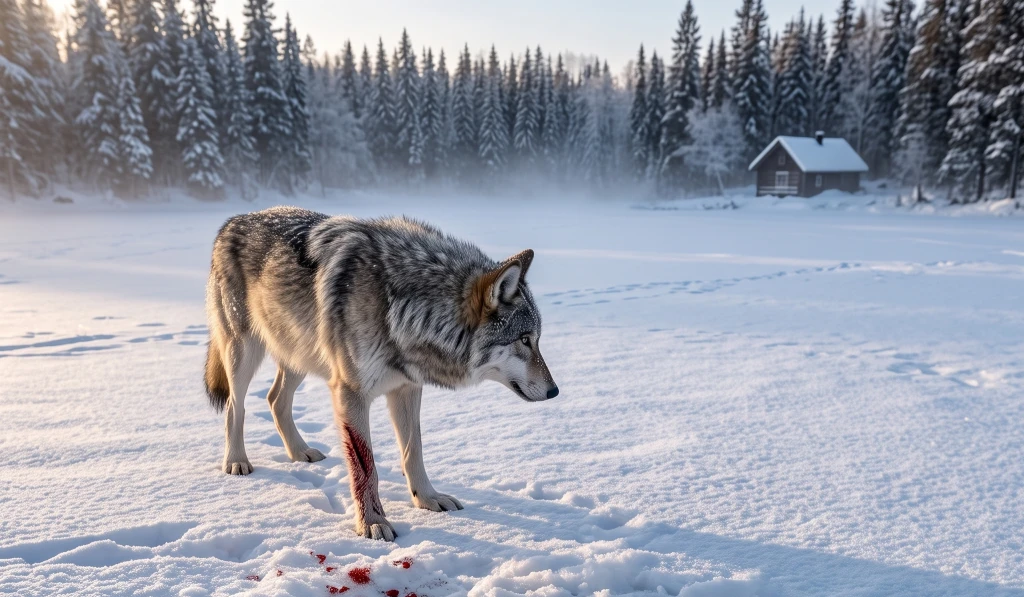
The wolf sat right over it.
Snow had collected along his back in a hard, wind-packed ridge. It was not the loose dust a running animal picked up while cutting through spruce. It had settled there. Layered there. Frozen there. The animal had been still for so long that the weather had begun to claim him.
Eli eased his snowmobile behind a stand of black spruce and killed the engine. The lake opened in front of him, broad and pale under a low Minnesota sky, its far bank smudged by blowing snow. For a moment, the sudden quiet made the whole place seem to lean toward him.
The wolf did not move.
That was the first thing Eli could not explain. Wolves in Juniper County did not sit in the open while a conservation officer watched them through binoculars. They slipped into timber. They crossed logging roads before a man could decide whether he had really seen them. They turned themselves into rumor.
This one stayed.
His left front paw hovered above the ice. Dark blood had frozen into the fur around the toes, and an old white scar curved along his side where the gray coat grew uneven. His head was not turned toward Eli. It was fixed on the lake ahead of him, on a darker seam in the snow where the inlet pushed unseen water below the surface.
A second snowmobile rolled in behind Eli and stopped short of the trees. Mara Ellis pulled off her helmet, tucked it under one arm, and followed his stare without saying anything at first. Mara worked the winter wolf contract for the state, and she had the kind of patience Eli associated with people who spent more time listening to animals than talking over them.
After a long moment, she said, “Same one?”
“Third day,” Eli answered.
Mara lifted her binoculars. “Same exact spot?”
“Close enough to make me hate it.”
The wolf turned his head then. His ears moved forward, then slid back just a little. Not a full threat. Not submission either. Something wary and exhausted sat in the space between those two things.
Mara lowered the binoculars slowly. “That scar.”
“You recognize him?”
“I don’t want to say yes until I’m sure.”
“Say what you’re thinking anyway.”
She watched the animal for another few seconds. “Two winters ago, Peter Lowell cut a young male out of an illegal cable restraint near the old burn. Left side was torn up. Gray coat. About this size now.” She paused. “Annie named him Smoke.”
Eli looked back across the lake. “A lot of wolves have scars.”
“Not like that.”
In his coat pocket, Eli carried a folded missing-person bulletin that had already gone soft at the creases. Dr. Peter Lowell, fifty-five, wildlife biologist at North Ridge University. Last known location: Mica Lake drainage. Missing since Friday afternoon. His daughter, Annie Lowell, eighteen, had been reported missing after deputies found out she had gone into the field with him.
For the first half day, everyone believed Peter had been alone. That was bad enough. Peter knew those roads, those ridgelines, those lakes. He had spent twenty years tracking animals across country that could punish a person for one careless assumption.
Then Annie’s roommate showed deputies the text.
Going with Dad to check cameras. If we survive the drive without arguing, call it a miracle.
Eli had known Peter for nearly eleven years. They had disagreed through public meetings, wolf-count hearings, rancher complaints, trail closures, and one memorable county board session where Peter had accused him of “managing fear instead of wildlife.” Eli had told Peter that giving research animals names made people careless. Peter had said names reminded the public that living creatures were not dots on a spreadsheet.
Their final argument had been shorter than most and uglier because neither man had meant it to be.
A warm rain before Christmas had weakened the north inlet on Mica Lake. Then the temperature dropped hard, sealing the surface under new snow. Peter wanted to retrieve three cameras before a storm buried them. Eli told him to use the long ridge road and stay off the lake.
“I know Mica,” Peter had said.
“You know summer Mica,” Eli told him. “This is January Mica. Different animal.”
“I’ll take the ridge trail.”
“Then take it.”
Peter promised. Eli accepted the promise because the alternative was imagining a careful man making a bad choice with his daughter in the passenger seat.
Now Peter’s truck was missing. Annie was missing. And a wounded wolf had spent three days sitting on bad ice as if he were waiting for someone slow enough to understand him.
Mara took one step out from the trees. The wolf rose immediately.
He was thinner than he should have been. Hunger and pain had carved narrow angles beneath the winter coat. He set the injured paw down, winced, and shifted sideways until his body stood squarely between them and the dark seam in the ice.
Mara’s voice dropped. “He’s blocking it.”
“Or he’s guarding his own space.”
“From what? Us?”
Eli did not answer. He unhooked a coil of rope from the snowmobile rack and walked to the nearest spruce.
Mara watched his hands. “Tell me you’re not going out there.”
“I’m not going far.”
“That’s what people say before they go far enough.”
He tied one end of the rope around the trunk and clipped the other to his harness. Mara muttered something under her breath, then did the same with a second line. Eli handed her an ice chisel before she could ask for one.
They moved out from shore several yards apart, spreading their weight and testing each step. The lake answered with small, mean sounds beneath the snow. Eli drove the chisel down before every footfall, felt the blade bite through crust, strike solid ice, and stop. When the sound changed, even slightly, he stopped too.
The wolf watched them come.
At sixty yards, his head lowered.
At fifty, a growl carried over the ice.
It was not loud. It was worse than loud. The sound was low, restrained, and threaded with warning, as if the animal were spending the last of his strength on the only language Eli might respect. Eli stopped because ignoring a wild animal’s warning was not courage. It was arrogance with a badge.
“Easy,” he said.
Mara shifted two steps to the left. The wolf moved with her, lame and deliberate, keeping himself between them and the seam. Blood marked the snow where his paw came down.
A gust swept across the lake and blurred him for several seconds. When it passed, Eli saw a straight black line under the ice near the wolf’s feet.
Nature made curves. It made bubbles, shadows, cracks, and rings. It did not often make a clean parallel line.
Eli lowered himself carefully, spreading his weight through one knee and one hand. With his glove, he brushed snow from the surface. The ice beneath was cloudy and dark, newly sealed in a place where it had no business pretending to be safe. Under the water, distorted by depth and moving current, two black rails ran over a shadow.
Roof rails.
His throat tightened so quickly he had to swallow before he could speak. “Mara.”
She went flat on her stomach and crawled closer, clearing a narrow window with her sleeve. The shape below sharpened by degrees. A dark pickup rested nose-down under the ice, rear end tilted higher, roof only a few feet beneath them. A university field decal clung to the back window. An orange waterproof case floated against the glass.
Mara whispered Peter’s name.
Eli reached for his radio. His hand felt clumsy inside the glove. “Command, Warren. We found the Lowell vehicle under the north inlet ice at Mica Lake. Need rescue, divers, medical, and shore extraction. Ice is unstable. Occupants unknown.”
The wolf backed toward the shoreline while Eli spoke, but he did not leave. He climbed the low rise above the boulder shelf, lifted his wounded paw, and sat again with snow moving around him.
Within forty minutes, the empty lake became a place of engines, radios, and shouted names. County rescue arrived by snowmobile and tracked utility rig. Deputies marked the unsafe ice wider than anyone wanted. Paramedics unpacked warming blankets and sled gear. Ray Braddock, the rescue chief, tested the inlet edge from shore and swore every time the chisel went through too easily.
“No heavy equipment past this line,” Ray said. “We’ll put another truck under.”
“The rear window looks broken,” Mara said.
Ray leaned over the cleared strip, then looked back at Eli. “Could mean someone got out.”
Eli kept his eyes on the black water under the ice. “Could mean someone tried.”
They searched for tracks, but the storm had spent two days erasing anything human. The only pattern left belonged to the wolf. His prints made a restless circuit between the ice seam, the boulders, and the spruce rise, over and over, as if he had been unable to leave one point but unable to stay still at another.
Mara walked that shoreline slowly, careful to keep away from the weak edge. When she returned, she held a small blue piece of plastic in her palm.
“Whistle,” she said. “Broken off at the mouthpiece.”
Eli looked toward the boulder shelf. The wolf had risen again.
Smoke stood on the slope with his ribs moving under his coat, eyes fixed on Mara’s hand. Then he turned toward a drift packed beneath a granite overhang and made a thin sound that was not quite a whine. He came down three limping steps, scraped once at the hardened snow with his injured paw, and jerked back as blood spotted the crust.
Ray stared. “What’s he doing?”
Eli hated how thin his answer sounded. “Showing us something.”
He clipped a fresh line around his waist and approached from the timber side, keeping the rocks between himself and the worst of the ice. The drift rose nearly six feet where wind had driven snow beneath the overhang. From ten yards away, it looked like every other winter pile along the shore.
Up close, there was a dark slit at the bottom.
Eli drove his shovel into the packed snow, then lifted one hand. “Cut the engines.”
The order moved down the shoreline. One machine died, then another, then the next, until the lake held only wind and breath and the faint creak of spruce behind them.
Eli dug slowly. Mara knelt beside him, passing chunks of hard snow back to Ray’s crew. They widened the slit by inches, careful not to collapse the packed roof. Smoke watched from the rise without blinking.
The shovel struck stone. Eli changed the angle and found a hollow under the granite, a pocket sealed almost shut by the storm. He pulled off one glove, pressed his bare fingers close to the opening, and held still.
Air moved against his skin.
He leaned down until his cheek nearly touched the snow. “Annie Lowell? Annie, this is search and rescue. Can you hear me?”
Nothing answered at first. Then three faint taps came from behind the wall of snow. Mara’s face changed. Eli pressed closer. “Annie, stay still. We’re opening it up.” A scrape came from inside the dark pocket. After that, a girl’s voice reached him, cracked by cold and so weak it seemed to belong to the stone itself. “Is Smoke still out there…”
To read the rest of the story – CLICK the NEXT button 👇👇👇