


By six in the morning, frost had turned Ranger’s black muzzle silver. The German shepherd lay three feet from his own doghouse, his chest pressed to the frozen boards of the little porch Caleb Whitaker had built with his own hands. Behind him, the doghouse stood open, insulated, dry, and warm enough that Caleb could see the faintest breath of heat lifting from the doorway whenever the wind shifted.
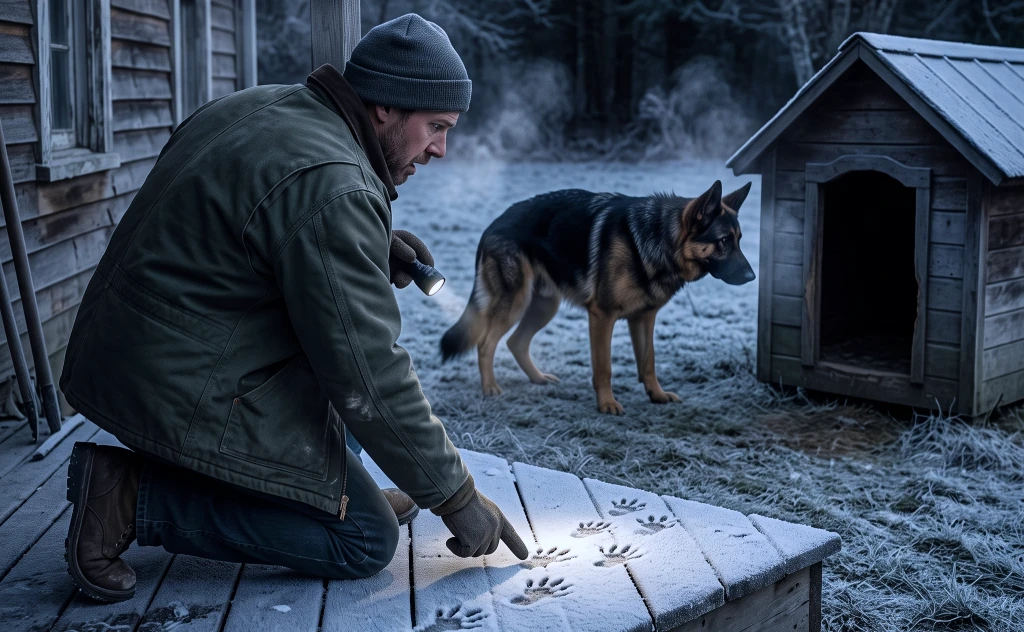
Ranger did not go inside.
He had been out there since before three.
Caleb knew because he had been awake to hear the first low whine. At first he thought the old floorboards had complained in the cold, or that a branch had scraped the side of the house. Then he had looked through the kitchen window and seen Ranger sitting rigid at the edge of his porch, ears forward, body angled toward the doghouse like a soldier guarding a door.
Now, three hours later, nothing had changed.
“Come on, boy,” Caleb called, stepping onto the back porch with his coat half-zipped and his coffee forgotten on the counter behind him. “You’re going to freeze your tail off out here.”
Ranger turned his head.
That was all.
The yard behind Caleb’s farmhouse sloped toward a narrow stand of maples, still black and bare in the late-April cold. Spring had come early to that corner of northern Pennsylvania, teasing daffodils out of the dirt and softening the creek banks, and then a hard freeze had swept in overnight as if winter had remembered one more errand. The grass was glassy with ice. The old apple tree near the creek had split under the weight of freezing rain. Every fence rail wore a white edge.
Ranger’s heated doghouse looked like the one sensible place in the whole yard.
Caleb had built it the previous fall, though “doghouse” had always seemed like too small a word for what it had become. It had a sloped roof, a little front overhang, a wide porch, and a round window set into one wall because Annie had once said every creature deserved a room with a view. He had lined it with cedar, added a safe warming panel, and laid down the thick plaid blanket Ranger had claimed from the living room the week after Annie died.
Ranger loved that doghouse. He ate on its porch, napped inside it when snow came down, and dragged every tennis ball he owned beneath the overhang as if storing treasure for a hard year.
But that morning, with the temperature below freezing and the wind cutting sharp across the yard, the dog would not cross his own threshold.
Caleb pulled his wool cap lower and stepped off the porch. His boots cracked through the icy skin over the grass. Ranger watched him with those deep brown eyes that had always seemed too serious for a dog who still got excited over cheese wrappers and mail trucks.
“What’s the matter?” Caleb asked. “You hurt?”
Ranger rose slowly.
Caleb stopped. There was something in the movement that did not belong to the dog he knew. Ranger did not limp, and he did not cower. He planted all four paws between Caleb and the doghouse door, lowered his head, and held himself there with a stillness that made Caleb’s hand fall away from his coat zipper.
“Ranger,” Caleb said, softer now. “Move.”
A low growl came from the dog’s chest.
Caleb felt it before he accepted that he had heard it.
In the seven years Ranger had lived with him, the dog had growled at raccoons on the trash cans, delivery drivers who ignored the gate sign, and once at a black bear lumbering along the far fence line. He had never growled at Caleb. Not once. Not even when Caleb had pulled porcupine quills from his muzzle while Ranger trembled and bled into the kitchen towels.
“Hey,” Caleb whispered.
Ranger’s ears flattened, but he did not move. His lip lifted just enough to show the white edge of one tooth. The sound in his throat deepened, not loud, not wild, but warning.
Caleb took one step back.
The growl stopped.
For a long moment they stared at each other across the frozen grass. Caleb’s breath came out in pale clouds. Ranger’s did too, faster and thinner, his body vibrating with the strain of holding still.
“What are you doing?” Caleb asked.
Ranger’s tail gave one uncertain flick, as if part of him wanted to trot over and press his head beneath Caleb’s palm the way he always did. But he did not leave the doorway. He remained where he was, guarding a place that had always belonged to him.
Caleb tried to laugh, but it came out flat.
“All right,” he said. “That’s new.”
Inside the house, the old wall clock in the kitchen ticked over the silence. Caleb could see it through the window, the same clock Annie had bought at a yard sale and painted robin’s-egg blue. He had not moved it after she died. He had not moved much of anything, if he was honest. Her gardening gloves still hung by the mudroom door. Her favorite mug, chipped near the handle, still sat on the second shelf where she could reach it.
Ranger had been the only living thing in the house that did not let the rooms turn into a museum.
He had forced Caleb out of bed in those first gray weeks after the funeral. He had nudged Caleb’s hand away from untouched dinners, dropped muddy toys in his lap, and slept across the bedroom doorway as if grief were something that might break in at night and needed guarding. Caleb had told people the dog was stubborn. He had never told them that sometimes Ranger was the only reason he turned the lights on in the morning.
So when Ranger growled at him, it did not feel like a training problem.
It felt personal.
Caleb rubbed the back of his neck and looked past the dog toward the dark rectangle of the entrance. He could not see much from where he stood. The blanket inside had been pulled toward the back wall, but that was not unusual. Ranger liked to rearrange things. A strip of brown leaf clung to the lip of the doorway, and there were muddy marks on the porch that might have been made by any animal passing through the yard before dawn.
“Did something crawl in there?” Caleb asked.
At that, Ranger stepped sideways and blocked the opening more completely.
Caleb’s skin prickled beneath his coat.
He tried again ten minutes later with Ranger’s breakfast. The dog usually became undignified around food, especially anything with egg in it, and Caleb had scrambled one plain egg into his kibble because the cold made him softhearted. He carried the bowl across the yard and set it on the ground halfway between them.
Ranger glanced at it.
Then he looked back at Caleb.
“Don’t tell me you’re too proud for breakfast now,” Caleb muttered.
The dog did not move.
Caleb waited until the wind numbed his fingers. Ranger’s body began to shiver, almost invisibly at first and then more clearly. That was what finally scared Caleb. Not the growl. Not even the strange guarding. Ranger could be stubborn, but he was not foolish. He knew warmth. He knew food. If he was willing to refuse both, then whatever had happened inside that doghouse mattered more to him than his own comfort.
Caleb went back inside because he did not know what else to do.
The house smelled faintly of coffee and cedar shavings. On the kitchen table lay the small stack of invoices he had meant to sort before heading to the cabinet job in town. He stared at them without seeing the numbers. His gaze kept drifting to the window, to the shape of his dog sitting guard in the white yard.
He called the vet’s office when it opened.
“Is he eating?” the receptionist asked.
“No.”
“Vomiting? Limping? Seizures?”
“No. He’s alert. Too alert, maybe.”
“Could be pain. Could be something territorial. Could be a wild animal nearby.”
“It’s not nearby,” Caleb said, watching Ranger lower himself again on the porch outside the doghouse. “I think it’s inside.”
The receptionist paused. “Inside his doghouse?”
“That’s what I’m trying to figure out.”
She told him not to force a confrontation. She told him to keep himself safe. She suggested calling animal control if he suspected a wild animal had taken shelter on the property. Caleb wrote the number on the back of an unpaid lumber receipt, then did not call it. He knew what happened too often when people called official help for frightened wild things. Sometimes it was necessary. Sometimes it was not gentle.
By midmorning, the sky had lowered into a dull pewter lid. Freezing mist drifted between the trees, and the boards of Ranger’s porch shone with a dangerous sheen. Caleb stood at the kitchen sink, his hands braced on either side, and watched his dog refuse warmth for the fifth straight hour.
“That’s enough,” he said to the empty room.
Ranger’s favorite bribe was steak.
Caleb had a piece of sirloin in the refrigerator that he had planned to cook that night, though planned was too generous a word. Since Annie’s death, dinner had become whatever required the fewest dishes. He took the steak out, trimmed off a handful of plain pieces, and cut them small. Ranger would follow steak into a thunderstorm, through a crowd, probably onto the roof if Caleb asked nicely enough.
While he worked, guilt tightened in his chest. He and Ranger had rules. Caleb did not trick him unless there was medicine involved. He did not lock him away from something he thought he needed to guard. Trust, Annie used to say, was a thing you fed every day, not a trick you pulled out when convenient.
“I’m not betraying him,” Caleb said under his breath.
The kitchen gave him no answer.
He put the steak in a bowl and went back outside.
Ranger lifted his head before the door even opened. His nose worked. Hunger flashed across his face in a way so familiar that Caleb almost smiled. The dog’s ears perked. His tail tapped the porch once, then twice.
“There he is,” Caleb said. “There’s my shameless freeloader.”
Ranger stepped down from the doghouse porch. One paw. Then another. He moved toward Caleb, drawn by the smell, but he kept glancing back at the dark doorway behind him. Caleb lowered the bowl and let the dog take one piece from his fingers.
Ranger swallowed and whined.
“Inside,” Caleb said. “Come on.”
The dog froze.
Caleb backed toward the porch, holding the bowl low. Ranger followed three reluctant steps, then stopped and looked over his shoulder again. His whole body seemed split in two, hunger pulling him toward Caleb, duty pulling him back to the doghouse. Caleb had never seen anything like it. The dog looked miserable.
“Two minutes,” Caleb promised, though he knew Ranger did not understand the words the way people did. “That’s all I need.”
He hated himself for saying it.
The promise worked anyway, or maybe the steak did. Ranger followed him into the mudroom, then into the kitchen, his nails clicking on the old pine floor. Caleb set the bowl in the far corner beside the pantry, the place where Ranger usually ate during storms. The dog lowered his head, took one bite, then looked up sharply as Caleb stepped away.
“It’s okay,” Caleb said.
Ranger did not believe him.
Caleb moved casually, or tried to. He walked toward the mudroom door without turning his back fully, one hand extended in a calming gesture. Ranger’s eyes followed him. The moment Caleb slipped through the door and closed it behind him, the dog abandoned the steak completely.
A deep bark hit the wood from the other side.
Caleb turned the lock.
Ranger barked again, louder this time. Then came the sound of paws scraping against the door, frantic and heavy. Caleb shut his eyes for half a second.
“I’m sorry, boy.”
He crossed the porch and stepped into the yard before his nerve could fail. Behind him, Ranger raced from the mudroom to the living room. Caleb knew the route by sound: nails across pine, rug sliding near the hallway, the dull thud of paws hitting the front of the sofa beneath the big window. A second later, Ranger appeared behind the glass, both front paws on the sill, teeth bared in a bark that fogged the pane.
Caleb kept walking.
Every step toward the doghouse felt wrong. The yard seemed larger than it had that morning. The distance from the porch to the little cedar structure might as well have been a mile. He could hear Ranger losing his mind behind the glass, could feel that panic following him like a hand between his shoulder blades.
At the doghouse, Caleb stopped.
The doorway was black inside. The little round side window had fogged from within.
That was new.
Caleb lowered himself to one knee. The cold came through his jeans at once. He reached toward the edge of the doorway, then hesitated. There were paw prints in the thin glaze of sleet on the porch, but not Ranger’s. These were smaller, delicate, almost hand-shaped, with long toes splayed in the ice.
Something shifted in the darkness. Ranger slammed against the living room window hard enough to rattle the glass. Caleb leaned closer, heart beating at the base of his throat. “What did you find, boy?” he whispered. From inside the doghouse, something growled back…
To read the rest of the story – CLICK the NEXT button 👇👇👇