


The first time I saw the dog on my mother’s grave, I thought someone had left her there by mistake. She was lying inside the little rectangle of gravel as if she belonged to it, her black body curled against the base of the headstone, her gray muzzle resting on her paws. She had rust-colored markings over her eyes and along her sides, the kind that made her look both old and watchful. When I stopped at the cemetery gate, she lifted her head and looked at me with the calm, assessing patience of someone who had been expecting me.
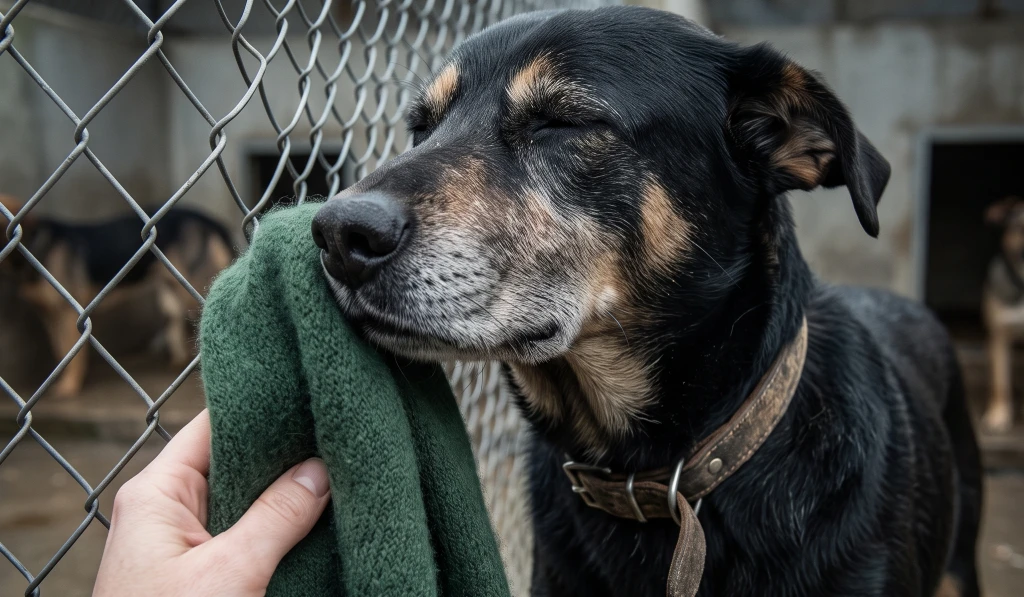
I almost turned around.
My mother had been gone a little over a year by then, and I had built a routine around missing her. Every other Saturday, unless the roads were icy or Daniel needed help with Noah, I drove to Maple Ridge Cemetery with grocery-store flowers, a rag, a bottle of water, and the same guilty feeling I never seemed to use up. I wiped down her headstone. I pulled weeds from around the edging. I sat on the narrow bench beside the plot and told her things I had not known how to say when she was alive.
That morning, someone else was already there.
“Hey,” I called, keeping one hand on the cemetery fence. “Go on. Shoo.”
The dog blinked at me.
She did not growl. She did not wag her tail. She only lowered her chin back to her paws, as if I had said something unimportant.
I stood there with a bouquet of yellow tulips going soft in my hand and felt foolish for being afraid of a tired old dog. Still, she was big enough that I hesitated. I had never had a dog. My mother never had either, not officially. She liked animals in the distant, practical way she liked most vulnerable things: feed them, don’t fuss over them, don’t make speeches about it. When I was a teenager, she used to set leftovers out behind our building for stray cats, and later, after she moved into her little ground-floor apartment on Cedar Street, she kept two metal bowls by the back door.
“For water,” she would say when I complained.
“For mosquitoes,” I would answer.
“For whoever needs it.”
That was my mother. Ruth Bennett had a way of turning the smallest act into a line you could not argue with without sounding like a worse person than you wanted to be.
I pushed the gate open carefully and stepped onto the path. March had not decided what season it was. The grass was wet, the sky low and gray, and the bare branches along the road clattered against each other every time the wind moved. Maple Ridge was not a grand cemetery. It was old, uneven, and mostly quiet, tucked behind the Methodist church and the county road, with a maintenance shed, a gravel drive, and a few ancient maples that dropped leaves into everybody’s vases.
The dog watched me come closer.
“I’m not here to bother you,” I said, which was a ridiculous thing to say to a dog, but grief had already made me talk to stones, so there was no point pretending I was above it. “I just need to put flowers there.”
She did not move.
My mother’s headstone was simple because she had insisted, while still alive, that nobody waste money on “a monument to somebody who spent most of her life clipping coupons.” It had her name, Ruth Elaine Bennett, the years of her birth and death, and a small carved branch of dogwood flowers that Daniel had chosen because my mother always loved the tree outside our old kitchen window.
Now an old black dog had her hip pressed against the stone like she was keeping it warm.
I waited another moment. Then I eased around the little plot, set the tulips in the metal vase, and crouched to clear away the dead leaves stuck in the gravel. The dog’s eyes followed my hands. Up close, I could see she was not wild exactly. Her coat was rough, but not filthy. She had an old leather collar, cracked from weather. Her ears were soft and folded, and her paws were thick, the nails too long.
“You know,” I said under my breath, “this is my mother’s grave.”
Her tail thumped once against the gravel.
I froze.
It was such a small response, barely even a wag, but something about it went through me. I had not said the words “my mother” aloud in weeks. Not to Daniel. Not to the women at school. Not even to Mark, my ex-husband, who had remarried six months earlier and moved to Charlotte with a woman who smiled in every photograph as if she had invented daylight.
The dog gave the gravel another slow thump.
I wiped the headstone because I had come to wipe the headstone. I trimmed the brown edges off a silk arrangement someone from church must have left. I sat on the bench and kept my purse in my lap like a shield. The dog closed her eyes and breathed in a deep, raspy rhythm. For forty minutes, we kept each other company without agreeing to it.
When I finally stood to leave, she opened her eyes.
“I don’t know where you came from,” I told her, “but don’t get too comfortable.”
She looked at me the way my mother used to when I made plans life had no intention of respecting.
Two weeks later, the dog was there again.
This time, she was lying on the other side of the headstone, partly in the shade of the maple, her nose tucked under her tail. I saw her before she saw me and stopped at the end of the row. A man three plots over was replacing faded plastic roses. Somewhere near the shed, a mower coughed and went silent. The dog lifted her head, recognized me or seemed to, and settled back down.
“You’re kidding,” I said.
She was not.
I told myself it was a coincidence. Cemeteries were quiet. The ground under the maple stayed dry. Maybe she had chosen the most comfortable patch and did not care whose name was on the stone. I put fresh carnations in the vase, wiped the pollen from the carved dogwood branch, and sat beside her again. This time, she moved just enough to put one paw against the edge of my shoe.
I did not touch her.
I thought about it, but I didn’t. I had spent a year training myself not to reach for things that could not reach back. My mother’s phone number. Her apartment key. Her old cardigan, which still held the faint smell of Ivory soap and the peppermint candies she carried in the pocket. Even grief had rules, and the first rule was that you did not let yourself need something that might disappear.
The third visit, I brought an extra bottle of water.
I told myself it was just common decency. The day had warmed suddenly, the way Pennsylvania sometimes does in early spring, and the cemetery spigot had not been turned on yet. I poured water into the shallow plastic container I used for cleaning and set it a few feet from the grave.
The dog watched.
“Don’t make a whole thing of it,” I said.
She stood slowly. Her back legs were stiff, and she favored the left one as she limped over to the water. She drank without taking her eyes off me, then stepped back to my mother’s grave and folded herself down with a sigh that sounded too human for comfort.
I wanted, suddenly and sharply, to call my mother.
That was the cruelest part of the first year after she died. The urge did not come during big moments, when people expected it. It came in grocery aisles, when I saw the brand of tea she liked. It came in school hallways, after one of my fourth graders said something funny. It came when Daniel sent me a picture of Noah wearing rain boots on the wrong feet. A thousand ordinary things still moved toward her before they remembered there was nowhere to go.
That afternoon, an old pickup rattled along the gravel road and stopped near the maintenance shed. Frank Dawson climbed out, wearing a canvas jacket, work gloves, and the permanent scowl of a man who had spent too much of his life explaining simple rules to difficult people. Frank had been the groundskeeper at Maple Ridge for as long as I could remember. He was lean, white-haired, and quiet, with a cigarette voice even though I had never seen him smoke.
He saw me looking at the dog and nodded toward her.
“She behaving herself?”
“You know her?”
“Everybody knows her.” He pulled off one glove and scratched his chin. “Well. Everybody who pays attention.”
“What’s she doing here?”
Frank glanced at the dog as if she might prefer not to have her business discussed. “Same thing you’re doing, I guess.”
I did not like how that landed. “She’s been on my mother’s grave every time I’ve come.”
“She’s here more than that.”
“How much more?”
He looked down the row toward the road. “Most days.”
I stared at him. “Most days?”
“Comes in after morning traffic dies down. Leaves around dusk, unless the weather’s bad. Doesn’t bother anyone. I don’t bother her.”
“That’s strange, Frank.”
“Lots of things are strange if you think they need explaining.”
I wanted a better answer than that. I wanted something practical: whose dog, from which house, why this plot, why my mother, why now. Frank seemed to have no interest in helping me turn the dog into a manageable fact.
“What’s her name?” I asked.
“Molly.”
The dog’s ear twitched.
Frank noticed and gave the smallest smile. “See? She knows.”
“Who named her?”
He shrugged. “She came with it.”
“Came from where?”
“Before my time with her.” He looked at me then, really looked, and his face softened in a way that made him seem older. “Your mom used to walk through here sometimes. Did you know that?”
“My mother?”
“Not to visit anyone that I saw. She’d cut through from Cedar Street if she was going to the grocery store. Sometimes she’d stop by the fence and talk to that dog.” He nodded toward Molly. “Or maybe the dog talked to her. Hard to tell with quiet women and old dogs.”
My throat tightened. “My mother never mentioned her.”
Frank’s expression did not change, but something in his silence felt almost like pity. “Parents don’t mention everything.”
I hated that he was right.
After he left, I sat on the bench longer than usual. The wind had shifted, bringing the smell of damp earth and cut grass from the lower section. Molly slept with her chin on my mother’s grave. I tried to imagine my mother walking through the cemetery with a grocery tote over her shoulder, stopping at the fence to speak to a dog. It was easy to imagine, which made it worse.
My mother had spent the last years of her life five miles from me, and I had known her schedule only in the ways that concerned me. Doctor on Tuesday. Church rummage sale on Friday. Dinner at my house every other Sunday, if she was “not too tired for Daniel’s stairs.” I knew what prescriptions she took and what brand of oatmeal she bought. I knew the sound her knees made when she stood up from my kitchen table.
I did not know she had friends at the cemetery fence.
I came back the next Saturday instead of waiting two weeks.
That was how the routine changed. I told Daniel I had errands on that side of town. I told myself the tulips had wilted and needed replacing. I told no one, including myself, that I wanted to see whether Molly would still be there.
She was.
By then, she did not bother pretending surprise when I arrived. She lifted her head, watched me put white daisies in the vase, and accepted the water I poured into the container. When I sat, she inched closer until her shoulder rested against the side of my shoe. I kept both hands on the bench.
“You’re not my dog,” I said.
Molly shut her eyes.
“You’re not anybody’s dog, from the look of it.”
Her tail moved once.
“You can stop agreeing with me.”
She sighed.
I almost laughed. The sound came out thin and startled, and it embarrassed me even though there was no one nearby. I had not laughed at my mother’s grave before. I had cried there, apologized there, complained there, sat there numb while the seasons dragged themselves across the grass. But laughter felt like trespassing.
Molly opened one eye as if to say she would allow it.
On the fourth Saturday, I brought a small bag of dog biscuits from the grocery store. I stood in the pet aisle for ten minutes, reading labels as if I knew what any of them meant, then chose the plainest ones because my mother had always distrusted anything shaped like a cartoon. Molly sniffed the biscuit, took it from the gravel, and carried it back to the headstone before eating it.
“That’s strange,” I told her.
She did not deny it.
When she finished, she shook herself and took two stiff steps toward me. For the first time, she came close enough that I could see the tag on her collar. It was old brass, scratched dull at the edges, hanging from a ring that had stained the leather dark. I leaned forward carefully.
“Molly,” I read aloud.
Her tail brushed the gravel.
Below the name was a line of smaller engraving, worn almost smooth. I reached, then stopped. Her eyes moved to my hand, not frightened, not trusting, only measuring. I had spent years teaching children how to sound out words, how to wait, how to ask before taking what wasn’t theirs. So I asked a dog for permission the way I should have learned to ask my mother more questions when I still could.
“May I?”
Molly held still.
The tag was cold between my fingers. I tilted it toward the light. The first line was clear enough. The second took a moment. I rubbed my thumb over the dirt in the grooves and bent closer, expecting a phone number, maybe an address from some family that had moved away.
Instead, I saw my mother’s name. RUTH BENNETT. For a few seconds, I could not make sense of the letters. They sat there in my hand, ordinary and impossible. My mother’s name, engraved on the collar of a dog she had never owned, a dog that had spent months sleeping against her grave as if the stone belonged to them both. Molly looked up at me, calm as ever. And for the first time since my mother died, I wondered how much of her life I had never known…
To read the rest of the story – CLICK the NEXT button 👇👇👇