


Noah Reed was lying flat between two rotten railroad ties when the headlight bloomed in the fog. At first he thought it was lightning caught low in the canyon. Then it steadied, round and white, moving along the rails of a line that was not supposed to carry anything anymore. The Ridgeway Spur had been dead for decades, a forgotten pencil mark on a county survey map he had pulled from a library discard box three towns back.
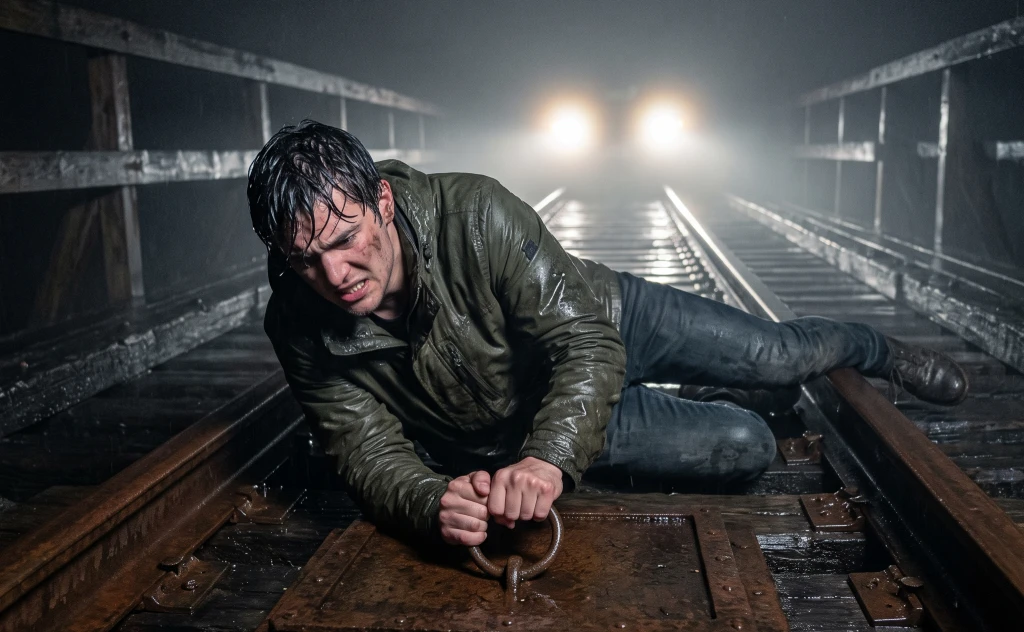
No train should have been coming.
He pressed his cheek against the wet timber and held still while rain hit the bridge hard enough to bounce. Fifty or sixty feet below him, the river moved through the gorge with a sound he could feel in his ribs. The fog had swallowed both ends of the trestle, leaving him suspended between a white light ahead and a drop he could not see.
The reasonable choice would have been to run. Noah had spent most of his twenty-one years learning that reasonable choices belonged to people who had somewhere else to go.
His pack was wedged against his shoulder, heavier now that the canvas had taken on rain. He knew it weighed forty-one pounds because he had set it on a postal scale outside a feed store in Harlan Junction before climbing into the mountains. A sleeping bag from a church donation table, a spare pair of socks wrapped in plastic, a dented pot, a folding knife, three days of food if he stretched it, and a notebook full of maps and useful facts written in pencil.
He liked knowing the weight of things. The world had moved him often enough that numbers felt kinder than promises.
The old railroad grade had pulled him in because it seemed to understand disappearance. It did not show up on the maps in gas stations or on his cheap phone when he could get a signal. But the 1952 Cedar County survey had marked it as a thin black line called the Ridgeway Spur, curling through fir and granite toward a trestle over Mercy Gorge, then ending without explanation.
He had followed it for two days. The grade was still readable if a person knew how to look: a slope too even to be natural, cuts in the ridge where men had once drilled and blasted, curves gentle enough for cars loaded with timber. Somebody had built it with patience. Then the world had turned away.
By the time the bridge appeared, Noah was wet, hungry, and more tired than he wanted to admit. The trestle stretched across the gorge in a dark lattice of timber and iron, the rails running over open air into fog. He had been halfway across when the storm came sideways off the canyon wall and knocked his breath flat.
Then the headlight appeared.
It did not move fast enough for a freight train. It crept. That made it worse somehow, that careful approach through a place he had believed belonged only to weather, rot, and him.
Noah tried to drag his pack toward the nearest end of the bridge, but the ties beneath him were slick, and the fog made distance useless. The light brightened. A small engine sound reached him under the rain, low and mechanical, not the deep pull of a locomotive but something with tires or steel wheels and a motor that had no business being there.
He flattened himself again and groped for a place to hide. His fingers swept over soaked wood, rusted spikes, grit, lichen, and then a hard straight edge that did not belong to any tie. He stopped moving.
Beneath the sludge packed between two cross beams was a square of dark metal set flush into the bridge frame. It was nearly invisible from above, just another patch of shadow, but his fingers knew the difference. The edge was too clean. The corners were too deliberate.
He scraped at it with his nails until a recessed iron ring lifted cold against his palm.
The headlight grew wider in the fog. Noah braced one boot against a beam, wrapped both hands around the ring, and pulled. Nothing happened. He pulled again, harder, his wet jacket clinging to his arms and water running under his collar.
The metal shifted with a reluctant groan.
“Come on,” he whispered, not to God exactly, not to anyone who had ever answered him, but to the old iron itself.
The hatch gave all at once. It opened just wide enough to show darkness under the bridge and the top rungs of a ladder set into stone. The air coming up from below smelled of cold rock, old dust, and something faintly dry, like a cellar that had been waiting with its door closed.
Behind him, the engine sound deepened.
Noah lowered his pack first and listened as it bumped once against the wall below. Then he got his boots over the edge and found the first rung. It held. The second held too. He pulled the hatch down over his head, not all the way, just enough to cut the rain and hide the shape of the opening from the light above.
Darkness folded around him.
For a few seconds there was only the ladder, the wet iron under his hands, and the sound of his own breathing. His boots found stone. He crouched, one hand still on the lowest rung, waiting for the room to show itself the way dark rooms eventually do when your eyes stop fighting them.
Above him, the bridge answered the weight of the approaching vehicle with a long wooden complaint.
The hatch trembled. A blade of pale light slipped through the seam and moved across the wall, then vanished. Something rolled onto the trestle overhead and stopped.
Noah stood perfectly still.
A man’s voice came down through the gap, muffled by rain and old timber. “This is the right bridge?”
Another voice answered, farther away. “Mile marker checks. County file said there’s some kind of access under the deck.”
Noah’s hand tightened around the ladder rung. His first thought was that he had stolen his way into a place that belonged to someone else. His second was stranger and colder: someone else had come looking for it.
The men above moved along the bridge. Their boots scraped. Metal tapped against metal, slow and searching. Noah backed away from the ladder, carrying his pack by one strap, and felt the passage widen around him.
There was a seam of light ahead, thin and gray. It came from a narrow opening cut into the rock, angled downward toward the gorge. The passage opened into a small chamber carved into the stone beneath the trestle, low at the edges but high enough in the center for him to stand.
His hand found a shelf. Something glassy knocked against his knuckles and nearly fell. He caught it by instinct.
A jar candle.
Beside it was a matchbox sealed in a tin. His fingers shook as he opened it, but the first match caught. He cupped the flame until it steadied, then touched it to the wick.
The room rose out of the dark by inches.
Shelves had been cut into the stone and reinforced with timber. A small cast-iron stove sat against the far wall, its pipe disappearing into a drilled channel. There were jars, cans sealed with wax, folded blankets wrapped in oilcloth, tools hung by size, and a plank workbench with a wooden box sitting squarely in the center as if someone had placed it there yesterday and expected him to find it.
Noah stared at the stove. Then at the food. Then at the window cut through the rock, no wider than a mailbox slot, looking out over the river far below.
The men above kept searching.
He moved to the workbench because the box seemed to be the one thing in the room asking to be understood. The lid lifted with a soft wooden click. Inside were folded papers, a black-and-white photograph, and a sheet laid on top in a different pencil hand.
One sentence was written across it, firm enough that the point had pressed grooves into the page. If you found this from the bridge, bolt the hatch. If men from the rail come looking, do not let them see the room…
To read the rest of the story – CLICK the NEXT button 👇👇👇