


The text came in while Mason Gray was standing in the back office of a South Side restaurant, listening to three grown men argue over money none of them had earned honestly. His phone buzzed once on the edge of the desk. Mason did not look down right away. People who had his private number knew better than to use it without a reason, and people who did not have his private number usually did not live long enough in his world to become interesting. He let the argument continue for another ten seconds, his hand resting beside a glass of water he had not touched.
Then the phone buzzed again.
This time he glanced at the screen.
Please help. He’s hurting my mom. I’m hiding.
The number meant nothing to him. No name. No photo. No code word from one of his men. Just a message written with the clumsy panic of a child trying to make her fingers work while fear was using up the air in the room.
Mason stared at it until the men across from him went quiet.
Another message appeared.
I tried to text Aunt Jenna. I think I put it in wrong. Please don’t tell him.
For a moment, Mason saw only the cheap fluorescent light above him reflected in the black glass of the phone. Then he saw something else, something much older than the restaurant, older than the scar across his left hand, older than the name Mason Gray.
A little girl’s bedroom. A hallway gone quiet. A missed call he had not answered in time.
He picked up the phone and typed back with both thumbs.
What’s your name? Where are you?
The reply came slowly, one small burst at a time.
Lily.
I’m 8.
319 Baird Street. Upstairs over the laundromat.
Please hurry.
Across the desk, Cal Reilly shifted in his chair. Cal had been with Mason for sixteen years, long enough to know when a room had changed temperature without anyone touching the thermostat.
“Boss?” he asked.
Mason stood and took his coat from the back of the chair.
Nobody else moved.
The restaurant below them was closed for the night, but the building still held the day’s smells: garlic, lemon oil, old wood, coffee burned down to mud in the kitchen pot. Outside, Pittsburgh had settled into that damp late-spring darkness where the bridges looked black against the river and the streetlights wore halos in the mist.
“Keys,” Mason said.
Cal’s eyes dropped to the phone in Mason’s hand. “Is this a setup?”
“Probably not.”
“Probably?”
Mason slid the phone into his coat pocket. “That’s enough.”
The younger man by the filing cabinet, a nervous collector named Owen who still thought silence was permission to speak, cleared his throat. “We don’t run toward unknown numbers at midnight.”
Mason looked at him once, and Owen seemed to remember several things at the same time. He closed his mouth and stepped aside.
Cal followed Mason down the narrow back stairs to the alley. “At least take two cars.”
“No.”
“Mason.”
That made him stop. Almost no one used his first name when there were other men close enough to hear it.
Cal lowered his voice. “You don’t know what’s waiting there.”
Mason’s phone buzzed again before he could answer.
He took Mom’s phone. He’s yelling about Dad’s money. I’m in the closet with towels.
Mason read the message twice. Then he looked at Cal.
“I know enough.”
The car was waiting beneath the fire escape, black and armored and too expensive for the neighborhood. Mason drove himself. He had a driver for ordinary nights, but this was not ordinary, and something in him did not trust the space between his hands and the wheel to anyone else.
The GPS said eighteen minutes.
He did not have eighteen minutes.
Baird Street was across the river, tucked into an old working neighborhood where houses leaned close together and every block had one storefront that had given up pretending it might reopen. Mason knew the area, not because he had grown up there, but because fear tended to leave maps behind. Debt lived in certain buildings. Addiction in others. Bad men found low-rent apartments above cash laundries because nobody wanted to get involved when the walls started carrying sound.
He drove through a yellow light and typed one-handed at a red.
Lily, stay where you are. Keep the phone quiet. Is your mom awake?
The answer came after a pause long enough to make his throat tighten.
I don’t know. She stopped talking.
Mason pressed harder on the gas.
There had been a time when he would have told himself this was not his problem. Twenty-five years of power had trained him to divide the world into useful and irrelevant, debtors and threats, people who mattered and people who would be forgotten by morning. That was how Mason Gray survived.
But Mason Gray had been built over someone else.
Before the suits, before the restaurants that served as fronts and the construction crews that did more than construction, before men lowered their voices when he walked into a room, he had been Evan Carver from a third-floor walk-up in McKees Rocks. He had shared a bedroom with his little sister Lucy, who collected bottle caps and believed every stray cat in the alley was just waiting for a proper invitation indoors.
Lucy had been eight too.
She had called him one November night when he was seventeen and working late at a tire shop. Their mother’s boyfriend had come back drunk after being told not to. Evan had looked at the ringing phone, seen home on the cracked screen, and let it go because his boss was shouting for him to finish a brake job before closing.
When he called back twelve minutes later, nobody answered.
Lucy lived until morning. Long enough for machines to breathe beside her. Long enough for Evan to sit in a plastic hospital chair with her cold fingers wrapped around two of his. Long enough for her to whisper, “Don’t let kids be scared alone.”
He had promised because promises were cheap when you had no idea what they would cost.
Then he spent the rest of his life becoming the kind of man children were warned about.
The phone buzzed again.
I can hear him in the hall.
Mason’s hands tightened on the wheel.
Don’t answer him. Don’t move. I’m close.
A second later:
Are you police?
Mason almost lied. It would have been kinder. It also would have been one more rotten thing stacked on top of a night already full of them.
No. My name is Mason. You texted the wrong number. But I’m coming.
The reply came back faster this time.
Okay Mason.
Those two words landed in him with a weight he had no defense against. Not Mr. Gray. Not boss. Not the name men used when they wanted to borrow his protection or beg their way out from under it.
Just Mason, from a child hiding in a closet with towels.
He called 911 and set the phone on speaker, low enough that Lily would not hear it if she messaged again. When the dispatcher answered, Mason gave the address, the apartment description, and the words domestic violence with a steadiness that did not match the speed of the car.
“Are you at the location?” the dispatcher asked.
“Two minutes away.”
“Sir, do not enter the residence. Officers are being sent.”
Mason looked through the windshield at the wet blur of traffic lights. “Send them faster.”
“Sir—”
He ended the call but kept the line open when the dispatcher called back. Let them trace him. Let them record whatever came next. For once in his life, Mason Gray was not trying to keep his name out of a police report.
He turned onto Baird Street at 11:59 p.m.
The laundromat sign was dark except for three flickering letters. Above it, a narrow apartment showed light behind yellow curtains. One curtain jerked as a shadow moved past it. Mason parked half a block away, not because he was hiding from the man inside, but because old habits still measured distance, doors, escape routes, sight lines.
As soon as he stepped out, he heard the crash.
Glass, maybe a lamp. Then a man’s voice, thick with alcohol and rage, loud enough to leak through the old brick.
“Where is it, Hannah?”
Mason crossed the sidewalk. A woman made a sound inside, not a scream exactly, more like the end of one. He took the outside stairs two at a time and found the apartment door cracked open, the cheap chain lock snapped against the frame.
His phone vibrated once more.
He found the closet.
Mason slipped inside.
The apartment smelled of detergent from the laundromat below, stale beer, and the metallic tang of fresh injury. A floor lamp lay sideways across a rug. A coffee table had been shoved hard enough to gouge the wall. A woman was on the living room floor in a pale blue sweatshirt, one arm curled close to her chest as if she had tried to protect herself even after she went down.
Hannah Harper was breathing.
That was the first thing Mason checked because everything else could wait half a second. Her pulse was there, uneven but real. He lifted his eyes toward the hallway.
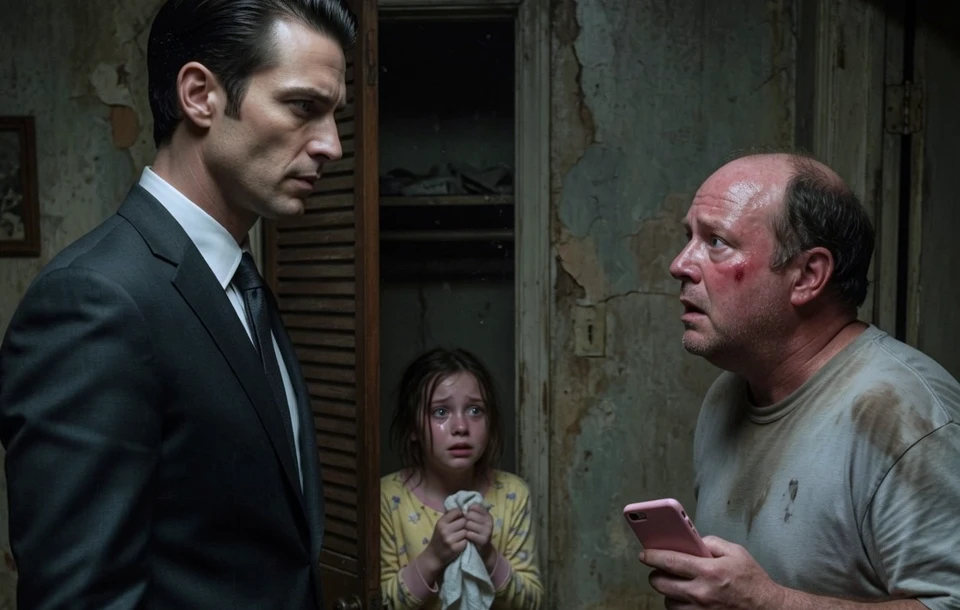
A big man stood outside a narrow linen closet, holding a pink-cased phone in one hand.
“Who were you talking to?” the man demanded.
Inside Mason’s coat pocket, the dispatcher’s voice was still tiny and frantic, asking if he could hear her.
Mason stepped out of the living room shadows. And the man in the hallway turned…
To read the rest of the story – CLICK the NEXT button 👇👇👇