


The first thing Captain Gabe Miller saw was not the animal’s face. It was the claws. Four pale hooks scraped against the concrete piling beneath the old Alligator Bend bridge while brown floodwater slammed over a ridge of broken branches and sheet metal. For one second, Gabe thought it was a dog, one more frightened thing left behind after Hurricane Rowan tore through South Florida and pushed the Everglades into people’s streets. Then the animal lifted its head, and the whole rescue boat seemed to go still around him.
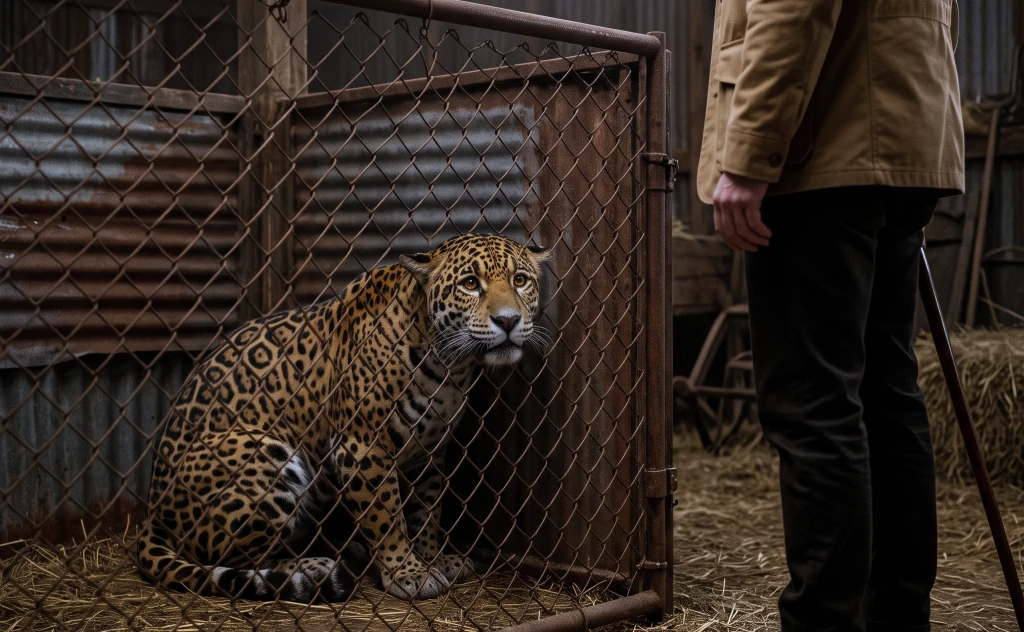
Black rosettes. Golden fur. A blunt, powerful jaw.
Luis Rivera, who had been fighting the current at the wheel for the last forty minutes, swore under his breath. “Captain,” he said, his voice tight, “that is not a panther.”
No, Gabe thought. It was not.
The jaguar clung to the bridge piling with its front paws while the rest of its body disappeared and reappeared in the churning water. Every time the current pulled, its shoulders shuddered. Every time debris struck the piling, the animal’s claws slipped lower, scraping white marks into the concrete before finding purchase again.
A jaguar had no business being in a flooded drainage canal on the western edge of Calusa County. Not in Florida. Not under a county bridge with a gas station sign floating past and somebody’s porch steps spinning in the water behind it.
“Keep us off the debris line,” Gabe said.
Luis already had one hand on the throttle and the other clenched on the wheel. He was the best boat operator Gabe had ever worked with, a man who could read moving water the way other people read street signs, but even he looked at the animal as if the river had just spoken in a language he did not trust.
“Sir, we have two missing residents upriver,” Luis said. “We’re low on fuel, the radio’s cutting out, and that thing can take a man’s arm off before we get a strap around it.”
Behind Gabe, Specialist Travis Cole lowered his binoculars. At twenty-six, Travis still had the careful posture of someone trying not to look young. Beside him, Tessa Grant tightened her grip on the rescue pole and said nothing, though Gabe saw her eyes move from the jaguar to the half-submerged trailer park beyond the bridge.
Luis was not wrong. That was the part Gabe hated.
The boat’s radio crackled against Tessa’s vest, a broken burst of dispatch chatter swallowed by wind and static. Somewhere beyond the drowned palmettos and twisted road signs, people might still be waiting on rooftops, in attics, on the second floors of houses that had never been meant to stand in this much water. Their assignment was search and rescue. Human search and rescue. They were not a wildlife team, not veterinarians, not miracle workers.
The jaguar’s left paw slipped.
Its body dropped hard into the water, and for one sharp moment only its head remained above the surface. The animal fought back up with a sound Gabe felt more than heard, a low, strangled cough that was not quite a roar and not quite a cry. One paw found the concrete again. Then the other. The current hammered its ribs.
Luis looked at Gabe. “Captain.”
Three years earlier, on another flooded road outside Tampa, Gabe had said almost the same thing Luis was saying now. Not our mission. Not our call. Not worth risking a boat when people were waiting. He had driven past a barking hound standing on the roof of a half-sunk sedan because the address they had been given was two blocks away. Later, another crew followed that dog’s barking to an elderly man trapped in the back bedroom of a house Gabe had not checked. The man lived, but Gabe had never forgotten the way the dog had known what the uniformed men did not.
He had learned to respect what panic looked like in an animal. He had also learned that a life in front of you did not become less real because it was not the life you had been sent to find.
“Bring us in slow,” Gabe said.
Luis stared at him. “Sir, I need you to say that again.”
“Bring us in slow. Upstream angle. Tessa, get the throw line ready. Travis, keep your hands clear unless I tell you otherwise.”
For half a second, no one moved. The order hung in the wet air between them, heavy with everything it might cost. Then Tessa stepped forward and clipped the rope bag to the rail. Travis set his boots wide and grabbed the boat hook. Luis shook his head once, but his hands obeyed before his mouth could argue again.
The boat turned into the current.
The outboard motor growled, then dipped as a wave of muddy water slapped over the stern. Luis worked the throttle in short, controlled bursts, cursing softly at every piece of debris that spun toward them. The flood had carried half the county into that canal: plastic barrels, porch furniture, tree limbs, a child’s blue cooler, a mailbox still bolted to its post. Any one of them could jam the prop or punch a hole in the hull if Luis misread the angle.
The jaguar watched them come.
Its eyes were pale amber, fixed and exhausted. It did not snarl. It did not bare its teeth. It simply clung to the concrete while the flood tried, again and again, to peel it away. That frightened Gabe more than a roar would have. A wild animal that had energy left made threats. This one was past warning.
“Ten feet,” Luis called.
“Hold us there.”
“I can hold for about fifteen seconds before that log hits us.”
“Then give me fifteen.”
Gabe clipped his safety line to the rail and moved toward the bow. The boat pitched beneath his boots, and Tessa caught the back of his vest before he could overbalance. He gave her a nod, then crouched, one knee braced against the wet deck.
“Do not put your hand near its mouth,” Tessa said.
“That was not my plan.”
“Good,” she said. “I like that plan.”
The humor was thin, but it kept fear from taking over the boat. Gabe reached for the rescue strap, looped it once around his wrist, then stopped himself and unlooped it. If the animal rolled or panicked, a wrapped strap could take him into the water with it. He had seen too many rescues go bad because someone confused bravery with bad mechanics.
Luis pushed the boat closer.
The jaguar’s ears flattened. Its lips twitched back, showing the edge of one white canine, but the sound that came out of it was weak and soaked with river water. It tried to pull higher on the piling and failed. Its claws shrieked against concrete.
“Now or never,” Luis said.
Gabe leaned out.
For a moment, he saw the animal not as a jaguar, not as a predator, not as a headline waiting to happen, but as muscle and fear and exhaustion wrapped in a body that could not hold much longer. Water streamed over its skull. One eye blinked against the spray. Its paws trembled.
“Easy,” Gabe said, though he knew the word meant nothing to it. “Easy.”
The first throw missed. The strap struck the concrete, slid over wet fur, and vanished into the current. Travis cursed and hauled the line back as Luis gunned the motor to keep them from swinging sideways into the bridge.
The jaguar slipped lower.
Tessa braced her pole against the piling and pushed hard. “We’re losing position.”
“Again,” Gabe said.
Luis brought the bow around in a tight correction that made the boat shudder. A plank slammed against the starboard side, and Travis kicked it clear before it could wedge under the rail. Gabe did not look back. He kept his eyes on the animal’s shoulders, on the narrow space between the waterline and the concrete, on the one chance they might still have.
The second throw landed across the jaguar’s chest.
The animal reacted instantly. Its head snapped toward the strap, jaws opening, and Gabe’s body went cold with the understanding of how fast it still could be. But the jaguar did not bite down. It bucked, panicked, and one paw lost its grip. The current grabbed its hindquarters and twisted.
“Pull!” Tessa shouted.
Gabe pulled. Travis pulled with him. The strap tightened across the animal’s wet body and slid dangerously close to its throat. Gabe shifted his grip, muscles burning, trying to pull sideways rather than back so the strap would catch behind the shoulders. Luis held the boat in place with a level of skill that would have looked calm from a distance and felt like war from the deck.
The jaguar came off the piling.
For one terrible second, the current took it completely.
Its body slammed against the side of the boat with a force that rattled every bolt in the rail. The jaguar’s front paws struck metal, claws cutting bright scratches into the aluminum. Travis lunged forward with the boat hook, then froze when Tessa barked his name.
“Not the head!” she said. “Guide the strap!”
Gabe dropped flat on the deck, hooked one arm through the rail, and reached down with the other. His gloved hand closed on soaked fur and loose skin at the back of the jaguar’s neck. The animal was heavier than he expected, dense with muscle even half-drowned. It thrashed once, not toward him but against the water, and the motion nearly tore his shoulder from its socket.
Luis yelled something Gabe did not catch.
Tessa grabbed the back of Gabe’s vest with both hands. Travis got the strap under the jaguar’s forelegs. The boat tipped hard to port as all four of them became one straining body, boots sliding, teeth clenched, arms shaking against the pull of the flood.
“Again!” Gabe shouted.
They heaved.
The jaguar’s front half came over the rail, claws shrieking against metal. Its hind legs kicked in the water, one paw striking the side of the boat hard enough to dent it. Gabe felt hot breath against his wrist and understood that if the animal turned its head, there would be no time to move.
It did not turn.
It dragged one paw forward, then another, helping without understanding, or perhaps only trying to find anything that was not water. Travis gave one last pull on the strap. Tessa threw her weight backward. Luis slammed the throttle just enough to swing them clear of the piling before a tree limb crashed into the place where the bow had been.
The jaguar slid onto the deck.
No one moved.
The animal lay on its side in a spreading puddle, chest heaving, water pouring from its fur. Its tail twitched once. Its claws flexed against the aluminum floor with soft clicking sounds that seemed too small for something that could kill them. A thin line of blood ran from a cut above one eye and disappeared into the rosettes along its cheek.
Travis breathed out first. “Is it alive?”
Tessa did not take her eyes off the jaguar. “Very.”
Luis cut the motor to idle and let the boat drift toward a pocket of slower water behind a stand of cypress. His face had gone the color of old paper beneath his rain-dark beard. “Nobody tell my mother about this,” he said.
No one laughed. The joke was too close to fear, and fear still had its hands on all of them.
Gabe pushed himself slowly to his knees. His shoulder throbbed. His gloves were scraped raw at the knuckles, and his safety line had twisted around his thigh. He unclipped it with care, keeping every movement small.
The jaguar lifted its head.
All four rescuers froze again. The animal’s ears tilted back. Its lips trembled, and a low sound moved through its chest, not loud, but deep enough to make the boat feel smaller. Gabe lowered his eyes slightly, not in submission exactly, but in refusal to challenge. He had been around enough frightened animals to know direct staring could become its own kind of threat.
“We’re not touching you now,” he said quietly. “You stay there. We stay here.”
“Captain,” Travis whispered, “you talking to the giant cat like it understands English?”
“No,” Gabe said. “I’m talking so you don’t panic.”
“That helps less than you think.”
Tessa edged toward the medical bag, then stopped when the jaguar’s eyes followed her. “We need wildlife response. Sedation, transport crate, the whole thing. If it goes into shock, we’re not equipped.”
Luis glanced toward the flooded road beyond the canal. “Nearest dry ramp is maybe a mile and a half east if it’s still above water.”
“Get us there,” Gabe said. “Slow.”
Luis looked as if he wanted to say something about fuel, missing residents, and the wisdom of hauling an apex predator through a disaster zone in a small aluminum boat. Instead, he nodded and eased them away from the bridge.
The jaguar did not rise. It lay with its head lifted a few inches off the deck, breathing hard through its nose. Water dripped from its whiskers. Every so often, one paw opened and closed, as if the concrete piling were still beneath it and the current still had not given up.
Only when they reached slower water did Gabe see the mark.
At first he thought it was a vine tangled in the animal’s fur. A dark line circled low around the jaguar’s neck, half-hidden beneath wet gold and black. It looked too straight to be a branch and too tight to be storm debris. Gabe leaned closer, then stopped when the animal’s eyes cut toward him.
“Tessa,” he said softly. “Look at the neck.”
Tessa shifted just enough to see. Her expression changed before she spoke. “That’s not from the bridge.”
Luis turned from the wheel. “What?”
Gabe waited for the jaguar’s breathing to settle into a rough rhythm, then used the tip of the rescue pole to lift the wet fur near the line. The animal growled, and he stopped at once. But he had seen enough.
The dark strand was not a vine.
It was steel cable, broken at one end and buried so deeply in the fur that the skin around it had rubbed raw. It had not washed there by accident. It had not wrapped itself neatly around the neck of a drowning animal in the middle of a hurricane.
Gabe looked from the cable to the impossible jaguar lying on the floor of his rescue boat, and the flood suddenly felt less like the beginning of the story than the thing that had exposed it. Someone had put that cable there…
To read the rest of the story – CLICK the NEXT button 👇👇👇