


Mark Bennett had been hiding in Spruce Hollow for nine days when the moose calf came to his porch to die. At first, he thought the sound outside was the loose shutter above the kitchen window. The cabin had a dozen old noises like that—boards swelling in the rain, pipes ticking after the stove warmed, pine branches scraping the roof whenever the wind came down off the ridge. But this sound came again, softer and uneven, not wood and not weather. Breathing.
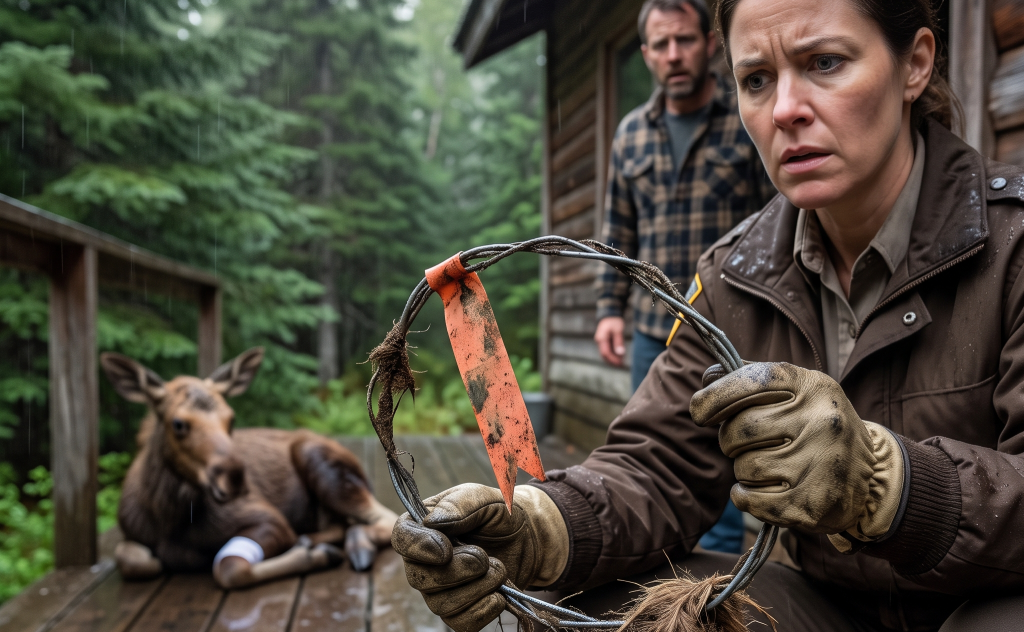
Mark stood in the kitchen with one hand on the coffeepot and the other braced against the counter. For a moment he did not move. He had come to northern Maine because nothing here was supposed to ask anything of him. Not the empty road, not the leaning mailbox, not the little cabin his uncle had left him and everyone else in the family had forgotten.
Then something shifted outside the back door, and the porch boards creaked.
He opened the door slowly. Cold rain slid under the roof and tapped against the steps. A moose calf stood in the gray light beneath the sagging porch overhang, all legs and wet brown fur, its long face lowered as if it had finally reached the end of whatever strength had carried it there.
One back leg was tucked awkwardly beneath it.
Blood had dried in a dark line above the hoof.
Mark stayed still. He knew enough about Maine to know that a calf meant a cow moose might be nearby, and a cow moose with a calf was not something a man argued with. His uncle Roy used to say a mother moose could turn a pickup truck into a beer can if she took the notion. Mark had laughed at that when he was younger. Standing five yards from a trembling calf, he did not feel like laughing.
“Easy,” he said, though he was not sure whether he was speaking to the animal or himself. “I’m not coming any closer.”
The calf lifted its head. Its ears twitched once, rainwater sliding from the tips. It did not bolt. It did not lower itself to charge or stumble away toward the trees. It only looked at him with dark, exhausted eyes, as if it had already tried the forest and the road and the rain and had come to the last place with a roof.
Mark swallowed. The cabin behind him smelled of burnt coffee, damp firewood, and the cardboard boxes he still had not unpacked. On the table sat the envelope from Lauren’s attorney, its corner curled from the humidity. Beside it, in a chipped blue coffee mug, lay his wedding ring.
He had not meant to bring the ring to Maine. He had taken it off in a rest stop outside Bangor, then found himself unable to throw it away, unable to put it back on, unable to leave it in the truck where he might see it every time he reached for change. So he had dropped it in the mug and treated it like some tool he had not decided whether to keep.
The calf’s injured leg trembled.
Mark stepped back inside and grabbed his phone. There was one bar of service if he stood near the pantry window and held the phone at shoulder height. He had discovered that on his second day, when Lauren called and he let the phone ring until it stopped.
This time, he searched for the number to the county dispatch office and asked for a game warden.
The woman who answered sounded awake in the way people sound awake when they have already handled three problems before breakfast. Mark gave his name, the cabin road, and the best description he could manage.
“Don’t touch it,” she said. “Don’t feed it. Don’t try to move it.”
“I wasn’t planning on moving it,” Mark said, watching through the window as the calf lowered its head toward the wet boards. “But it’s bleeding.”
“I understand. A warden will call you back. Is the mother visible?”
“No.”
“Any tracks? Any sign she’s close?”
“Lady, the whole yard is mud.”
“Then stay inside and keep eyes on the calf from a distance. Cow moose can leave calves alone for a while, but if it’s injured, we need to be careful. Do not approach unless someone tells you to.”
Mark almost said he was not an idiot. The words rose automatically, defensive and useless. He swallowed them because he could hear himself in them, the old version of himself Lauren used to look at across the dinner table when he corrected instead of listened.
“I’ll wait,” he said.
The dispatcher took his number. Fifteen minutes later, a game warden named Nora Blake called from somewhere south of him, her voice cutting in and out as if it had to fight through the rain.
“Mr. Bennett, I’m about forty minutes away if the north bridge is still passable,” she said. “Until I get there, I need you to do exactly what dispatch told you. Don’t feed the calf, don’t put blankets on it, don’t let it inside.”
“I wasn’t going to let a moose into my kitchen.”
“You’d be surprised what lonely people do with injured animals.”
The words landed too close to the truth, though she could not have known that. Mark looked toward the table, toward the attorney’s envelope and the ring in the mug, and felt an irritation he did not quite earn.
“It showed up under my porch,” he said. “I didn’t invite it.”
“I know. And you called. That was the right thing.” Her tone softened by half an inch, not enough to become gentle but enough to become human. “What I don’t want is for good intentions to make the situation worse.”
Mark watched the calf try to shift its weight. It managed half a step, then folded down hard onto its front knees. The sound it made was not loud. That somehow made it worse.
“She just went down,” he said.
Nora was quiet for a second. “She?”
“I don’t know. It just looked like a she.”
“Stay where you are. I’m on my way.”
The call dropped before he could answer.
For the next half hour, Mark stood at the pantry window and watched rain turn the yard into silver-gray mud. The cabin sat at the edge of a clearing, with spruce and fir pressed close on three sides. Behind the trees, an old logging road ran up toward a ridge where nobody lived anymore. In front of the cabin, the gravel road curved past Ruth Calder’s place and disappeared toward town, though “town” in Spruce Hollow meant a gas pump, a post office window inside a general store, and a diner that closed whenever the owner felt tired.
Mark had come here because his uncle’s cabin was the one place Lauren had never been.
That sounded foolish when he put it plainly. There were places in Portland she had never been, too. There were motels, fishing camps, rented rooms above garages. But the cabin had history without her in it. It had Roy’s old workbench, Roy’s cracked leather chair, Roy’s stack of Field & Stream magazines from years when Mark still believed adults knew what they were doing. It had a roof that leaked over the mudroom and a porch that sagged in the corner, and every repair gave Mark something to do with his hands.
His hands had always been better than his mouth.
Lauren had told him that once during one of their last fights. They were standing in the kitchen of the house they were about to sell, the house where he had rebuilt the deck and tiled both bathrooms and installed the cabinets himself after work because paying someone else felt irresponsible. Lauren had been crying, but quietly, which was worse than yelling.
“You fix everything except the thing I’m asking you to hear,” she had said.
He remembered looking at the cabinet doors, checking whether they hung even, because looking at her face made him feel cornered. Three weeks later, she told him about Evan. Not cruelly. Not dramatically. She sat across from him at the same kitchen table and said she was leaving, and the softness in her voice hurt more than anger would have.
“I’m tired of being alone next to you, Mark.”
The calf lifted its head. Mark blinked hard and returned to the room he was actually in. Rain tapped the glass. The calf’s sides moved quickly with each breath.
“You and me both,” he muttered.
By the time Nora Blake’s truck crawled into the clearing, the rain had eased into a cold mist. She was in her forties, maybe, with a brown uniform jacket, a ball cap pulled low, and the controlled expression of someone who had learned not to let strangers borrow her emotions. She parked near the road instead of the cabin, stepped out with a field bag, and looked first at the tree line, not the calf.
“Any sign of the cow?” she asked.
“Nothing.”
“Any noise from the woods? Crashing, grunting, anything like that?”
“No. Just rain.”
Nora nodded once and walked slowly toward the porch. She did not go straight at the calf. She moved in an arc, watching the trees, stopping every few steps. Mark followed from the doorway until she glanced back and lifted one hand.
“Stay there.”
He did. He did not like being told to stay, but he did it.
The calf tried to rise when Nora got closer. Its legs unfolded in a clumsy rush, one hoof skidding on the wet boards. It made it halfway up before the injured leg failed. Nora stopped immediately and lowered her voice.
“Easy. Nobody’s pushing you.”
Mark heard the difference in her voice and wondered how many frightened creatures had heard it before him. She crouched several yards away, opened her bag, and pulled on gloves. Her gaze moved over the calf’s body, pausing at the back leg. The rain had cleaned some of the mud away, leaving the wound more visible than Mark wanted it to be.
“That’s not fresh from this morning,” she said.
“What does that mean?”
“It means she’s been moving on it for a while.”
Nora shifted a little closer. The calf flinched but did not get up. Mark’s fingers tightened around the doorframe as Nora leaned in just enough to see the wound without grabbing the animal.
Then her face changed.
It was not much. Her jaw set, and the practical calm in her eyes sharpened into something colder.
“What?” Mark asked.
Nora did not answer right away. She reached into her bag and pulled out a small pair of cutters, then stopped as if thinking better of it. Instead, she took a picture of the calf’s leg, then another from closer. Only after that did she ease two fingers toward the dark, matted hair above the wound.
The calf kicked weakly. Nora drew back.
“Mr. Bennett,” she said, still looking at the leg, “did you see anything in the yard before I got here? Any metal? Any cable? Any old fencing?”
“No. Why?”
She stood, came back toward the porch steps, and held out her gloved hand. Something thin and dark lay across her palm, twisted with mud and hair.
At first Mark thought it was a thorn.
Then he saw the orange plastic caught around one end, the kind of faded survey tape loggers tied to branches and forgotten fences. The wire was bent into a tight curl, too neat to be a random scrap.
Nora looked from the wire to the woods behind the cabin.
“That wound isn’t from a wolf,” she said.
Mark stared at the little coil in her hand. “Then what is it from?”
Nora’s mouth tightened.
“Something a person left behind…”
To read the rest of the story – CLICK the NEXT button 👇👇👇