


The first time the Army came to my apartment, I was barefoot, half-dressed for work, and certain I was being evicted. It was 6:04 on a Wednesday morning in September, the kind of gray Cleveland morning when the streetlights were still on and the whole building smelled faintly of wet brick, old grease, and somebody’s cigarettes. I had one arm through my scrub top and a cup of instant coffee cooling on the counter when the knock came. Not a neighbor’s knock. Not the landlord’s lazy fist on the door.
Three hard strikes. A pause. Then three more.
I stood perfectly still in my tiny kitchen, listening to the old refrigerator rattle behind me. My rent was late again. My electric bill had a red stamp across it. My phone had been buzzing for two days with messages I couldn’t afford to answer. So when I opened the door and saw three people in dress uniforms standing in the hallway, my first thought was not that they had come to honor someone.
My first thought was that I had done something wrong.
The man in front was tall, maybe fifty, with a square jaw, close-cropped hair, and a face trained into military stillness. The two officers behind him stood so straight they looked carved into the dim hallway. Their shoes shone under the flickering bulb outside my door.
“Ms. Maya Ellis?” the colonel asked.
My hand tightened around the door edge. “That’s me.”
“I’m Colonel Marcus Bell,” he said. “We’re here about Walter Keene.”
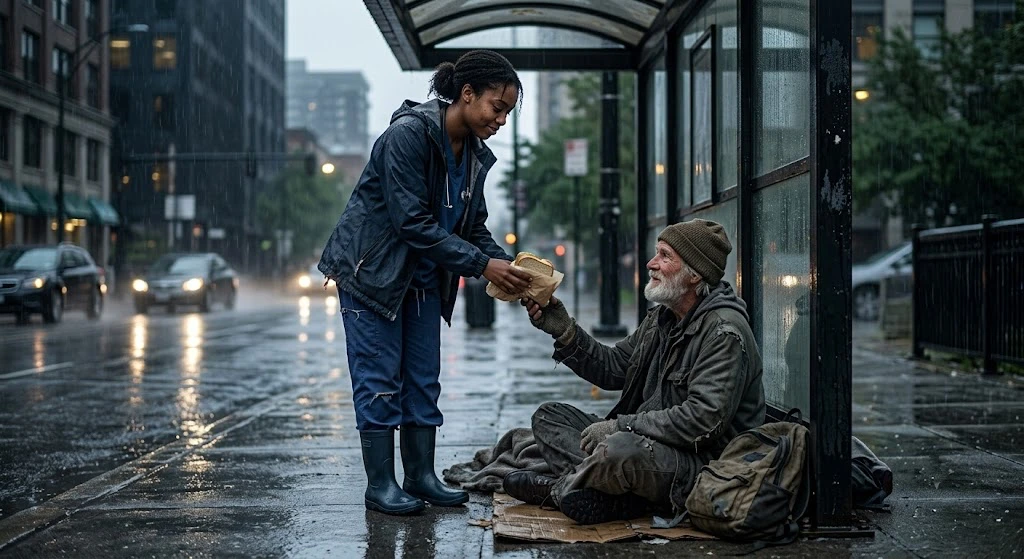
For a second, the name didn’t fit inside that hallway. Walter belonged to a cracked bus shelter, a flattened cardboard box, a dented thermos lid full of coffee. Walter belonged to early mornings when the city still pretended not to see him.
My throat closed. “Is this about the letter?”
The colonel’s expression shifted just enough to scare me more.
“Yes, ma’am,” he said. “General Mercer received it. And she has questions about what you did for him.”
Six months before that knock, Walter Keene was just the old man sleeping outside the boarded-up laundromat on Briar Street.
I noticed him because everyone noticed him, even when they pretended they didn’t. He was in his late sixties, white, thin in the way people get when hunger has been given too much time, with a gray beard tucked into the collar of a coat that had lost most of its buttons. He slept beneath an army-green blanket that looked older than I was, his belongings tied inside two black trash bags and stacked neatly near his head.
I was twenty-three, Black, exhausted, and trying to stretch one life across too many obligations. I worked mornings in the cafeteria at Lakeview Regional Medical Center, evenings at a discount grocery store, and two nights a week I sat in a community college classroom pretending my eyes didn’t burn while my instructor talked about anatomy charts. I wanted to become a nurse. Some days that dream felt like the only clean thing I owned.
For two weeks, I walked past Walter like everyone else.
That is the part I hate admitting. I would step around the damp corner of his cardboard, pull my coat tighter, and tell myself I had nothing to give. I had thirty-two dollars in checking, a landlord who treated mercy like a luxury service, and a fridge that mostly held condiments. I was not heartless. I was tired. There is a difference, but it can look the same from the sidewalk.
Then one Monday in March, I packed two peanut butter sandwiches by mistake.
I was making my lunch at five in the morning with the lights off because I was trying to pretend the electric bill wasn’t real. The bread was the cheap kind that stuck to the roof of your mouth. The peanut butter came from a plastic jar big enough to survive a nuclear winter. I made one sandwich, wrapped it, and then, because my mind was already halfway to work, made another.
I realized it only when I was three blocks from home, standing across from the laundromat while the wind dragged loose newspaper down the curb.
Walter was awake that morning. He sat with his back against the brick, his blanket pulled over his knees, watching people hurry around him. Not asking. Not calling out. Just watching, as if he had learned that wanting too visibly made people cruel.
I stopped before I could talk myself out of it.
“Excuse me,” I said.
He looked up. His eyes surprised me. They were pale blue, sharp and steady, not empty at all.
I held out the sandwich. “I made an extra. I’m not going to get a break until late, and it’ll go bad in my locker.”
He looked at the plastic wrap in my hand, then at my face, then down at my shoes. One of the soles was peeling loose near the toe. He noticed that. I could tell.
“You should keep it,” he said.
His voice was rough from cold, but clear.
“I’m offering it,” I said.
“That’s different from having extra.”
I almost pulled my hand back. Not because he was wrong, but because he was too right. Instead, I made myself hold the sandwich out another inch.
He took it with both hands.
“Thank you, Miss Maya,” he said.
I looked down at my hospital badge and gave a tired laugh. “That thing gives everybody away.”
“Walter Keene,” he said, as if we were meeting at a church social instead of beside a dead laundromat. “U.S. Army, once upon a time.”
I nodded because it seemed rude not to. “Do you drink coffee?”
“Black,” he said. “When I can get it.”
The next morning I brought my dented thermos and an extra paper cup. The morning after that, I brought a banana with brown spots and another sandwich. By Friday, I was leaving my apartment ten minutes earlier so I could sit on the cold metal bench beside him before the Route 52 bus came grumbling around the corner.
It did not feel like charity. Charity had a distance to it, a clean hand reaching down from somewhere safe. What Walter and I had was messier than that. I gave him breakfast, and he gave me ten minutes in the day when nobody needed anything from me except my presence.
He asked about my classes. I told him about memorizing the bones of the wrist until the words sounded like a spell. He listened with the focus of a man studying a map.
“You’ll pass,” he said one morning, while I complained about a lab practical I was sure had ruined my life.
“You don’t know that.”
“I know discipline when I see it.”
That made me laugh, because discipline was not what my life felt like. My life felt like duct tape over a broken pipe. But Walter said things with such certainty that, for a few seconds, I borrowed his confidence and carried it with me onto the bus.
He told me stories, too. Strange ones. Impossible ones.
He talked about helicopters with no markings, landing in fields before sunrise. He talked about pulling diplomats out of places that never made the news. He talked about men in suits who never gave their real names and radios that went silent when silence meant somebody might live. He said “classified” the way other people said “weather,” casually, almost bored by it.
I assumed the stories were what the street had left him.
Not lies exactly. More like a room he had built in his mind where he could still be important, still be young, still be somebody men in clean uniforms needed. I did not correct him. I did not ask for proof. A man sleeping on cardboard does not owe anyone a résumé before he is allowed to keep his dignity.
One wet April morning, a man in a charcoal suit kicked Walter’s blanket into the gutter.
It happened so fast I almost didn’t understand what I had seen. The man was walking with a leather briefcase and a phone pressed to his ear, his umbrella tilted low against the rain. He could have gone around. There was room. Instead, he hooked his polished shoe under the edge of the blanket and sent it sliding into the dirty water near the curb.
Walter reached for it slowly, as if moving too quickly might make the humiliation larger.
“Hey!” I shouted.
The man turned with annoyance, not guilt. “He’s blocking the sidewalk.”
“He’s a person,” I said. My voice came out louder than I expected, sharp enough that two commuters looked over. “You saw him.”
The man rolled his eyes and kept walking. “Then take him home with you.”
I wanted to chase him. I wanted to say something so fierce it would follow him into every clean room he entered that day. Instead, I dropped to my knees beside Walter and grabbed the soaked blanket from the gutter. Cold water ran through my fingers, black with street dirt and oil.
“You don’t need to do that,” Walter said.
“Yes, I do.”
We wrung the blanket together. My scrub pants soaked through at the knees, and the rain crawled under my collar. Walter kept his head bowed, but I saw his hands shaking. Not from the cold. Not entirely.
When we had squeezed out as much dirty water as we could, I draped the blanket over the bench rail and handed him his coffee. He looked at me for a long moment, his face tired and unreadable.
“You’ve got a backbone,” he said quietly.
“I’ve got a bus I’m about to miss.”
“Backbone first,” he said. “Bus second.”
I smiled despite myself. He didn’t.
“You’re going to need that,” he added.
At the time, I thought it was just another one of Walter’s dramatic lines, the kind that belonged to helicopters and men without names. I didn’t know that one day I would be sitting under bright government lights with a microphone in front of me, repeating his name to people who should have known it long before I did.
By May, breakfast with Walter had become part of my body’s rhythm.
My alarm went off at five. I made two sandwiches, poured coffee into the thermos, packed whatever fruit I could afford, and walked to Briar Street in the blue-dark morning. Some days I ate my half at the bus stop. Some days I lied and told Walter I had already eaten. He never believed me, but he let the lie stand when I needed it to.
I was behind on everything that spring. My studio apartment was four flights up in a brick building that breathed cold through the window frames and heat through the walls in the summer. The stove had two working burners if I jiggled the knob just right. The bathroom ceiling grew mold no matter how hard I scrubbed it. Rent was $725, and I owed Mr. Donnelly, my landlord, almost half of that from February.
There were bills on my counter like accusations. Electric. Phone. Medical debt from an ER visit when my asthma got bad two years earlier. Tuition for the community college. A notice from the landlord folded into thirds because I was tired of seeing the word “final.”
And beside all of it sat the peanut butter.
One night after my grocery shift, I came home with my feet throbbing so badly I had to sit on the stairs between the third and fourth floors. When I finally got inside, I opened my wallet and counted what was left from payday. Seventy-eight dollars. That had to cover bus fare, groceries, the electric payment, and the extra forty I had promised Mr. Donnelly.
I stood at the counter for a long time, looking at the bread.
Any reasonable person would have stopped. Walter would have told me to stop if he’d known how close I was to losing the apartment. He would have split the sandwich, pushed it back into my hands, and said something about fair being fair.
But the thought of walking past him empty-handed made my chest ache in a way hunger never did.
At Lakeview, Rosa Alvarez figured it out before anyone else.
Rosa ran the cafeteria kitchen like a general with a hairnet. She was in her sixties, Puerto Rican, five feet tall if she stretched, and capable of terrifying grown surgeons with one look over the steam table. She had worked at Lakeview long enough to know every quiet disaster a person could hide under a clean uniform.
“You eating today?” she asked me during lunch rush, while I wiped down tables.
“I had breakfast.”
Rosa glanced at me over her glasses. “Coffee is not breakfast.”
“I ate.”
“You fed your bus stop friend again.”
I bristled before I could stop myself. “His name is Walter.”
“I know his name because you say it like I should already be ashamed.” She turned toward the kitchen, returned with a plastic container of rice, beans, and chicken, and shoved it into my hands. “Sit down for six minutes and put that in your body.”
“I’m on shift.”
“You’re on my shift. Sit.”
The food was warm through the plastic. The smell hit me so hard my eyes burned.
Rosa softened then. “Maya, I’m not telling you to stop caring about him. I’m telling you not to disappear while you’re trying to keep him seen.”
I ate in the storage room with a mop bucket beside my chair and cried into the rice where nobody could watch.
On the first Monday in June, Walter was gone.
His cardboard was gone. His blanket was gone. His trash bags were gone. The brick wall outside the laundromat looked naked without him, and the empty place where his body should have been seemed larger than the whole block.
I waited through my bus, then the next one. By the time I made it to Lakeview, Rosa took one look at me and said, “What happened?”
“I don’t know.”
For six days, I searched in the only ways a person with no money and no authority can search. I walked three blocks in each direction. I asked at the corner store, the gas station, the church pantry. I went to the men’s shelter after my grocery shift, feet screaming inside my cheap shoes, and asked the woman behind the plexiglass if they had a Walter Keene.
“Are you family?” she asked.
I hesitated too long.
She shook her head. “Then I can’t tell you much.”
“I just need to know if he’s alive.”
Her face changed a little, but not enough to open any doors. “People move around.”
That was what everyone said. People move around. As if vanishing was a lifestyle choice. As if a human being could be missing only if someone official had first agreed he existed.
On the seventh morning, I left a paper bag tucked into a crack in the laundromat wall. Inside was a sandwich, a banana, and a note written on the back of a grocery receipt.
Walter, I hope you’re safe. —Maya
That afternoon, on the bus ride home, I saw him.
He was back at the laundromat, sitting against the brick with his blanket folded over his lap. He looked thinner. Not just hungry-thin, but hollowed out, like someone had carved a week from inside him. His face was gray, his beard untrimmed, and when I jumped off at the next stop and ran back, he lifted his head as if it took all his strength.
“Miss Maya,” he said.
I crouched in front of him, breathless. “Where were you?”
“Had a bad spell.”
“That is not an answer.”
“It’s the answer I’ve got.”
I noticed his right hand then. There was a clean pink line across the back of it, too neat for a street scrape. It looked like something had been stitched and recently opened to air.
“What happened to your hand?”
Walter slid it under the blanket. “Old trouble.”
“Walter.”
His eyes sharpened. For the first time since I had known him, there was command in his face. Not the soft, sad dignity of a man at a bus stop. Command.
“Leave it,” he said.
The words stopped me. He seemed to hear the harshness in them, because his face loosened afterward. He reached into the inner pocket of his coat, moving slowly, and pulled out a white envelope sealed with too much tape. My name was not on it. The front was addressed in careful, shaky block letters to someone I didn’t know.
Major General Elaine Mercer
Department of Defense
Washington, D.C.
Walter held it out.
“If I’m not here one morning,” he said, “mail this.”
I stared at the envelope instead of taking it. “You just got back.”
“Maya.”
“No. Don’t do that. Don’t talk like you’re already leaving.”
He held the envelope between us, his hand trembling from the effort. “Promise me.”
The bus groaned around the corner behind me. Rainwater dripped from the laundromat awning onto the sidewalk, steady as a clock. I looked at the old man who had shared his breakfast with me when I was starving, the man whose impossible stories suddenly felt less impossible than they had a week before.
I took the envelope.
Walter closed his eyes, and for one terrible second, I thought the promise itself had used up the last of him…
To read the rest of the story – CLICK the NEXT button 👇👇👇