


The morning the military came to my apartment, I had peanut butter on my thumb and twenty-seven dollars in my checking account. I was standing barefoot in my tiny kitchen, spreading breakfast onto two slices of discount wheat bread, when the knock landed on my door. Not the soft little tap of a neighbor asking for sugar. Not the impatient thump of my landlord. It was measured, heavy, official. Three sharp knocks, then silence, as if whoever stood outside already knew I would answer.
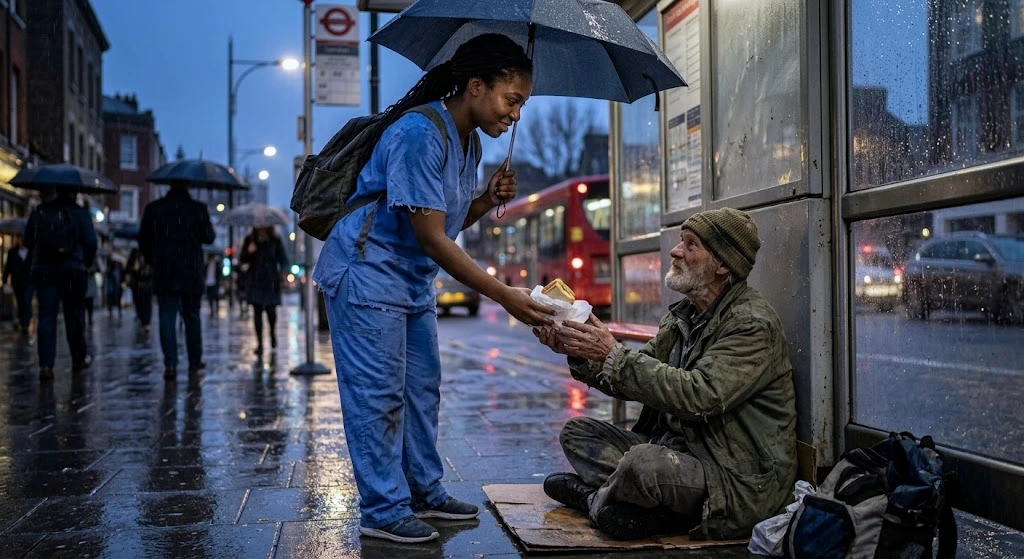
At six in the morning, in my building, nobody knocked like that unless they had come to take something.
I wiped my hand on my scrub pants and looked through the peephole. The hallway light flickered over three dress uniforms. Brass buttons. Dark jackets. Still faces. For a second, I honestly thought exhaustion had made me hallucinate.
Then the man in front looked straight at the peephole and said, “Ms. Brooks? We’re here about Walter Mercer.”
My hand went cold on the deadbolt.
Six months earlier, Walter had been just a shape under an old army blanket outside the shuttered check-cashing place on Hawthorne Avenue. Every morning, I passed him on my way to catch the Route 19 bus. Every morning, I made myself look at the cracked sidewalk, the bus schedule, the traffic light, anywhere but at the man sleeping against the brick wall with his whole life stuffed into two plastic grocery bags.
I was twenty-two, Black, broke, and running on caffeine and stubbornness. I worked breakfast prep at St. Agnes Medical Center, stocked shelves at a PriceSave grocery three nights a week, and took nursing classes at Harbor County Community College whenever I could afford the next bill. My apartment was a fourth-floor walk-up with one working burner, a radiator that clanked like an old train, and a ceiling stain that changed shape when it rained.
I told myself the same thing every tired person tells herself when she sees somebody worse off.
I can’t help him. I can barely help me.
For almost two weeks, I believed it because believing it let me keep walking.
Then one Thursday in March, I packed an extra peanut butter sandwich by mistake. I had planned to eat it between shifts, but my schedule changed and I knew it would sit in my locker all day until the bread went wet and sad around the edges. I was so hungry that morning my stomach hurt, but the thought of that man waking up to nothing while I carried food past him felt worse.
He was awake when I reached the stop. Sitting upright, not sprawled, with his back against the brick and his hands folded over one knee. His beard was white in patches. His cheeks were hollow. But his eyes were sharp enough to make me slow down.
“Sir?” I said.
He looked at me like he was already preparing to be mocked.
I reached into my tote bag and held out the sandwich wrapped in wax paper. “I made too much. It’s just peanut butter.”
He didn’t take it right away. His gaze moved from the sandwich to my hospital badge, then to the frayed cuff of my coat. He saw too much. That was the first thing I learned about Walter Mercer. People walked over him and around him, but he missed almost nothing.
“You sure you can spare it, Maya?” he asked.
I glanced down at my badge, startled by my own name on his tongue. “That depends. Are you allergic to peanuts?”
A tiny smile tugged at his mouth. “No, ma’am.”
“Then I can spare it.”
He accepted the sandwich with both hands, careful as if I had handed him something breakable. “Walter,” he said. “Walter James Mercer.”
After that, I brought him breakfast every morning. Not much. A sandwich. A banana when I had one. Coffee from a dented thermos I bought at Goodwill because the cap doubled as a cup. I always told myself it was no big deal, but it became the one steady thing in a life held together by bus transfers, overdue notices, and prayers I was too tired to finish.
Walter never begged. He never performed gratitude. He would take the food, nod once, and say, “Morning, Miss Maya,” like we were meeting at a diner instead of a bus shelter with graffiti scratched into the glass.
Sometimes we talked about my classes. He knew the difference between memorizing a body part and understanding why it mattered. When I complained about anatomy, he would ask questions that made me look at my textbook differently.
“Don’t learn the bones like a list,” he told me once, cradling his coffee in both palms. “Learn them like a map. A body is always trying to tell you where it hurts.”
I laughed because I thought he was just being poetic. Later, I realized Walter had spent his whole life reading maps that other people were never allowed to see.
He told stories, too. Strange ones. Impossible ones. He talked about flying low through mountain fog with no lights. About men in suits whose names never appeared in newspapers. About landing in fields that did not exist on any public chart. He never made himself the hero of these stories. That was what made them unsettling. He told them like a man trying to set down weight, not inflate himself.
“I once pulled a senator out of a mess so ugly they burned the whole file,” he said one damp morning.
I handed him a banana and tried to smile. “You rescued a senator?”
“Two men, actually. One elected. One not.” He looked past me toward the waking street, and for a moment the bus stop was not there anymore. “Some promises get written down. Some don’t. The unwritten ones are the ones that can ruin you.”
I thought the street had scrambled his memories. I had seen enough patients in the cafeteria, enough exhausted families in waiting rooms, to know how illness could bend the mind. I never corrected him. It seemed cruel to take away the only version of his life that still gave him dignity.
The city was not as gentle.
One morning, rain came down sideways, cold enough to sting. A man in a gray wool coat hurried past the shelter and kicked Walter’s blanket out from under the edge of the overhang. It slid into the gutter, soaking up filthy water. The man did not even look back.
I did.
“Hey!” I shouted. My voice snapped through traffic louder than I expected. “Pick that up.”
The man turned with his umbrella angled over one shoulder. “He’s blocking the sidewalk.”
“He’s a person,” I said, already walking toward him. “And you’re old enough to know better.”
People at the stop stared at me. The man muttered something under his breath and kept going. I knelt beside Walter and dragged the blanket out of the gutter. It was heavy, sour with rain and street grime, and my knees soaked through my scrub pants in seconds. Walter reached for the other end, but his hands were shaking too hard to help much.
“You didn’t have to get wet over me,” he said.
“Yes,” I said, twisting brown water from the blanket. “I did.”
He watched my face for a long time. Rain gathered in his eyebrows and ran down into the white of his beard. “Hold on to that spine, Maya Brooks,” he said quietly. “There’ll come a day when somebody tries to make you feel small in a room built for powerful men.”
I snorted because it sounded like one more line from one of his spy stories. “I’m late for the cafeteria. That’s the only powerful room in my life.”
But Walter did not smile. He just folded the wet blanket across his lap and took the coffee I gave him as if my hands had become part of some ceremony neither of us knew how to name.
By May, I could make two peanut butter sandwiches in the dark without fully waking up. Bread, spread, fold, wrap. One went into my tote. One stayed on the counter for me if I had time. Most mornings, I did not have time.
My bills began to pile up in angry colors. Pink notice from the landlord. Red letters from the electric company. White envelopes from medical collections, each one pretending to be polite while threatening to crush me. I owed $650 in rent, then an extra forty dollars a week because I had begged for a payment plan. I owed for a hospital visit from two years earlier, which was funny in the ugliest possible way because I spent my days feeding people inside a hospital that would have sent my own debt to collections without blinking.
Mrs. Lena Wu, my supervisor in the cafeteria, noticed before anyone else did. Mrs. Wu had been running that kitchen for twenty-eight years and could tell by the way a worker moved whether she had eaten.
“You’re getting pale,” she said one afternoon while I wiped trays that were already clean.
“I’m fine.”
“You are a terrible liar.” She leaned against the stainless-steel counter, arms folded. “Are you feeding the man at your bus stop again?”
“His name is Walter.”
“I know his name because you say it like you’re defending him in court.” Mrs. Wu disappeared into the back and returned with a container of baked ziti and two rolls wrapped in foil. She shoved them into my hands. “Eat this before you fall into the soup.”
My throat tightened so hard I had to look away. “I didn’t ask for—”
“I know. That is why I’m giving it to you.” Her face softened, but her voice stayed sharp enough to cut onions. “Kindness is not supposed to be a suicide mission, Maya.”
That night, I sat on my mattress on the floor and counted money until the numbers stopped looking real. After rent, bus fare, and the electric payment, I had less than thirty dollars to last almost two weeks. The peanut butter jar sat on the counter under the buzzing kitchen light, half full. I knew exactly how many sandwiches it could make if I spread it thin.
I also knew Walter would understand if I stopped.
That should have made it easier.
On Friday morning, I brought breakfast anyway. Walter took the sandwich, unwrapped it, and without a word tore it neatly in half. He handed one piece back to me.
“Don’t argue,” he said.
I tried to laugh, but it came out wrong. “You boss everybody around like this?”
“Only people who look like they’re about to lie to me.”
I ate my half beside him while the bus shelter filled with commuters pretending not to watch. Peanut butter stuck to the roof of my mouth. The coffee was bitter. Walter seemed satisfied, as if we had corrected some imbalance in the universe.
The following Monday, he was gone.
His cardboard was gone. His bags were gone. Even the little flattened place near the brick wall where his shoulder usually rested looked swept clean. I waited through my bus and the next one, telling myself he had found a warmer spot or been moved along by police. I checked again after work. Then Tuesday. Then Wednesday.
By Thursday night, panic had become a physical thing under my ribs. I walked to the Mercy Harbor shelter after my grocery shift, my feet burning in my cheap shoes. The woman behind the intake window searched his name and found nothing. Three hospitals refused to tell me anything because I was not family. A police dispatcher said grown adults had a right to move around. Everybody sounded reasonable, and none of them helped.
On the seventh morning, I left a brown paper bag tucked into the crack of the brick where he used to sleep. Inside was a sandwich, a banana, and a note.
Hope you’re safe. —M
That evening, the Route 19 rolled past Hawthorne Avenue just as the sun was sinking behind the laundromat roof, and I saw him.
Walter was back in his place, sitting against the brick with his bags beside him. He looked thinner. Gray. There was a hospital band on his wrist, half hidden under his sleeve, and a clean pink scar crossed the back of his hand like somebody had opened him carefully and sewn him closed.
I jumped off at the next stop and ran back so fast my lungs burned.
“Where were you?” I demanded, dropping to my knees in front of him. “I called hospitals. I went to the shelter. I thought you were dead.”
Walter looked at me for a long second before recognition came fully into his eyes. “Not yet.”
“That’s not funny.”
“No,” he said. His voice was sandpaper. “It isn’t.”
I reached for his wrist. “What happened to your hand?”
He pulled his sleeve down. Not fast enough. I had already seen the scar, the band, the bruises where IVs had been. His expression closed like a door.
“Walter.”
He reached inside his coat instead of answering and drew out a sealed envelope. It was thick, creased at one corner, and addressed in handwriting so shaky each letter seemed to have cost him something. He held it between us.
“If I disappear again,” he said, “mail this.”
I stared at the envelope. “What are you talking about?”
“Promise me.”
“No. You don’t get to vanish for a week and come back asking me to promise things like that.”
“Maya.” He said my name with a kind of command I had never heard from him before. Not loud. Not angry. Just unmistakably trained. “Promise.”
The bus groaned toward the curb behind me, brakes squealing. I took the envelope because he looked too tired to keep holding it up. My thumb brushed the address, and my stomach tightened before I could understand why. It was addressed to a general at the Pentagon…
To read the rest of the story – CLICK the NEXT button 👇👇👇