


Emma Hart did not let go of Caleb Walker’s jacket when the station clock turned 6:12 a.m. Her fingers were twisted into the rough green fabric as if that alone could hold him in Pittsburgh, as if the whole weight of the Army, the train schedule, and the life he had chosen might give way to one nineteen-year-old girl who was trying very hard not to sob in public. Around them, the old station was already awake: coffee lids snapped into place, suitcase wheels rattled over tile, and a boarding announcement echoed beneath the high ceiling with the cold patience of something that did not care who was being left behind.
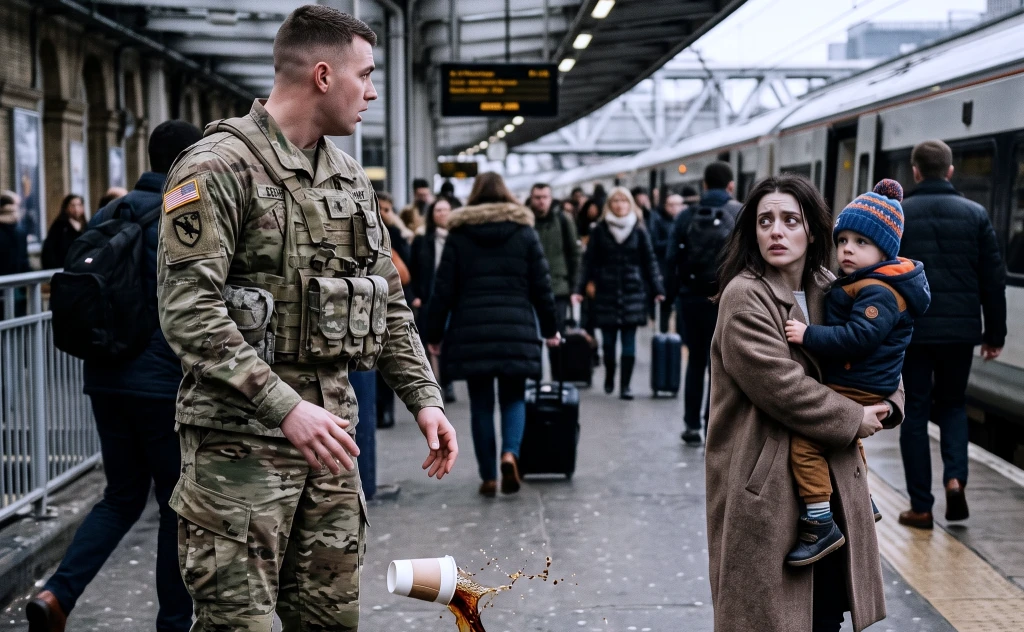
Caleb bent his head until his forehead touched hers. He was taller than everyone in their little circle now, broad-shouldered and straight-backed in a new uniform that still had the stiff, unworn smell of a life he had not yet earned. The rucksack at his feet looked too heavy for an ordinary morning, but he kept smiling because his mother was crying, his father was pretending not to, and Emma was shaking against him like the platform had dropped out from under her.
“It’s training,” he whispered. “Not the moon.”
Emma gave a small broken laugh, but it came out wet and almost soundless. “You always say things like that when you’re scared.”
“I’m not scared.”
“You’re lying.”
Caleb’s mouth moved like he wanted to argue, but he only pulled her closer. Behind them, his friends from high school were trying too hard to be loud. One of them slapped his shoulder and called him “Airborne” like it was a joke instead of a goodbye. His father, Robert, kept clearing his throat and checking the departure board, though nothing on it had changed. Diane Walker stood a few feet away in a camel-colored coat that probably cost more than Emma’s mother made in a month, dabbing carefully at the corner of one eye with a folded tissue.
To anyone passing by, Diane looked like a proud mother trying to hold herself together. Emma had known her long enough to understand that Diane never did anything without considering how it looked.
Caleb did not see that. He saw his mother’s tears and believed in them.
He had always been that way—quick to trust the people he loved, even when love made him blind. Emma had loved that about him once. She loved it still, standing under the station lights with his heartbeat under her cheek and the first real goodbye of their lives pressing in around them.
They had grown up four blocks apart in a working-class pocket of Pittsburgh where everybody knew which porches belonged to grandmothers, which alleys to avoid after dark, and which kids had to learn early how to stretch a dollar. Caleb had been the boy who carried Emma’s backpack when she had too many library books, the boy who stood between her and two older kids who made fun of the patches on her coat, the boy who walked her home after late tutoring sessions even when it meant missing dinner.
Emma had been the girl who helped him pass chemistry, the girl who brought him sandwiches when football practice ran late, the girl who knew he hated asking for help and offered it in ways that let him keep his pride. Their love had not arrived all at once. It had grown quietly out of homework, bus stops, scraped knuckles, shared headphones, and the long summer evenings when Pittsburgh’s hills turned purple and the city lights came on one window at a time.
By senior year, everybody knew. Caleb and Emma were one of those pairs people stopped separating in conversation. Teachers said their names together. Friends made room for them on benches. Emma’s mother, Ruth, smiled whenever Caleb came by, because he never entered her small sewing room without asking if anything needed lifting. Robert Walker liked Emma too, though he was careful not to say so too loudly in front of his wife.
Diane had never smiled at Emma unless Caleb was watching.
Diane Walker was deputy director in the city’s property and development office, a woman with perfect hair, polished nails, and a gift for making people feel underdressed even when she said nothing. She had spent years building the kind of life she believed her son deserved: the right schools, the right internships, the right introductions, the right future. In Diane’s private map of Caleb’s life, there had never been space for a seamstress’s daughter from a rental duplex with peeling paint and a mother whose hands ached from hemming other people’s clothes.
There had been someone else in Diane’s mind. Madison Reed, daughter of a local developer, had been invited to Walker family barbecues more than once. She was pretty, ambitious, and came attached to the sort of family name Diane respected. Caleb had been polite to Madison and nothing more, which Diane treated as a temporary failure of imagination.
Then Caleb had announced he was signing an Army contract.
Diane had stared at him across the dinner table as if he had told her he was throwing himself off one of the bridges downtown. College could wait, Caleb told her. He wanted to serve. He wanted to become part of something that demanded more from him than comfort. He wanted Airborne training because the idea scared him enough to feel honest.
“You’re nineteen,” Diane said that night. “You don’t know what you want.”
Caleb looked at Emma before he answered. “I know enough.”
That had been the beginning of the storm in the Walker house. Diane made phone calls. She visited offices. She spoke to people who owed her favors and came home furious when nobody could undo a legal contract signed by a young man who had passed every requirement and meant what he said.
Now the train was here.
Its arrival came with a long metallic breath and a shudder that moved through the platform. Doors opened. Conductors stepped down. People adjusted bags, hugged quickly, checked tickets, and turned into versions of themselves that could survive departure.
Robert gripped Caleb’s shoulder. “Keep your head, son.”
“I will.”
“And call your mother.”
Caleb smiled, but his eyes softened. “I’ll call both of you.”
Diane stepped forward and folded him into an embrace that looked elegant until her hands tightened hard across his back. “You don’t have to prove anything to anyone,” she said against his shoulder. “You can still come home.”
Caleb closed his eyes briefly. “Mom.”
“I’m serious.”
“I know.” He kissed the top of her head. “But I’m going.”
Diane drew back, and for one unguarded second Emma saw something sharp beneath her grief. Not fear. Not only fear. Possession.
Then Caleb turned to Emma, and the platform narrowed to the space between them.
“I’ll write when I can,” he said. “Text when they let me. Call if I get five minutes.”
“Don’t say it like you’re making a schedule.”
“I’m making a promise.”
Emma tried to smile. “Then keep it.”
“I will.” He reached into his pocket and pressed something into her hand: a cheap keychain from the overlook where they had watched Fourth of July fireworks two months earlier. A tiny metal skyline, already scratched. “Until I get back.”
She closed her fingers around it. “I don’t need a souvenir. I need you.”
“You have me.”
The conductor called for boarding. Caleb’s friends shouted last jokes. Robert blinked too fast. Diane’s tissue trembled at her mouth. Caleb kissed Emma then, not like a boy showing off in a station, but like someone trying to leave part of himself where he knew it would be safe. Emma held on until the conductor called again.
He climbed the steps with his rucksack over one shoulder. At the top, he turned back and lifted his hand.
Emma lifted hers too, though she could not feel her fingers.
The train began to move with a slow, heavy pull. Caleb walked beside the window from inside the car, waving until the platform started sliding away from him. His face blurred behind glass and morning light. Emma followed until she reached the yellow safety line, then stopped because there was nowhere else to go.
For a few seconds after the last car disappeared, everyone remained facing the empty track. The space where Caleb had been seemed louder than the train itself.
Diane was the first to move. She lowered her hand, reached into her purse, and took out a compact mirror. With two precise strokes, she wiped the ruined mascara from beneath her eyes. When she turned toward Emma, the soft, grieving mother was gone.
Her voice dropped so only Emma could hear it. “The performance is over,” Diane said. “My son is gone now. So are you…”
To read the rest of the story – CLICK the NEXT button 👇👇👇