


The key looked too small to be the last thing my husband had left me. It sat in my palm at 11:38 p.m. on my sixty-eighth birthday, cold as a coin from the bottom of a drawer, while rain blew sideways across a half-lit industrial street in Portland. The building in front of me had no sign, no clean windows, no hint that anyone had cared about it in years. One roll-up door sagged in its frame. Weeds pushed through the cracked pavement. Somewhere behind the fence, a loose piece of sheet metal tapped in the wind with the stubborn rhythm of a warning.
I should have gone to my sister’s house. I should have called a hotel, or an old friend, or even a cab that would carry me anywhere but here. Instead, I stood beside my dented sedan with one suitcase, one purse, and a brass key from my husband’s estate attorney, trying not to think about what my son had said as he set me out of my own home.
“You’re too old to know what to do with anything real, Mom. Dad knew that.”
I had heard cruel words in my life. Marriage, motherhood, grief—they all strip away the illusion that people will always speak gently when it matters. But I had never heard that voice come from Graham. Not like that. Not with his father’s jaw and my eyes and a stranger’s contempt.
The lock fought me. My fingers were damp from the rain, and the old metal plate was rough enough to scrape my knuckles. I had to brace the suitcase against my hip while I turned the key with both hands. When the bolt finally gave, it did not click so much as surrender, a heavy internal drop that seemed too loud for that deserted street.
The door opened three inches, then stuck.
I put my shoulder to it, shoved, and stumbled into the dark.
The smell hit first: dust, rubber, cold concrete, a faint sweetness of old leather beneath the sour bite of motor oil. My flashlight beam jittered across the floor. I expected trash bags, broken equipment, maybe stacks of yellowing file boxes that Malcolm had forgotten to throw away. He had been organized about almost everything, but even organized men have their blind corners. I told myself this was one of his.
Then the light landed on a shape under gray fabric.
I stopped so quickly the suitcase bumped into the back of my calf.
There was not one shape. There were three.
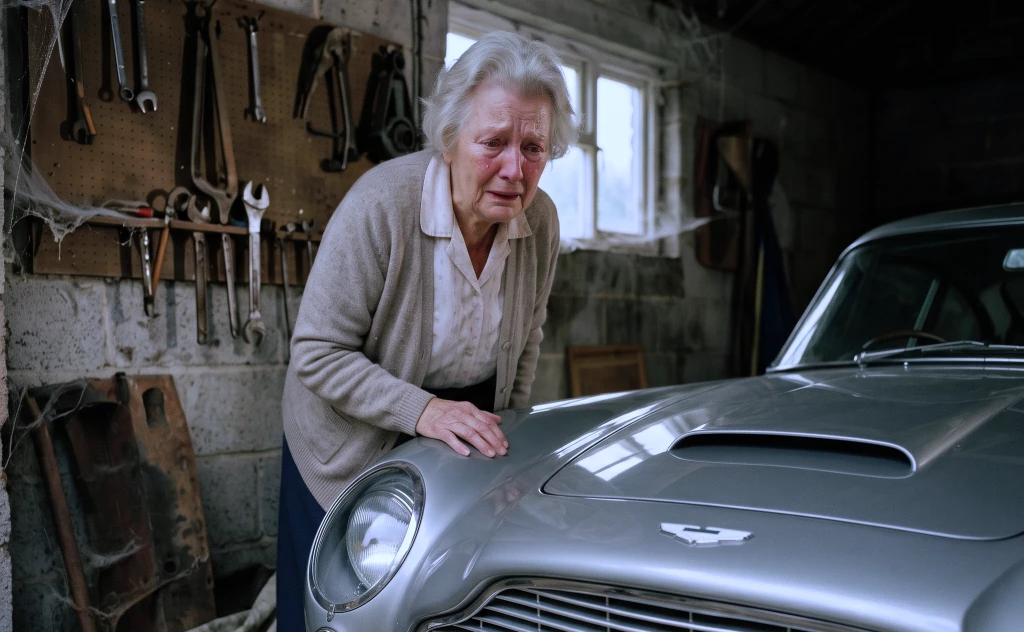
They stood in a perfect line along the center of the room, each covered in a tailored cloth that hugged the contours beneath it. Long hoods. Low roofs. Curves that did not belong to ordinary cars. The floor around them was swept clean, cleaner than the doorway had led me to expect, and little brass stands stood beside each one like markers in a museum.
For several seconds, I forgot the rain, my son, the attorney’s office, even the fact that I had nowhere else to sleep. I only stared at those silent forms while my breath warmed the cold air in front of my face.
Malcolm had never collected cars. He had driven sensible sedans, leased every four years, always in colors that did not show dirt. When Graham was a boy, Malcolm used to tease him for spending Saturdays watching auto auctions on television.
“Engines are for getting you where you need to go,” he would say. “Never make a religion out of them.”
Yet here, in a warehouse that had been described to me as “the garage and its contents,” my practical husband had left three covered vehicles arranged with a care I had never seen him give to anything he did not love.
I raised the flashlight toward the first one and saw a sliver of exposed chrome near the front where the cover had slipped. The grille caught the beam and threw it back at me in a hard, bright flash. My heart beat once, sharply.
No, I thought. That cannot be.
Before I could make myself move closer, the whole day returned to me in pieces.
That morning, I had sat in a leather chair in Mr. Benson’s office, wearing the black dress I had worn to Malcolm’s funeral three weeks earlier. Rain had streaked the tall windows behind his desk, turning downtown Portland into a blurred painting of gray glass and brake lights. Graham sat beside me in a charcoal suit that fit him too well. He smelled faintly of expensive cologne and impatience.
Mr. Benson had been our family attorney for almost twenty years. He had golfed with Malcolm, sent flowers when Graham graduated from Stanford, and once spent half a Christmas Eve fixing a paperwork problem so my mother’s medical bills could be paid on time. That morning, he would not quite look at me.
“Before I read Mr. Hayes’s final instructions,” he said, aligning the papers in front of him, “I want both of you to understand that the estate plan was revised carefully and executed with full capacity. Your father—your husband—was very clear.”
Graham leaned back. “Of course.”
I thought the stiffness in the room came from grief. I was still naive enough to believe grief explained most things.
The legal language washed over me at first: trust provisions, brokerage accounts, real property, personal effects. Malcolm had handled our finances for most of our marriage. Not because I was incapable, but because he had loved numbers the way some men love fishing, and I had been relieved to let him. I knew we were comfortable. I knew the Pearl District condo was valuable. I did not know the exact shape of our life on paper.
Then Mr. Benson cleared his throat.
“To my son, Graham Hayes, I leave the condominium located at the Pearl Meridian building, together with my primary investment account and the personal property contained therein, subject to the provisions already established.”
Graham’s face remained solemn, but something in his posture eased.
Mr. Benson turned the page.
“To my wife, Eleanor Hayes, I leave the property located at 87 Marlowe Street, Portland, Oregon, commonly referred to in my notes as the Eastbank garage, together with all contents therein.”
He kept reading after that. I know he did. There were other clauses, smaller bequests, executor instructions, charitable gifts. But I did not hear them. My mind had stopped at garage.
After forty-three years of marriage, after raising a son, after helping Malcolm through surgeries and medications and the slow humiliations of a failing heart, he had left me a garage.
Graham’s hand came down on my shoulder, warm and heavy. He leaned close enough that Mr. Benson could pretend not to hear.
“Don’t look so scared, Mom,” he murmured. “I’ll make sure you’re managed.”
Not cared for. Managed.
I remember staring at the carpet between my shoes. It was navy with a tiny gold pattern, chosen to look understated and expensive. I remember thinking that Malcolm had tied my scarf for me the morning he proposed, because my hands had been trembling then, too. I remember waiting for Mr. Benson to explain that I had misunderstood.
He did not explain.
He gave me a folder, a copy of the will, and a small brass key in a paper envelope. When our meeting ended, Graham stood first.
“I have calls at one,” he said. “We should go.”
It was still raining when he drove me back to the condo. I watched the city smear across the passenger window and tried to summon the courage to ask why. Why would Malcolm hide this from me? Why would he leave the home we had made together to our son and send me, on paper, to a building I had never seen?
But Graham was already on his phone, speaking to someone named Carter about contractors and timing.
The condo looked untouched when we arrived, which made what happened next feel even more brutal. The white orchids were still on the entry table. Malcolm’s reading glasses still sat beside his chair. The framed photograph of the three of us at the coast, taken when Graham was fourteen and still let me ruffle his hair, still leaned against the bookcase where I had dusted it the week before.
Graham set my suitcase in the foyer.
I looked at it, then at him. “Why did you bring that down from the bedroom?”
His expression did not change. “Because I think it’s best if you stay somewhere else for a while.”
The sentence entered the room quietly. It took me a moment to understand it.
“This is my home,” I said.
“It was,” he replied, checking his watch. “Dad transferred it to me. It’s very clear in the documents.”
I stared at him. “Graham, your father has been gone three weeks.”
“I know exactly how long it’s been.” For the first time, irritation broke through the polish. “And I also know this place needs work. I have a design team coming tomorrow morning to evaluate the study and the primary suite. There’s no point delaying everything.”
“Everything?” I repeated. “You mean replacing your father’s rooms before his clothes are even gone?”
His mouth tightened. “Mom, don’t make this dramatic.”
I wanted to be angry then. I wish I had been. Anger would have given me a spine, a sharp edge, something to hold in front of myself. Instead, I felt hollowed out by disbelief.
“Where am I supposed to go tonight?”
“Aunt Linda has space,” he said. “Or a hotel. You have credit cards.”
“I don’t know what accounts are still open to me.”
He gave a short laugh. “You could always try your garage.”
The cruelty landed harder because he smiled after saying it.
I gripped the back of a dining chair. “That is not funny.”
“No, the will wasn’t funny either.” He turned toward me then, and I saw something in his face I had been avoiding for years. Not just impatience. Resentment. “Dad left me the responsibility, the public assets, the property taxes, the mess. He left you a storage building. Maybe he finally understood what I’ve been trying to tell him.”
“What have you been trying to tell him?”
“That you don’t need much.” His voice dropped lower. “You never wanted to understand the money. You never wanted to deal with reality. You floated through because Dad handled everything.”
“I raised you,” I said, and even to my own ears, it sounded small.
“Yes,” Graham said. “And you did that. But this is business. This is an estate. You’re too old to know what to do with anything real, Mom. Dad knew that.”
I cannot tell you what I said after that, because I do not think I said anything. I remember walking to the coat closet. I remember taking Malcolm’s old raincoat because it was the closest one, then hanging it back because it still smelled like him and I could not bear to wear it out into Graham’s weather. I remember lifting my suitcase, heavier than I expected, and realizing Graham did not move to help me.
The elevator carried me down thirty-two floors in silence. The doorman, Mr. Alvarez, looked at my suitcase and opened his mouth as if to ask a question. Then he saw my face and only said, “Good night, Mrs. Hayes.”
I drove without choosing streets. Downtown dissolved into warehouse blocks, then rail yards, then stretches of pavement where streetlights buzzed above chain-link fences. At some point, I pulled over and opened the envelope from Mr. Benson. The key fell into my palm. Beside it was a typed address.
87 Marlowe Street.
When I arrived, the building looked even worse than it had sounded. But it was mine. At least according to the will, this broken-looking place belonged to me, and that was more than I could say for the bed I had slept in the night before.
Now, standing inside it, I raised my flashlight again.
The sliver of exposed chrome did not disappear. Neither did the brass display stand beside the first covered car. I moved closer, my shoes whispering over concrete that should have been gritty but was not. As I neared the wall, my flashlight caught something pale beside a row of switches.
An envelope.
It was taped to the painted cinderblock with two neat strips of blue painter’s tape, as if someone had placed it there recently and expected me to find it. My name was written across the front in Malcolm’s hand.
Eleanor.
For a moment I could not touch it. My husband’s handwriting, with its careful loops and left-leaning slant, was more intimate than any photograph. I had seen it on grocery lists, anniversary cards, the notes he used to leave on my coffee mug when he left early for appointments.
The rain rattled the roof. Somewhere inside the walls, a heater clicked on.
I reached for the envelope, then stopped as my flashlight slipped downward and struck the brass stand beside the first car.
The engraved plate was small, polished, and impossible to misunderstand.
1965 Aston Martin DB5.
I stood in the empty garage with Malcolm’s letter inches from my hand, staring at a car worth more than any house I had owned, and understood with a sudden, frightening clarity that my husband had not left me a garage at all.
He had left me a locked door. And he had known Graham would be the one to send me through it…
To read the rest of the story – CLICK the NEXT button 👇👇👇