


Valerie Hart found out about the other woman because of a dress. Not a text message. Not a lipstick stain. Not some late-night phone call with a voice on the other end that went quiet when she answered. Just a dress, sealed in thin plastic, swinging beside her husband’s navy wool suit at the dry cleaner’s on Madison Avenue. At first, she thought the girl behind the counter had made a mistake.
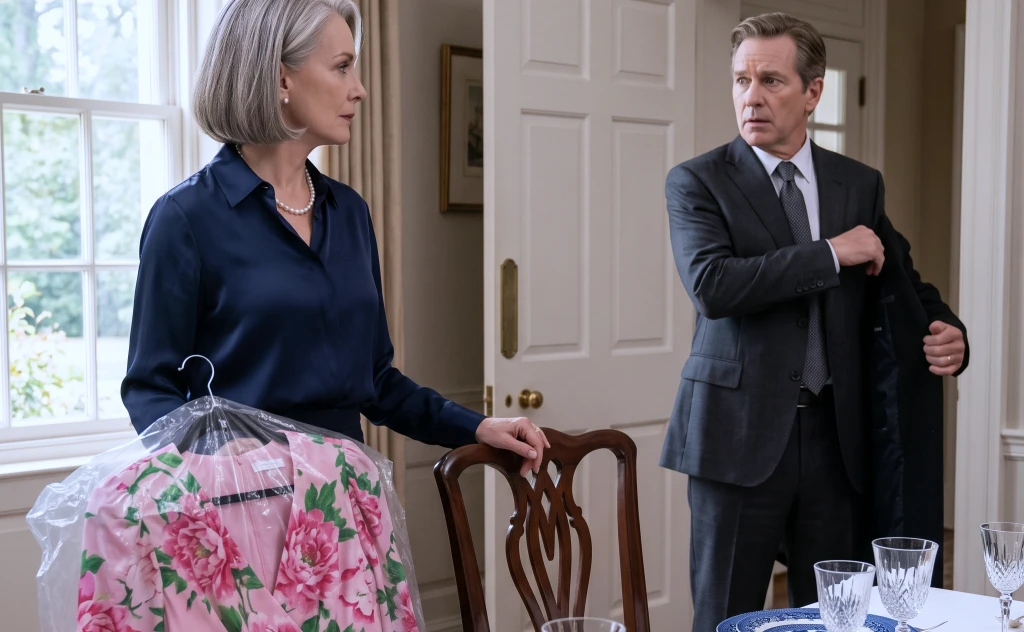
“That isn’t mine,” Valerie said, keeping her gloved hand on the hanger with Alan’s suit. “I only dropped off the suit.”
The girl, who had a neat black bob and the kind of red manicure Valerie had always considered impractical, looked down at the claim ticket. She ran one lacquered nail across the paper, then across the tag stapled to the plastic bag.
“Suit, navy wool, one piece. Dress, silk floral, one piece,” she read. “Same ticket.”
Valerie stared at the dress.
It was enormous, or at least that was the first word her wounded pride gave her. Bright pink peonies sprawled across the fabric, loud and lush and almost cheerful, the kind of print a woman bought when she wanted to be noticed from across a room. It was not young. It was not elegant. It was not the sort of thing Valerie had imagined when she occasionally allowed herself to imagine the kind of woman who might steal a husband after thirty-one years of marriage.
In movies, the other woman was always twenty-seven, blond, and narrow as a wineglass.
This dress belonged to somebody who had lived.
Valerie almost laughed, but the sound stuck behind her teeth. She took the suit and the dress because arguing with a girl at a dry cleaner’s suddenly felt humiliating. The plastic crackled as she walked home, the floral dress brushing against Alan’s jacket like it had every right to be there.
The apartment smelled of lemon polish and beef stew when Alan came in at 6:42 p.m., fourteen minutes later than usual. Valerie knew because she had looked at the clock three times and told herself each time that she was not waiting. She had set the table with the blue plates, the ones Alan said made ordinary food look nicer, and folded the napkins into clean rectangles beside the forks.
The dress hung over the back of his chair.
Alan stopped in the doorway to the dining room. He looked at the dress first, then at Valerie, then at the floor. In that order. That was how she knew.
“What is that?” she asked.
Her voice was calm. She was proud of that. Calm had always been one of her accomplishments, something she kept polished and visible, like the silver serving spoons in the sideboard.
Alan took off his coat slowly. He was sixty-two, broad through the shoulders, still handsome in the blunt, dependable way that had made people say Valerie was lucky when they were young. He had gray in his beard now, and a tired softness around his eyes. For one wild second, she thought he might invent a cousin, a charity drive, a coworker’s emergency.
Instead, he sat down hard in the chair opposite the dress.
“I’m sorry,” he said.
Valerie felt something small and cold open inside her.
“That isn’t an answer.”
Alan rubbed both hands over his face. “Her name is Linda.”
The name made it worse because Valerie knew a Linda. Linda from the hair salon on West 21st, the woman who had cut Valerie’s hair too short the previous spring when her regular stylist was out with pneumonia. Linda with the raspy laugh, the heavy perfume, and the bracelets that clattered when she turned the chair. Valerie had disliked the haircut so much she had worn scarves for two weeks.
“Linda from the salon?” she asked.
Alan did not answer quickly enough.
Valerie looked at the dress again. The flowers seemed to pulse under the plastic. “How long?”
He closed his eyes.
“How long, Alan?”
“A little over a year.”
The stew cooled between them. Valerie had chopped the carrots into perfect half-moons, skimmed the fat twice, and warmed the bread in the oven because Alan hated cold rolls. She noticed absurd things: the tiny chip on the rim of his plate, the place where his wedding ring had rubbed a pale groove into his finger, the way the dress kept shifting whenever the heat kicked on.
“Do you love her?” she asked, although she already knew the answer. Men did not sit that way for something casual. They lied for casual. They confessed for love.
Alan looked at her then, and his face was ruined with relief and guilt.
“Yes,” he said. “I do.”
Valerie nodded once. She did not throw the stew. She did not slap him. She did not scream, though her jaw ached from holding her mouth closed. She stood, lifted the dress by its wire hanger, and laid it across his lap.
“Then take this with you,” she said.
The divorce was quiet enough to make people uncomfortable. Alan offered apologies, explanations, and financial arrangements. Valerie accepted the apartment because her name was on it too, let him keep the car because she hated driving, and did not argue when he took the small cabin near Lake Geneva because Linda apparently loved gardening and already had plans for tomatoes.
Valerie had never liked the cabin. The mosquitoes were vicious, the plumbing moaned, and Alan always expected her to spend weekends cleaning a second kitchen.
Still, when his clothes disappeared from the closet and his coffee mug vanished from the shelf, the apartment became too large. She could hear the refrigerator hum from the bedroom. She could hear the elevator cables behind the walls. At night, the empty half of the bed seemed less like freedom than evidence.
Her daughter, Mia, called from Las Vegas and said she was flying home.
“You are not,” Valerie said. She was standing in front of the open pantry, looking at three cans of diced tomatoes and wondering why she had bought so much food for a man who no longer lived there.
“Mom, your husband left you after thirty years.”
“He did not leave me on the side of the highway. I have a roof and a bank account.”
“You have a bank account that Dad funded.”
Valerie closed the pantry door harder than necessary. “That was cruel.”
“It was true.”
Mia had always had that habit, throwing truth like a brick and then acting surprised when people ducked. She was thirty-one, slim and strong and far too sure of herself, performing in a casino show Valerie had never watched all the way through because the costumes made her uncomfortable. All those years of ballet lessons, private coaching, summer intensives, and SAT tutors, and her daughter had chosen a stage where strangers drank cocktails and applauded women in sequins.
“You need work,” Mia said. “You need to get out of that apartment.”
“I have an architecture degree.”
“From 1986.”
“It still counts.”
“I’m not saying it doesn’t count. I’m saying software exists.”
Valerie ended the call before her daughter could send links to online courses, senior job programs, or articles with titles like Rebuilding Your Life After Divorce. Then she sat at the kitchen table and opened her old portfolio.
The pages smelled faintly of dust and cardboard. There were hand-drawn elevations, inked floor plans, a university project for a public library that had won a departmental prize. Valerie ran her hand over the careful lines and remembered the girl who had drawn them, the girl who once believed she would design museums and lake houses and schools full of light.
Alan had not forbidden her from working. That would have been easier to explain. He had simply preferred the house a certain way. Warm dinner. Clean towels. Mia delivered to lessons, rehearsals, orthodontist appointments, and college visits. His mother had been a nurse, strict about hygiene and schedules, and Alan admired a home that ran like a well-managed clinic.
Valerie had let her life narrow because narrowing had felt like devotion.
The first interview went badly, though she did not know it until the woman across the table asked what design software she was comfortable using. The fifth went worse. By the tenth, Valerie recognized the polite expression hiring managers wore when they had already decided no but were required to finish the conversation.
At the fifteenth, a kind older woman in the waiting area leaned close and said, “Honey, try the county workforce center. They at least know what to do with people like us.”
People like us.
Valerie went the following Tuesday because her savings were shrinking and because she would rather have swallowed a spoonful of bleach than ask Mia for money.
The Cook County Workforce Center occupied the second floor of a municipal building that smelled of old carpet, printer toner, and vending-machine coffee. A television mounted in the corner played muted local news. Plastic chairs lined the walls. People stared at forms, phones, shoes, anything except one another.
Valerie wore her camel coat, the one Mia had said made her look like she stole it from a museum coat check. She had brushed her hair into a smooth silver bob and put on lipstick because desperation did not have to be sloppy.
The woman assigned to her file looked younger than Mia but carried herself as if she had been tired since childhood. Her nameplate read MEGAN COLLINS — CAREER SERVICES SPECIALIST. She had a round face, dark hair pulled into a knot, and a gray cardigan buttoned wrong at the bottom. There was a half-eaten granola bar beside her keyboard.
Megan flipped through Valerie’s paperwork. “So you haven’t had paid employment since 1991?”
“I raised a child,” Valerie said.
“I didn’t say you didn’t work. I said paid employment.”
Valerie sat straighter. “Is unpaid labor not labor now?”
Megan looked up. For the first time, interest sharpened her face. “It is. Employers are just annoying about proving it.”
That was not the answer Valerie expected, and it left her briefly without a weapon.
Megan tapped the resume. “Architecture degree. No current license. No CAD experience listed. No Revit, no SketchUp, no project-management platforms.”
“I can learn.”
“I’m sure you can. But they’ll ask why they should pay you to learn when they can hire someone who already knows.”
Valerie’s cheeks warmed. “You people are very encouraging here.”
“I’m not paid to encourage you. I’m paid to keep you from wasting your bus fare.”
Valerie almost stood up. Then Megan’s gaze flicked to the emergency contact line.
“You have a daughter?”
“Yes.”
“How old?”
“Thirty-one. And before you ask, no, I am not moving to Las Vegas to live with her between feathered headpieces and protein powder.”
Megan’s eyebrows lifted.
Valerie heard herself and disliked the sound, but she continued because shame often came out of her as criticism. “She dances. Professionally, she says. I paid for proper ballet training and college prep, and she ended up wearing rhinestones for tourists.”
Megan closed the folder.
The little snap of cardboard sounded final.
“Well,” Megan said slowly, “I can’t get you a job as an architect today.”
Valerie picked up her purse. “I gathered that.”
“But I might have a job for you.”
Valerie paused.
Megan looked toward the glass wall of the office, where other clients waited with forms in their laps. When she spoke again, her voice had changed. It was lower, stripped of its bureaucratic edge.
“This isn’t through the county. It would be private. Cash, or Venmo if you know how to use it.”
“I know how to use Venmo,” Valerie said, offended for reasons she could not fully explain.
“Good.” Megan swallowed. “I need someone to help me practice talking to my mother.”
Valerie stared at her.
Megan’s fingers tightened around Valerie’s folder. “My therapist says I can’t keep letting my mom decide whether I deserve to eat, date, sleep, breathe, or exist in public. But every time she calls, I become twelve years old again. I can write the right things down. I can rehearse. Then I hear her voice, and everything I learned disappears.”
“That is unfortunate,” Valerie said carefully, “but I don’t see what it has to do with me.”
Megan gave a short, embarrassed laugh. “You sound like her.”
The words landed between them with terrible precision.
Valerie rose from the chair. “That may be the rudest thing anyone has said to me this month, and my husband left me for a hairdresser.”
“I’m sorry. I didn’t mean—”
“I think you did.”
Megan’s face flushed, but she did not look away. “Maybe. But I also think you know exactly how women like my mother talk, because you do it without even noticing.”
Valerie reached for her papers. Her hand was steady. Her face was composed. She had survived a floral dress, a confession, and fifteen interviews with women half her age who smiled at her as if she were a piece of furniture from the wrong decade. She would not be insulted by a county employee in a crooked cardigan.
Then Megan said, very quietly, “Please. I need to learn how to answer her before I eat myself into the hospital.”
Valerie’s hand stopped on the folder.
Behind Megan, through the glass, a man in a work jacket leaned over a form while his wife rubbed circles between his shoulders. The television flashed weather alerts nobody could hear. Somewhere down the hall, a printer jammed and beeped with mechanical outrage.
Valerie looked at Megan again and saw that the young woman’s mouth had begun to tremble. Not dramatically. Not prettily. Like a child trying not to cry in a room where crying would make everything worse.
For one second, Valerie saw Mia at nine years old, standing in tights and a leotard after a bad audition, insisting she was fine while tears hung from her chin.
Valerie sat back down.
“I am not a psychologist,” she said.
“I have one.”
“I am not your mother.”
“I know.”
“And if I agree, you will never tell anyone I was hired because I’m unpleasant.”
Megan gave a wet, startled laugh.
Valerie smoothed her coat over her knees. “You may tell people I’m a communications consultant.”
Megan wiped under one eye with the heel of her hand. “Deal.”
Valerie should have left then. She should have taken the bus home, reheated soup for one, and continued searching for respectable work that did not involve impersonating another woman’s mother. Instead, she watched Megan pull a yellow legal pad from her drawer, write MOM across the top, and place her phone between them like evidence.
It buzzed before either of them spoke. Megan looked down at the screen and went pale. Valerie did not mean to read the message, but the letters were large and cruel. Did you weigh yourself this morning, or are we pretending again? Megan pushed the phone toward her with two fingers. “That,” she whispered, “is what I need you to teach me how to answer…”
To read the rest of the story – CLICK the NEXT button 👇👇👇